|
This page may contain links that result in small commissions to keep this free site up and running.

Welcome Guest! Registering and/or logging in will remove the anchor (bottom) ads and the security checks. It's Free!
To participate in the forum you must log in or register. | Author |
 Replies: 8 / Views: 18,255 Replies: 8 / Views: 18,255 |
|
|
Bedrock of the Community
United States
10045 Posts |
Sparta has a reputation for being a bit of an odd/extreme culture within the Greek world, and I became curious about their coinage, since there is very little existing specimens before Roman influence. Here is an interesting writeup for the coin below. Interesting how Areus I (309 to 265 BC) was the first Spartan king to issue coinage--and only to pay mercenaries. It makes me wonder what Sparta used for money: did they chiefly barter, or did they use coins minted elsewhere? They certainly did not use Athens coins, as they were rivals. Areus was the first Spartan king to have an elaborate court of his own, following the models of the Macedonians, and was the first to issue a coinage. It was produced in order to pay mercenaries during the Chremonidean War (268/7-262/1; an anti-Macedonian alliance between Athens and Sparta that ultimately failed - it was named after Chremonides, an Athenian politician who was later forced to flee to the Ptolemies). The coins of Areus were modeled on those of Alexander and his successors, which were the most acceptable currency of the time. The head of Herakles, who was the ancestor of both of the Spartan royal houses (the Agiad of Areus I and Eurypontid, represented by Eudamidas II - circa 275-244 - who is ignored by the coinage) was used here, however, to symbolize the nearly sole power of Areus himself, instead of the Dioscouri who were symbols of the traditional Spartan dyarchy. The club on the reverse of this coin also became a type in its own right on the coinage of Lakedaimon. Areus was killed in battle in 265 on the outskirts of Corinth, then held by the Macedonians. Only three other tetradrachms of Areus I are known: one, with an Î- Ρ monogram, in Paris (Grunauer 1), and two, with a differing monogram, in Berlin and New York (Grunauer 2-3). This piece is, therefore, the rarest coin of Sparta, and surely the most historically significant. 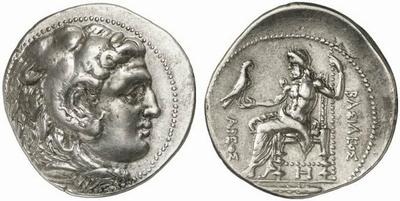 (This is not a coin I can remotely afford--it sold for $61,200  An example of later coinage (2nd-1st C. BC)  Laconia. Lacedaemon (Sparta). Bronze hexachalkon (25 mm, 8.15 gm). Laconia. Lacedaemon (Sparta), Second-first century BC. Bearded head of Lycurgus right, wearing taenia / Λ--A flanking club-caduceus, moneyer's abbreviated name ΦΙ--Λω across fields, all within wreath. Grunauer 118, pl. xvii, 14. Extremely rare. Extremely fine. Laconia. Lacedaemon (Sparta). Bronze hexachalkon (25 mm, 8.15 gm). Laconia. Lacedaemon (Sparta), Second-first century BC. Bearded head of Lycurgus right, wearing taenia / Λ--A flanking club-caduceus, moneyer's abbreviated name ΦΙ--Λω across fields, all within wreath. Grunauer 118, pl. xvii, 14. Extremely rare. Extremely fine. |
|
|
|
Moderator
 United States
23731 Posts |
Interesting to see coins from Sparta, didn't know they existed.
|
|
Pillar of the Community
United States
870 Posts |
The main form of barter in Sparta were iron ingots.
|
|
Bedrock of the Community
Australia
21794 Posts |
In fact, the Spartans did have a currency, but it was based on iron spits, not coins. They used this form of currency for about 400 years, according to Seltman, in his book 'Greek Coins'.
|
|
Bedrock of the Community
 United States
10045 Posts |
Wow...iron ingots, for 400 years? Their "spartan" reputation is well--earned! Thanks for the info!  |
|
Moderator
Australia
17012 Posts |
Plutarch reports that the Spartans continued to use the traditional iron spikes known as "obols" (after which the small silver coins were named) as money, long after the rest of the Greek world abandoned them in favour of the more convenient coins, as a deliberate policy to prevent people from coveting and accumulating wealth. All coins in Sparta were deemed the property of the State, for use by the State in trading with inferior Greeks. Plutarch, Parallel Lives, Lysander, section 17. Don't say "infinitely" when you mean "very"; otherwise, you'll have no word left when you want to talk about something really infinite. - C. S. Lewis
|
|
Bedrock of the Community
United States
10045 Posts |
Quote:
All coins in Sparta were deemed the property of the State, for use by the State in trading with inferior Greeks. Interesting footnote on Sparta's monetary policy; I can only guess this severely restricted the import/export business and cultural exchange with neighboring, "inferior", states.  From what I've read, the only real currency Sparta possessed was a standing army, which effectively limited their influence to that of subjugation of neighbors as a "helot" slave-labor class. Here I thought Rome was militaristic, but at least they left us culture, religious and philosophical ideas, and a legacy of technical innovation. It's no wonder that Sparta rejected Athenian culture and philosophy--their way of life doesn't score too well against the ideals of the philosophers. Sparta's legacy is the word "spartan", a reputation of military force, and a suitable name for college football teams.  |
|
Valued Member
Canada
155 Posts |
This was to pay mercenaries? I would have thought that the Spartan ideal would have been to avoid anyone but Spartans to fight their cause. very informative, and a very interesting story about how they adopted coinage - not trade, but for military purposes. I guess that shouldn't be that surprising after all.
|
|
Pillar of the Community
3352 Posts |
 => gorgeous coins, DVC |
| |
Replies: 8 / Views: 18,255 |
|
To participate in the forum you must log in or register.
 
- 1975 D Lincoln Cent 2 Lincoln's Reverse Memorial And Obverse
- 1974 San Marino 20 Lire, PCGS MS-67, San Marino, Lobster
- 1795 Liberty Cap Large Cent, PCGS AU-58+, S-76 Struck Over 1794 S-71, Jeff Garrett Discovery
- 2026 Declaration Of Independence Quarter With July 4th Privy Mark, PCGS MS-66
- 1978 Mexico - 10 Centavos W/Straight Clip
- 2019 P Nickel: WDDR-005
- 1994-P Nickel Overpolished Die?
- 2022 10c Double Clipping Error
- 1871 Victoria Sovereign, London
- Possibly Merovingian 8th Century
- Specie Payments Suspension And Gold Coin Circulation After 1861 In The Usa?
- Looking For Nic-A-Date Pro's And Con's
- 2021-P Nickel With Feeder Finger Damage.
- 2025 P Nickel With DDR.
- 2021 - P Lincoln Shield Cent With Uncentered Broadstrike, Stiff Collar, And Ffd (Coin #3 Of 3)
- 2005 - D Lincoln Memorial Center With Broadstrike (Coin #2 Of 3)
- 2000 - P Lincoln Memorial Cent Wide AM Gift
- 1999 - P Lincoln Memorial Cent With Broadstrike (Coin #1 Of 3)
- 1872-H Off-Centre Double Struck 25 Cent
- 2026 Trump Dollar Coin - Strikethrough Or Ding?
Disclaimer: While a tremendous amount of effort goes into ensuring the accuracy of the information contained in this site, Coin Community assumes no liability for errors. Copyright 2005 - 2026 Coin Community Family- all rights reserved worldwide. Use of any images or content on this website without prior written permission of Coin Community or the original lender is strictly prohibited.
Contact Us | Advertise Here | Privacy Policy / Terms of Use
|
| Coin Community Forum |
© 2005 - 2026 Coin Community Forums |
| It took 0.31 seconds to rattle this change. |
 |
|
| |
| |




 Posted 05/09/2012 12:54 am


