| Author |
 Replies: 10 / Views: 1,530 Replies: 10 / Views: 1,530 |
|
|
Pillar of the Community
United States
3229 Posts |
Here is my Probus: obverse IMP C M AVR PROBVS P F AVG, radiate, draped and cuirassed bust right; reverse CLEMENTIA TEMP, emperor standing right receiving Victory from Jupiter standing left holding scepter, XXI in ex I received this and two other coins as an early B-Day gift from my mom! Thanks Mom!  Because of ancientcoinguys top 25 post and very helpful CCF members I now know that the XXI in the exergue means that this antoninianus was at one time 20 parts bronze and one part silver:) I have tried to reference the a mint by using wildwinds, vcoins, helevica's, and acsearch. I am having a challenging time find the "I/dot" officia. The closest match I can find is this one: http://www.acsearch.info/search.htm...=&a=&l=#1105 I think I see an "I"; Not a 100% positive. I am going to guess that my coin is from the Antioch mint. My second guess is Cyzicus. I am totally guessing off from two hunchs. First, I think the acsearch coin referenced about is a match. Second, I did not see a dot after the central officia letters any of the Cyzicus coins or others. Many of the Antioch coins had a dot following the officia letter. Help with mint and RIC would be much appreciated:) BTW the Sear# quoted by the seller is Sear#3344. A few thing I like about this coin are: (1) The clear "Probus" in the legend. (2) The reddish patina / mottled silver (its looks so ancient:) (3) The santa beard on Jupiter. So cool.  I think the santa beard may realy be a head-dress?)  (4) My mom picked this one out! 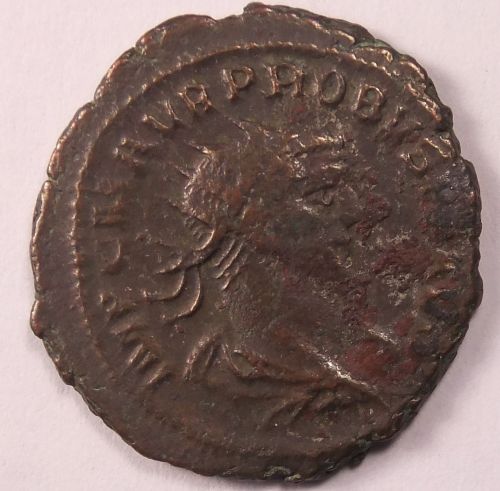 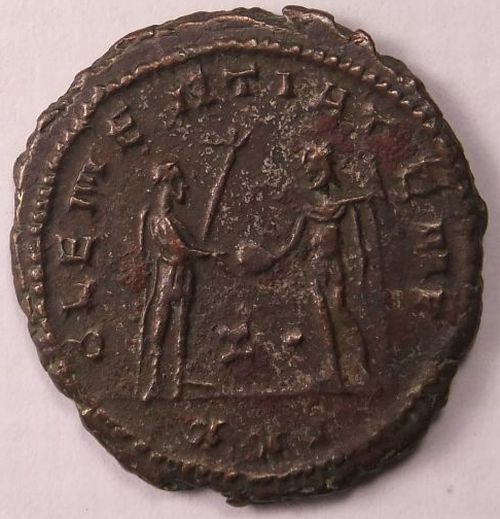 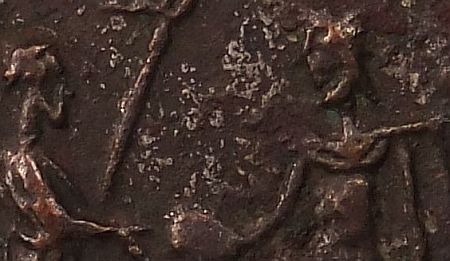 |
|
|
|
Pillar of the Community
United States
1316 Posts |
TJs, Sweet coin, love the color, seeing the silver under the patina, way cool!!  .. Happy Birthday, your Mom did a good job!! |
|
Pillar of the Community
United States
842 Posts |
I can see where you might think that the letter in the middle of the reverse is an I. It could be, but did you entertain the possibility that it is a Z? Try looking for that, too.
|
|
Pillar of the Community
United States
4253 Posts |
I think the "I" looks more like a Z. If so, then it would be RIC 644 or possibly 642, both from Siscia.
|
|
Pillar of the Community
United States
2596 Posts |
|
|
Pillar of the Community
United Kingdom
2121 Posts |
The style is wrong for Siscia. This is an Antioch coin.
Martin
|
|
Pillar of the Community
United States
1549 Posts |
I see it as an RIC 920 (page 119). That number requires the obverse legend with PF before AVG which is weak but present on this coin. If the PF is missing, the coin is a different number. Also required to be this number is Jupiter handing the emperor a globe rather than a figure of Victory which would change the number. Between the reverse figures is a workshop Greek numeral which can be A, B, gamma, delta, E, S, Z or H and any of them are still RIC 920. I see Z. It seems that all 8 variations come both with and without a dot following the numberal. I suspect that indicates some long lost change (weight?, date?, night shift? - I have no idea what made them add the dot or whether one or the other came first). All this is based on RIC V part 2 which came out in 1933. Its assignments and arrangements are very out of date and have been superseded by more recent studies which are not in English and not in my library. There is a lot online at http://probvs.net/probvs/ including a bibliography that is scary in how much has been written since RIC which remains the standard catalog. We really need a new revision of the whole coinage - all mints - in one volume. Are we right assigning this issue to Antioch? I believe so but, not having read all those books since 1933, I could have missed something here. As far as this coin goes: I like the reverse a lot. The obverse is weaker but still shows what it needs to show and you should be happy to have the coin. I suggest you buy coins like this one which have all the detail necessary to allow full attribution (even though the PF is weak, it is there). I now suggest you look for your next Probus from the many with left facing fancy busts either military or in consular robes. There are only a few thousand variations and they need studying by someone young enough to put the decades into it that the coins deserve. You can see poor, older photos of some of my coins here: http://www.forumancientcoins.com/do.../probus.htmlI really should update that page but I spend too much time typing here to do all the things I'd like to do. |
|
Pillar of the Community
United States
5010 Posts |
what a great gift!  |
|
Pillar of the Community
 United States
3229 Posts |
I see the "Z" now.  (sure looks like an "I".  ) Only I guess its not:) I sincerely thank all of you. I told my mom about what a great community that I belong to here at CCF:)  I explained to her that without the help from all of you here on this forum I would not be collecting coins. Simply put, I would not trust myself enough to purchase "genuine" coins without your help. Peace to you all!:) 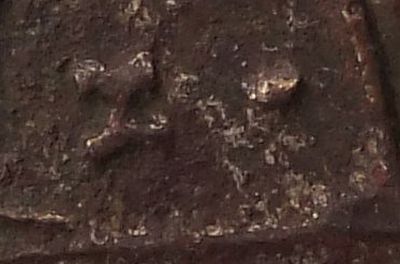 |
|
Pillar of the Community
United States
1549 Posts |
Just a couple hints on reading late Romans:
A and H are often confused. A rarely has a really sharp point at the top (that is more likely to be a delta) and often is clearly open.
H and N get confusing since the slant of the middle bar is not always as clearly slanted or not as we would like.
It is not always safe to compare workshop letters on a die with other same letters on that same die. They seem to have been cut (later?) not always by the same hand?
I is usually just a straight line but not with a large stroke at top and bottom. There are periods when they tried to force as many letters as possible into upright strokes. III could be M or N.
S often has a smaller bottom curve than the top. A lot of these differences came from cutters being Greek speaking and not familiar with some Latin letters (G, L, R, S etc.) Don't think these problems mean coins are fake but do learn what letter forms were popular and how Gallienus was different from Constantius a hundred years later or London was different from Alexandria 2000 miles away.
...and mostly: Today we have many typestyles or fonts. Some are more fashionable than others now but were rare not long ago and will become old fashioned in a few years. The same holds for the Romans.
|
|
Pillar of the Community
United States
1549 Posts |
Here is a fact you can share with your mother. All of us, young and old, benefit in the long term from more people being interested in these coins. There are plenty of coins to go around but if dealers see no potential sales for coins, they won't buy them from us when we, or our heirs, are ready to sell. I does no good for something to exist if there is no way for it to be found by people who want it. I want every year to bring twice as many collectors and twice as many dealers selling twice as many coins so I can find things that I want, can afford and don't have. If you wish to thank me, consider buying a few thousand coins from my estate when that time comes. I hope 90% of my coins won't be sold while I am alive. 'Dealers' that cheat beginners (especially young people) are ruining something good by driving away people who could be friends, customers and another generation of dealers to keep up the idea that these old scraps of metal are worth more than their melt value. After my family takes out a few coins to remember me by, there will be several (hundreds, thousands?) left over and I hope somebody wants them. Relatively few of us are blessed with kids whose interests match ours exactly. I have a grandson who would really like it if I collected ancient Egyptian (his interest is before coins were invented) things but he got stuck with a grandfather interested in Roman, some Greek and some medieval. My job now is to be sure there are people now 0 to 30 who think this stuff is neat enough to want my coins when I'm done with them.
|
| |
Replies: 10 / Views: 1,530 |
|







 Posted 06/06/2012 7:11 pm





