| Author |
 Replies: 28 / Views: 4,333 Replies: 28 / Views: 4,333 |
|
Pillar of the Community
United States
6130 Posts |
I was working through my backlog the other day and found this little guy (16mm) in my "to clean" pile:   By far the most "barbaric" ancient I own, complete with gibberish legends and a giraffe neck. I think the portrait is supposed to be Claudius II or Tetricus I. I started to do some digging, and have yet to find any real evidence of a study into this coin type, despite their popularity. Does anyone know of a reference material that could help me narrow this one down beyond just "barbarous, ca. 270 AD"? Also, post the barbarous coins from your collection! The more whacky the style, the better! Edited by Finn235
03/10/2016 01:33 am
|
|
|
|
Pillar of the Community
Australia
1006 Posts |
If you want you can look at the barbarous imitations of early Philip II tetradrachms which are at times incredibly difficult to tell apart from the genuine ones
|
|
Pillar of the Community
United States
949 Posts |
Quote:
Does anyone know of a reference material that could help me narrow this one down beyond just "barbarous, ca. 270 AD"? At 16mm I'm glad to see you have not closed the door on the possibility that it is not barbarous but merely poorly preserved. As for your search it would help to narrow things down to know what you have checked. Are you looking for online references only or does print work too? Have you looked in RIC? BMCRE? RSC? All three of these have extensive listings of the coins of the Tetrici and related. |
|
Pillar of the Community
Belgium
1194 Posts |
A few months ago , I was also searching some documentation for barbarous coins , but found only one work in Dutch dating from 1982. I am still looking on internet to buying it , but I found it to read in the library of the University of Leuven. . It is very difficult to identificate this kind of coins , the legend is most of times impossible to read , even the name of the emperor is difficult to find . Your coin is typical for the end of the 3th century and to identificate with Claudius II goticus , Treticus I or II . For me , it is one of the Tetrici. On the reverse , it looks to me as Salus standing at left with a scepter in the left hand and feeding a serpent with the right hand . I repeat I suppose this identification . I will make a resume of my notes I took reading this book and communicate it here . For myself , this coins are very interesting : it is cheap to buy and give you a lot of work looking for the identification . Hereby a coin of Tetricus I , with a Salus ressembling to yours . albert 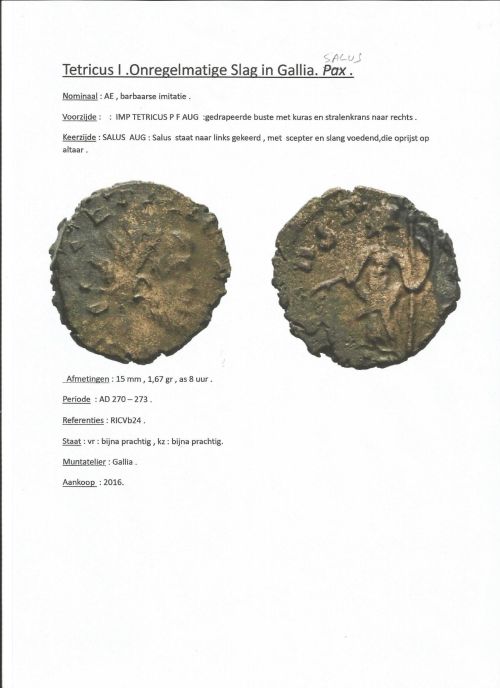 |
|
Pillar of the Community
United States
949 Posts |
My point was that before you can claim it is barbarous you have to rule out that it is merely a poorly preserved issue of the empire. My understanding is that this has not yet been done, because the OP was asking about references for coin listings. Did I misunderstand that? Was the OP only looking for studies of barbarous coins on the assumption that this cannot be an issue of the empire?
|
|
Pillar of the Community
 United States
6130 Posts |
I was originally asking about the equivalent of Wildwinds or RIC for imitations of roman coins; all I have been able to find so far is a handful of footnotes about them in online catalogs, certainly no serious literature on the subject. My main interest is in whether the "degenerate" coins can be pinpointed to originating from a certain area or culture, or whether they must all be grouped together.
I do also have a very nice (I think) barbarous AE4 cross reverse coming in the mail; it could possibly be a post-Roman Germanic issue.
|
|
Pillar of the Community
Belgium
1194 Posts |
for most of this coins , you are only sure they have been struck in Gallia .Sometimes you can find a nice coin you can identificate .This coins are normally a little bit smaller than the official coins :15/17 mm and 19/20 mm .There is also a difference in the weight , I have coins from 1.2 gr to 2.38 gr .albert ps : the obverse is IMP C TETRICUS P F AUG , on the reverse ,you have an X just before the face . 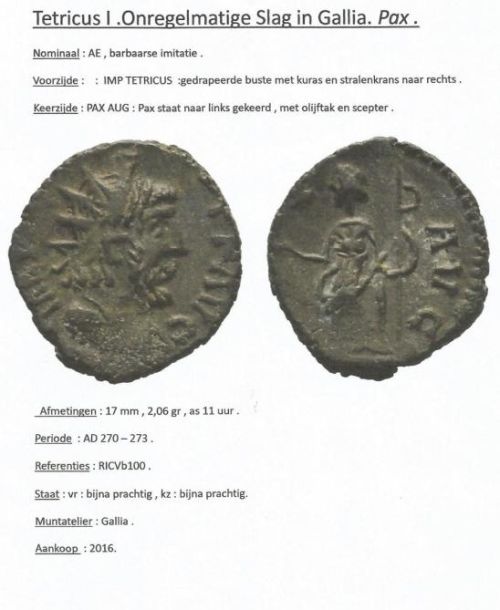 |
|
Pillar of the Community
United States
6130 Posts |
Along the same lines, here is an itty bitty little thing, copying the AE4 cross reverse of the late Theodosian dynasty. 8mm in diameter and just over half a gram. I cannot determine whether this one is contemporary (400-450), or simply a post-Roman issue of ca. 475-600.   Edited by Finn235
03/11/2016 10:54 pm
|
|
Pillar of the Community
United States
6130 Posts |
Lot arrived in the mail, containing not one but two barbarous cross coins: 1 - 10mm, 0.52g   This one is really neat, given both the extremely simple style, and the fact that the legend is just "IYIYI". I don't know if the same applies to the reverse, or if the engraver simply tried to replicate a wreath. Second I am 99% sure is barbarous 10mm, 0.92g   Just look at that portrait! Theodosius III must be doing his giraffe impression again. |
|
Pillar of the Community
Belgium
1194 Posts |
|
|
Pillar of the Community
United Kingdom
4208 Posts |
That is indeed a barbarous issue, after Tetricus. I have a nicer one from the same tribe somewhere...I have many many barbarous coins that I've cleaned, but as far as I know, no one has completed a reference for them and there isn't enough information on find locations to tell where most came from. I tried hard to get find locations for as many as possible, but people just dont care about the tiny finds and so nearly all of them are simply 'found in the UK' - perhaps there never will be a reference guide for them.
The cross issues are even worse. You can barely tell the barbarous from the real ones, and even the official issues arent properly catalogued yet, probably because of the wild variation and lack of surviving legends.
|
|
Pillar of the Community
United States
949 Posts |
Quote:
I have many many barbarous coins that I've cleaned, but as far as I know, no one has completed a reference for them and there isn't enough information on find locations to tell where most came from. I tried hard to get find locations for as many as possible, but people just dont care about the tiny finds and so nearly all of them are simply 'found in the UK' - perhaps there never will be a reference guide for them. Sad, but all too true. Unfortunately, this state of affairs strengthens the claims of the archaeologists against the hobby. The drive for MARKET competes against the quest for knowledge and understanding. Who of us can defend the proposition that barbarous imitation was not a form of counterfeiting per se, but rather a local effort to fill a local vacuum for coinage consistent with the local standard of living? It is an important hypothesis, but given the consistent lack of attention to the very details Ben mentions, one that is very hard to work out. Perhaps on this one the archaeologists have a point?! Edited by lrbguy
03/16/2016 09:46 am
|
|
Pillar of the Community
United States
6130 Posts |
I think the distinction between imitation or counterfeit would be the answer to the question, "What would happen if the minter was caught in his own jurisdiction?" Counterfeiters are unauthorized and in it to make a profit; imitative coins are issued officially, piggybacking on the popularity of a more renowned currency. I would consider a currency official when it does not attempt to imitate, but rather portray an actual, autonomous ruler.
Given the apparent popularity (and price!) of attributed Vandal coins, I really am surprised at how little effort has gone into analyzing archaeological finds, as Ben mentioned. I would suspect the matter to be complicated by international trade of these crude, illiterate pieces; just because a coin is found in the southern UK does not necessarily mean it was not minted by a Germanic tribe.
This latest lot contained several official cross AE4's and a few that are probably too poorly preserved to call. All had the same bluish patina, which makes me tempted to say that they all circulated and were stashed together.
Edited by Finn235
03/16/2016 2:54 pm
|
|
Pillar of the Community
United States
6130 Posts |
http://www.ebay.com/itm/Lot-of-20-u...1395?txnId=0More on the way! I tried not bidding on them, but... well that just didn't work out so well  Top right in the first pic looks like it has some real promise. Tiny, squished portrait obverse, cross potent reverse in the same style as the first coin I posted a few posts back.
Edited by Finn235
03/25/2016 09:38 am
|
|
Pillar of the Community
United Kingdom
2105 Posts |
I bought a small collection of FEL TEMPS recently which contained a couple of Barbarous imitations of galley types. Both are in fairly nice style. Constantius II - AE2 - Barbarous imitation of Trier Obv:- CONSTANT-IVS P F AVG, Pearl diademed, draped & cuirassed bust right Rev:- FEL TEMP REPARATIO, Emperor standing left, in a galley; Phoenix on a globe in right hand and holding labarum in left hand; Victory at the tiller of the galley right Minted in Trier; (//TRS),  Constans - AE2 - Barbarous imitation of RIC VIII Trier 215 Obv:- D N CONSTA-NS P F AVG, Pearl iademed, draped, cuirassed bust right Rev:- FEL TEMP REPARATIO, Emperor standing left, in a galley; Phoenix on a globe in right hand and holding labarum in left hand; Victory at the tiller of the galley right. Minted in Trier; (//TRS), A.D. 348-350 Reference:- Barbarous imitation. cf RIC VIII Trier 215  Martin |
|
Pillar of the Community
United States
6130 Posts |
Those are nice! I honestly probably would not even think to question their status as being official, although they do have very interesting eyes!
|
| |
Replies: 28 / Views: 4,333 |










 Posted 03/10/2016 08:27 am


