I've written a number of posts about the 1936-dated Delaware Tercentenary half dollar -
Note: the Delaware Tercentenary was a 1938 event - here's another...
In addition to the commemorative half dollar, the Delaware Tercentenary Commission also sponsored a commemorative medal. It was available in large (70 millimeter) silver for $7.50, large (70 mm) bronze for $2.50 and small (38 mm) bronze for 50 cents. All sizes were produced in high relief.
The obverse of the medal is dominated by a left-facing depiction of the
Kalmar Nyckel,, one of the two ships that landed at "The Rocks" (present-day Wilmington, DE in 1638) and brought the original colonists; the other ship was the the
Fogel Grip. Delaware's anniversary years are found above the ship, with a descriptive commemorative inscription below it.
The reverse design is essentially the Coat of Arms of Delaware; the Arms were adopted on January 17, 1777. A shield is presented at the center of the Arms; it is divided into three segments. The top segment includes a wheat sheaf and an ear of corn, the wheat is representative of Sussex County and the corn is symbolic of Kent County; both elements are symbolic of Delaware's successful agricultural industry. The middle segment is symbolic of the Delaware River and its importance to Delaware's economy and transportation. The bottom segment depicts an ox in a field; the ox is meant to represent the importance of animal husbandry to Delaware's economy.
Above the shield is seen a three-masted sailing ship under full sail; it is symbolic of shipbuilding in New Castle County and the commerce driven by Delaware's extensive coastline.
The shield's left supporter (viewer's perspective) is a farmer holding a hoe which points to the importance of farming to Delaware's overall economy. The right supporter presents a militiaman holding a musket (recall when the Arms were created/adopted!) and is meant to illustrate the important role the citizen-soldier plays in preserving American liberties.
A ribbon that extends between the two supporters features the State Motto "Liberty and Independence."
[The description of the Arms is drawn from the web site of the State of Delaware; you can read more here:
https://viola.delaware.gov/delaware-facts-symbols/On the medal, the Coat of Arms is encircled by a wreath tied with ribbons that feature the names of Delaware's important colonial patriots and leading Delaware political and/or business figures from post-colonial times. Moving clockwise from the 12 o'clock position, the names are:
- (George) Read
- (John) Dickinson
- (Commodore Thomas) MacDonough
- (Master Commandant Jacob) Jones
- (Joseph) Shipley
- (Joseph) Tatnall
- (Governor Gove) Aulsbury
- (Henry) Ridgely
- (eleuthère Irenee) du Pont
- (George) Gray
- (Thomas) Bayard
- (Nicholas) Van Dyke
- (John) Clayton
- (Robert) Kirkwood
- (John) Haslet
- (Thomas) McKean
- (Cesar) Rodney
I'll leave it to you to look up a biography on those listed - many are very interesting!
Remember, the wreath is an adornment added for the Tercentenary Medal to expand the historical scope of the medal's design, it was not and is not part of the original 1777 Coat of Arms. Hence, the inclusion of psot-colonial era names.The design of the official medal's obverse was included in the cachet applied to a first day cover created for the Tercentenary. The Planty catalog lists the cover as #836-37 and identifies the cachet/cover as being produced by Thomas Speer on an orange envelope. The official celebration ceremonies took place on June 27, 1938 (the date on the cover).
1936 Delaware Tercentenary Half Dollar
 1936 Delaware Tercentenary Official Medal - Silver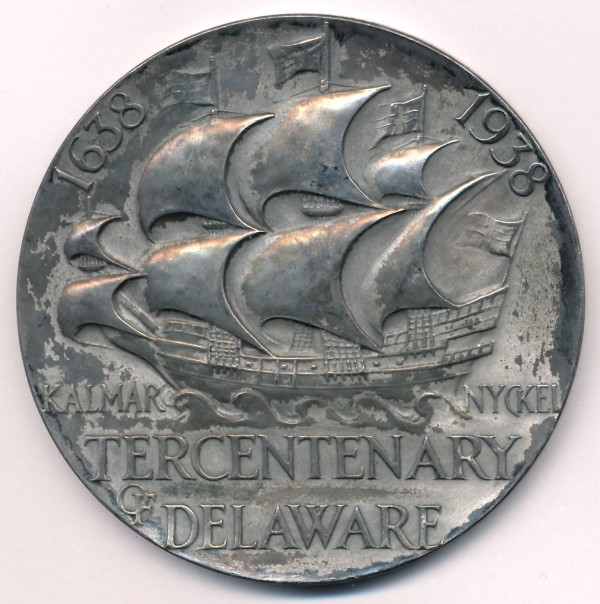
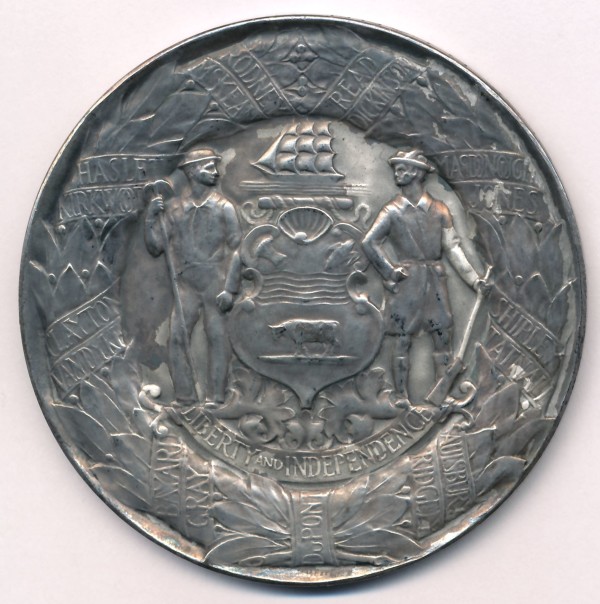 1936 Delaware Tercentenary Official Medal - Bronze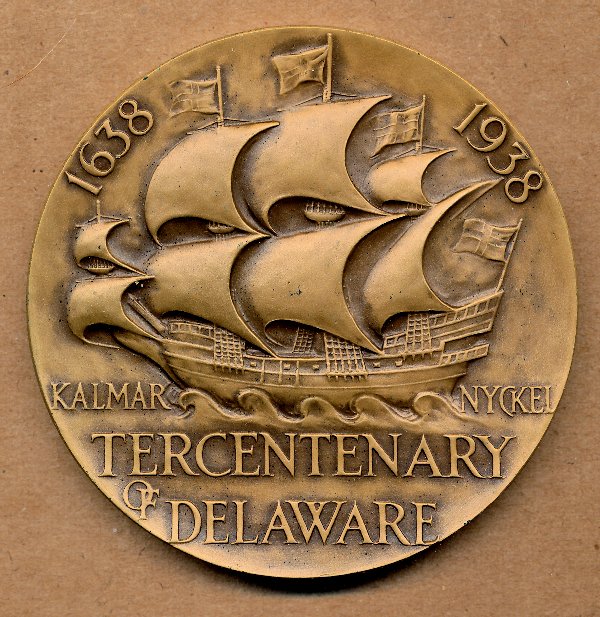
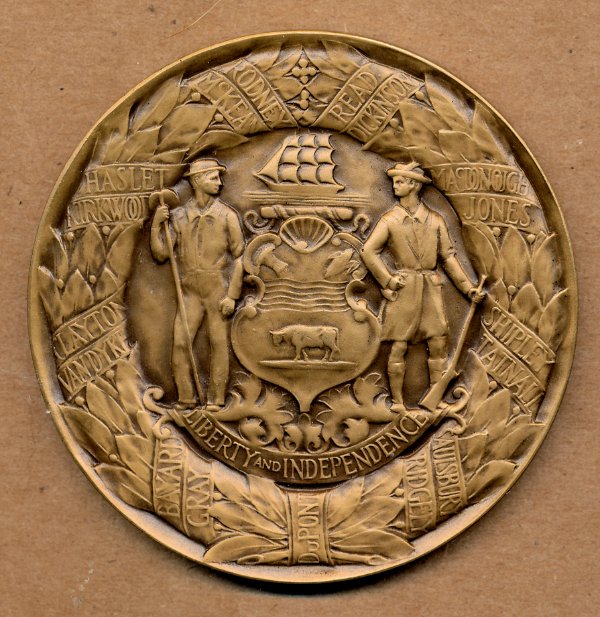 1936 Delaware Tercentenary First Day Cover with Medal Image
Other of my 1936 Delaware Tercentenary posts can be found here:
Commems Collection.







 Posted 09/27/2021 12:14 pm





