In early 1937, companion bills were introduced in the House and Senate that called for "50-cent pieces in commemoration of the sesquicentennial anniversary of the expedition of General Benjamin Logan into that territory now known as Logan County. Ohio, and the destruction of the last great Indian stronghold in Ohio." (If introduced today, I believe the bill's language would be quite a bit different to make it more politically-aware.)
The House bill was introduced in January by Representative Arthur William Aleshire (D-OH) and referred to the House Committee on Coinage, Weights, and Measures. The Senate bill followed in April and was introduced by Senator Robert Johns Bulkley (D-OH); the bill was referred to the Senate Committee on Banking and Currency.
General Benjamin Logan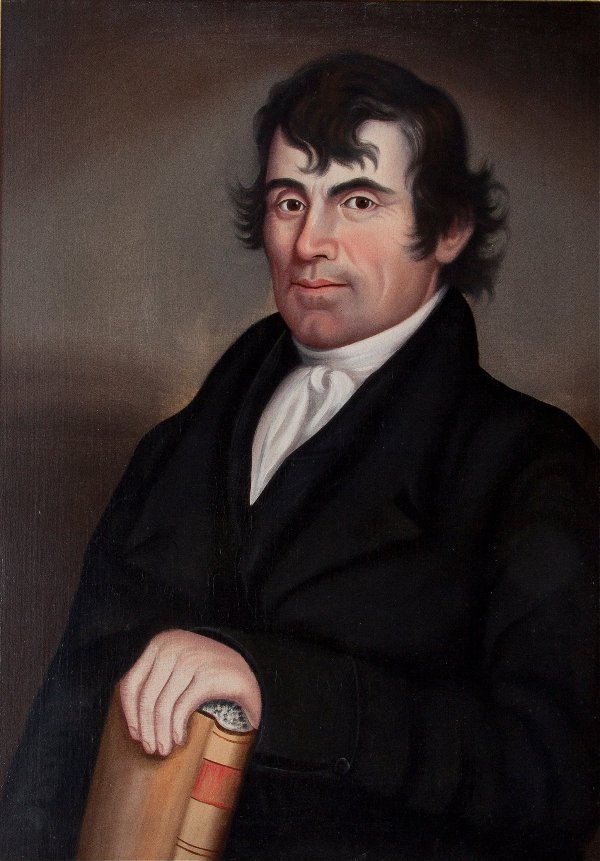 (Image Credit: Cincinnati Museum Center at Union Terminal. Public domain, via Wikimedia Commons.)
Benjamin Logan was born in Augusta County, Virginia in 1743. In his adult life, he helped to settle Kentucky (originally an area belonging to Virginia), advocated for Kentucky's statehood and served in various government positions. Logan served in the Virginia House of Delegates (1781-82; 1785-87), attended Kentucky's Constitutional Convention in 1792 and later served as a member of Kentucky's House of Representatives (1792-1795).
The coin was meant to pay homage to Logan's military service, however, rather than his political career. As part of the Virginia militia, prior to the American Revolution, Logan took part in multiple campaigns against Native Americans who were in conflict with the growing number of European settlers encroaching upon their hunting lands. After the American Revolution, in 1786, Logan led a militia group from Kentucky on a raid north of the Ohio River (into present-day Ohio) to put down members of the Shawnee Nation who had been launching attacks against settlers in Kentucky. Most of the Native American villages Logan and his men encountered were poorly defended as the warriors from each were largely off to support a looming battle in another area. Unfortunately, many women, children and elderly were either killed or taken prisoner, and 13 villages were burned to the ground during the raid.
Though they set out with the intention of putting an end to the Native American unrest and attacks on settlers, the actions of Logan and his men actually incited the Shawnee and led to the escalation of the Northwest Indian War.
The bills called for a single Mint facility to strike 25,000 half dollars of standard specifications and for them to be delivered to the Logan County Commemorative Coin Association in a single batch. All of the coins were to be "dated" 1937, regardless of when struck, and were to be issued within one year of the bill's enactment. The bill's language ensured that it was to be a collector-friendly issue that followed the Senate Committee's established guidelines. (See link below.)
Neither bill was reported out of Committee nor considered by either chamber as a whole - possibly due to the somewhat local nature of the event to be commemorated vs. one of national significance. Ultimately, there would be no 1937 Benjamin Logan half dollar (or privately-struck Logan commemorative medal). If the bill had moved forward and gained approval, it would have been another after-the-fact coin as the 150th anniversary of Logan's raids was in 1936 not 1937. (Makes me wonder if the dual date "1786-1936" would have found its way into the coin's design.)
For more about the Senate Committee's commemorative coin provisions, see:
-
Quick Bits #44 - Committee On Banking And CurrencyFor other of my posts about commemorative coins and medals, check out:
Commems Collection









 Posted 04/05/2022 05:45 am


