A work in progress - comments/feedback welcomed and appreciated!
THREE BASIC DIE EVENT EXPRESSIONS - A PRELIMINARY STUDY SUMMARY
Previously [
https://coinweek.com/coin-die-desig...the-21st.../ ] I have discussed both exponential and spherical curvatures appearing on dies striking Emerging Liberty Dimes and also [
https://coinweek.com/transitioning-...f-2026-p.../ ] the dynamics produced from the transitioning of these two curvatures, one to the other.
I have also discussed the basic design principle: Design Relief Dictates Die Shape. Higher relief requires steeper die curvature to ensure proper metal flow during striking.
On 2026-P Emerging Liberty Dimes, the exponential curvature between the base of the neck and the edge, along with the transitioning of the spherical and exponential curvatures between the designer's initials, one into the other, along with the high and abrupt relief of the base of the neck, combine to create a ZONE OF
CONCENTRATED PRESSURE AND STRESS.
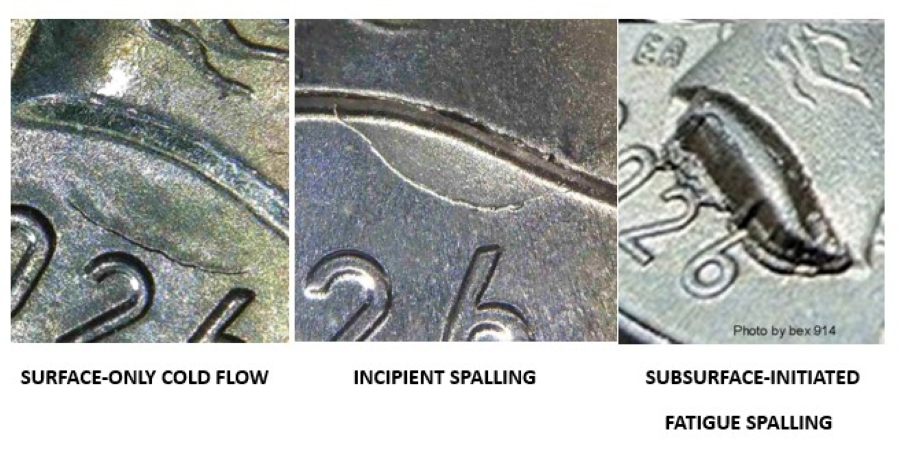
Within this ZONE, continual striking pressure produces three basic types of die events.
SURFACE-ONLY COLD FLOW (RIPPLES): The transitioning of curvatures creates a channel beneath the neck. It should be noted that, while a channel is found on the coin, the area is an "inverted channel" on the die - a zone raised above the curvature of the adjacent areas on either side. This raised zone becomes a zone of focused pressure and stress during striking, compounded by the more rapid acceleration of an exponential curve. Initially, with repeated strikes, this pressure moves a wave or ripple of metal in the direction of the edge of the die, constrained and focused by the definition of the (inverted) channel.
The initial effect of this pressure is like a barge cutting through the water in a narrow channel, pushing a pressure wave in front of it. The sides of the channel represent the merging of radial curvatures focusing the zone and the accelerating curve and pressure are the barge pushing the wave.
INCIPIENT SPALLING: Incipient spalling usually looks like a small, localized damage patch with surface-breaking microcracks, micro-pits, and very shallow flaking or material pull-out, often developing into a roughened, V-shaped, or elliptical spall boundary rather than a clean crater.
SUBSURFACE-INITIATED FATIGUE SPALLING: With further repeated strikes, beyond those producing surface ripples and incipient spalling, this pressure and stress produce a subsurface shear zone resulting in a release of a major section of the die face resembling a Freestanding Interior Internal Die Break (FIDB). (
https://www.error-ref.com/freestand...internal.../ ). The result, however, is instead, a subsurface-initiated fatigue spalling which may be inferred by the radically different morphologies of FIDBs compared to the features in our example.
This is because a spall's shape and thickness are set by where the crack initiates and how it propagates relative to the surface.
In a Hertzian contact, that is the contact between two curved surfaces, the greatest shear stress usually happens below the surface, at a depth that scales with the contact size—often about 0.47 times the contact patch radius (the small area where the two surfaces are in contact). If the load and surface curvature vary substantially, that depth can change significantly, which can lead to a spall with uneven depths like the one shown here.
Scans currently underway may provide additional data that modifies these initial impressions.









 Posted Today 2H 56M ago


