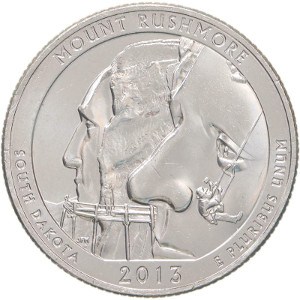
Before I discuss the proposed 1927 Mount Rushmore coin bill, I wanted to go back a few years more and provide a quick recap of the bills that called for the creation of the National Memorial that would come to be named Mount Rushmore.
In January and February 1925, bills were introduced in the House and Senate, respectively, "To authorize the creation of a national memorial in the Harney National Forest." The House bill, introduced by Representative William Williamson (R-SD), moved forward after being referred to the Committee on Public Lands. The Committee reported the bill favorably with an amendment recommended by the Secretary of Agriculture. As the location of the Memorial had not yet been determined, the Secretary wanted to add language to the bill to ensure that the Memorial would "not interfere with the administration of the Harney National Forest."
The amended Memorial bill passed the House and Senate without challenge and was signed into law by US President Calvin Coolidge on March 3, 1925. The Mount Harney Memorial Association was subsequently created by the South Dakota Legislature to oversee the Memorial project. The US Congress' Act authorized the Association to "select the name, location, and design of such memorial." Mount Rushmore was on the road to reality!
And now, on to the "What If?" coin...
In 1927, to help financially support the Memorial project, Senator William Henry McMaster Case (R-SD) introduced a bill calling for half dollars "in commemoration of the dedication of Rushmore Mountain, located within Harney National Forest, South Dakota, for the carving thereon of a heroic monument commemorating the deeds of George Washington, Thomas Jefferson, Abraham Lincoln, and Theodore Roosevelt in the founding, preservation, and territorial expansion of the Republic, and in memory of Calvin Coolidge, President of the United States of America, in whose administration this memorial was begun."
(Note: Coolidge was alive and well at the time.)The bill's preamble extended the objectives of the Memorial to include commemorating "the founding and preservation of the Republic, the purchase of Louisiana Territory, the admission of the Republic of Texas into the Union, the acquisition of California and Oregon and the completion of the Panama Canal." Quite a bit to commemorate with one Memorial - regardless of its size!
Up to five million (!) coins were to be struck on behalf of the Mount Harney Memorial Association. The Association could request the coins in whatever quantities and at whichever times it desired as long as it could pay for them - no ordering restrictions were included in the bill. IMO, the bill's language regarding the number of mint facilities that could be used to strike the coins is open to interpretation. Instead of specifying use of "a mint" or the use of any/all facilities, the bill specified that the coins would be struck "at
the mint of the United States." I believe this could be interpreted either as the main mint in Philadelphia or inclusive of all facilities available to the Mint (i.e., inclusive of Denver and San Francisco).
The bill was referred to the Senate Committee on Banking and Currency upon its introduction, but was never reported out for further consideration. There would be no financial support for the Memorial by way of a US commemorative coin.
Several things about the 1927 bill struck me the first time I read it: 1) its long title, 2) its request for five million coins, and 3) its inclusion of "in memory of Calvin Coolidge, President of the United States of America, in whose administration this memorial was begun." It's all very reminiscent of the language and requests included in the 1925 Stone Mountain coin bill (that bill referenced the late President Warren G. Harding). I think I know which bill Senator McMaster used as a template for his bill!
Mount Rushmore was commemorated by a commemorative three-coin set in 1991, in honor of the 50th anniversary of its completion.
1991 Mount Rushmore Golden Jubilee Half Dollar

For other of my posts about commemorative coins and medals, including more "What If?" stories, see:
Commems Collection.








 Posted 09/11/2022 06:33 am