In July 1947, Senator Edwin Carl Johnson (D-CO) introduced a bill that called for "50-cent pieces to commemorate the patriotic services of General Maurice Rose and to perpetuate the General Rose Memorial Hospital as a historic shrine." The coin was to "commemorate the life and gallant military service of the late General Maurice Rose who sacrificed his life for the American victory against the Nazis in World War II." (From the original Bill.)
Maurice Rose was born in Middletown, Connecticut, to a Jewish family. He moved with his family to Denver, Colorado when he was three years old. He was raised in Denver, attending Jewish elementary schools while growing up, before attending East High School. He enlisted in the Colorado National Guard in 1916, and served in France during World War I. He also served in the US Army during World War II, including command roles in North Africa, Italy, France and Germany. He ultimately achieved promotion to Major General in August 1944 and was assigned to command the 3rd Armored Division in North Africa. He built a reputation for strategic leadership and for commanding his forces from the front vs. the rear. His aggressive style earned his commands the "Spearhead" nickname. Rose was killed in action on March 30, 1945 in Germany. He was the highest-ranking Jewish officer in the US Army at the time of his death;
Major General Maurice Rose, Circa 1944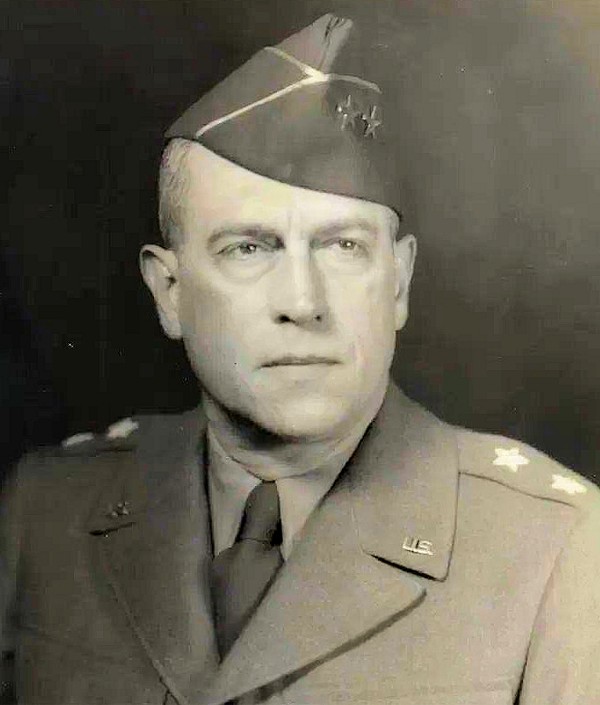 (Image Credit: US Army/ Public Domain.
Rose was a highly-decorated soldier, including receiving the:
- Distinguished Service Cross
>>>>> For heroism of the highest degree that does not quite merit the Medal of Honor.
- Distinguished Service Medal
>>>>> For exceptionally meritorious service to the United States Government in a duty of great responsibility.
- Silver Star Medal with 2 Bronze Oak Leaf Clusters
>>>>> For combat valor; the Bronze Oak Leaf clusters indicate additional awards.
- Legion of Merit with Bronze Oak Leaf Cluster
>>>>> For exceptionally meritorious conduct in the performance of outstanding services and achievements.
- Bronze Star Medal with Bronze Oak Leaf Cluster
>>>>> For heroic achievement/service in a combat zone.
- Purple Heart with 2 Bronze Oak Leaf Clusters
>>>>> For those wounded or killed while serving with US Military; the bronze oak leaf clusters indicate additional awards.
A very informative biography of General Rose can be found here:
Colorado Encyclopedia - Maurice Rose.
Senator Johnson's bill proposed the coining of up to 500,000 silver half dollars of standard specifications, but did not place a restriction on the number of Mint facilities that could be used. Considering the number of coins in the request, orders for coins from Philadelphia, Denver and San Francisco seem a near certainty. Likely linked to the large number of coins requested, the bill also included a provision that allowed the coins to be struck for a period of five years post-enactment. Hello, five-year, three-Mint commemorative coin program!
The coin was to benefit the General Rose Memorial Hospital Association, which was to use proceeds from coin sales "to maintain and preserve as a suitable memorial the General Rose Hospital at Denver, Colorado."
The bill was referred to the Senate Committee on Banking and Currency, which reported it without amendment and with a recommendation to pass. The bill was taken up by the Senate and passed without debate or objection. After it passed, however, Senators Robert Alphonso Taft (R-OH), Scott Wike Lucas (D-IL) and Ralph Edward Flanders (R-VT) each rose to voice their objections to the latest influx of commemorative coin bills and the use of US coinage as a fundraising tool by non-Federal Government organizations. None of the Senators specifically objected to the Rose coin bill, however.
The Senators' statements notwithstanding, the General Rose bill was immediately followed by the Senate's passage of bills for commemorative coins for the Minnesota Territory Centennial, Mount Rushmore's completion and the Oregon Trail Memorial Association, Idaho Unit. When the introduction of a bill for a coin for Reading, Pennsylvania followed, however, Senator James William Fulbright (D-AR) rose to object and made a motion to reconsider each of the bills the Senate had just passed. The next day, Fulbright withdrew his motion for reconsideration, stating "if we let all these bills go, they will disclose how ridiculous it is to have so many of these that will better enable the President to veto all of them." Certainly a cynical approach!
With the bill no longer subject to potential reconsideration in the Senate, it was sent to the House of Representatives for its consideration; the bill was subsequently referred to the House Committee on Banking and Currency. It was never reported out by the House Committee, and thus died for lack of action.
Though the commemorative coin proposal failed, construction of the hospital bearing the General's name proceeded and was dedicated in August 1948 by General Dwight David Eisenhower; the hospital opened for patients in March 1949. The hospital was sold in 1995 and presently goes by the name HealthONE - Rose Medical Center.
The Rose Community Foundation, whose mission is "To advance inclusive, engaged and equitable Greater Denver communities through values-driven philanthropy" is currently sponsoring a drive to raise funds to complete a bronze statue of the General to be placed across from the Colorado Capitol in Denver. For more about the the Rose community Foundation, an organization started with the funds received from the sale of the hospital, check out: .
Rose Community Foundation.









 Posted 09/19/2022 05:41 am


