In a case of great early planning, companion bills were introduced in the House of Representatives (March 1962) and Senate (January 1963) that called for half dollars to be struck "in commemoration of the one hundredth anniversary of the purchase of Alaska from Russia." The House bill was introduced by Ralph Julian (D-AK); the Senate bill by Edward Lewis "Bob" Bartlett (D-AK) for himself and Ernst Henry Gruening (D-AK). Julian's bill was referred to the House Committee on Banking and Currnecy; the Senate version to its Committee of the same name.
US Secretary of State, Frederick William Seward and Eduard de Stoeckl, the
charge d'affaires of the Russian embassy in Washington, DC were the primary negotiators of the Treaty that enabled the US to purchase Alaska from Russia for $7.2 million (USD) in 1867 following agreement and ratification of the Treaty of Washington; the Treaty was signed by US President Andrew Johnson on May 28, 1867. As the US Senate needed to ratify the purchase treaty, the transfer of the territory did not officially take place until October 18, 1867.
The Alaska Purchase added ~586,000 square miles to the US - about 71% of the ~828,000 square miles the US acquired from France as part of the Louisiana Territory Purchase made in 1803. ICYWW: $7.2 million in 1867 would equate to ~$144.8 million in 2022 - a great deal even with inflation factored! The purchase was not supported by all at the time - hence its "Seward's Folly" nickname - but has proven to be an outstanding purchase in terms of mineral/resource wealth and geopolitical strategic importance.
Signing the Alaska Treaty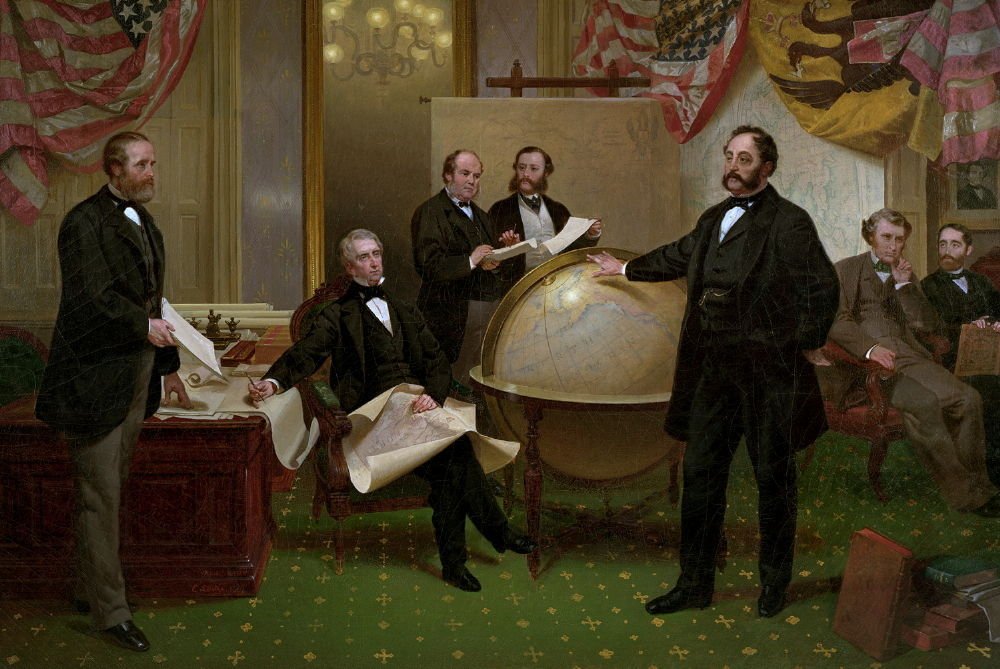 (Image Credit: Public Domain.)
The original painting was created by Emanuel Leutze in 1867. Depicted in the painting, from left to right: Robert Smith Chew (US Diplomat), William Henry Seward (US Secretary of State, seated holding a map), William Hunter (US Diplomat), Waldemar de Bodisco (Secretary of Russian Mission), Baron de Stoeckl (Russian Ambassador, standing with hand on globe), Charles Sumner (US Senator), Frederick William Seward (Assistant US Secretary of State).
The coin bills called for 100,000 half dollars to be struck without any restrictions regarding which Mint facilities could be engaged. The coins were to bear the date "1967" and have an expiration of coining authority on December 31, 1967. Coins could only be ordered by representatives of the Governor's Office of Alaska, and had to be for a minimum of 5,000 coins at a time. Net proceeds from the sale of the coins were to be used only for authorized centennial commemoration projects/events.
Neither of the bills was reported out of its respective Committee, and so died for lack of action when the 88th Congress adjourned in October 1964.
A year later, in October 1965, a bill was introduced in the Senate (89th Congress) that called for commemorative medals vs. commemorative half dollars. It had the support of the Treasury, and easily passed the Senate and House; President Lyndon Baines Johnson signed the bill into law on April 14, 1966. (I'll post about the medals at some point in the future.)
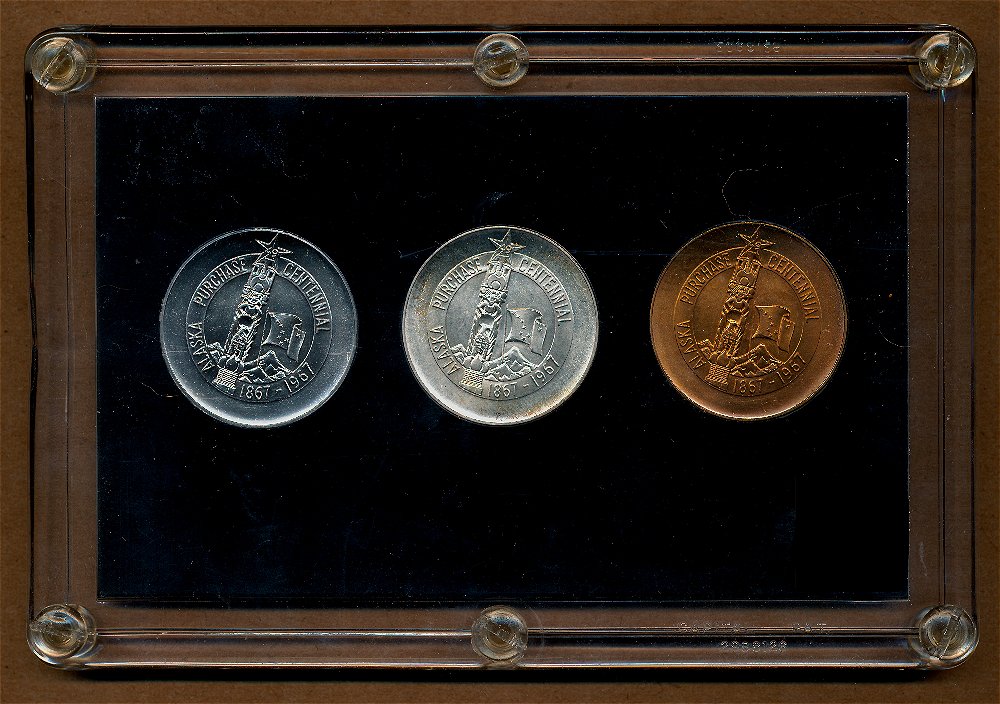
Here's my three-piece set of US Mint-struck medals; the sets were limited to 1,000 and the only way to secure the platinum version.
1967 Alaska Purchase Centennial Medals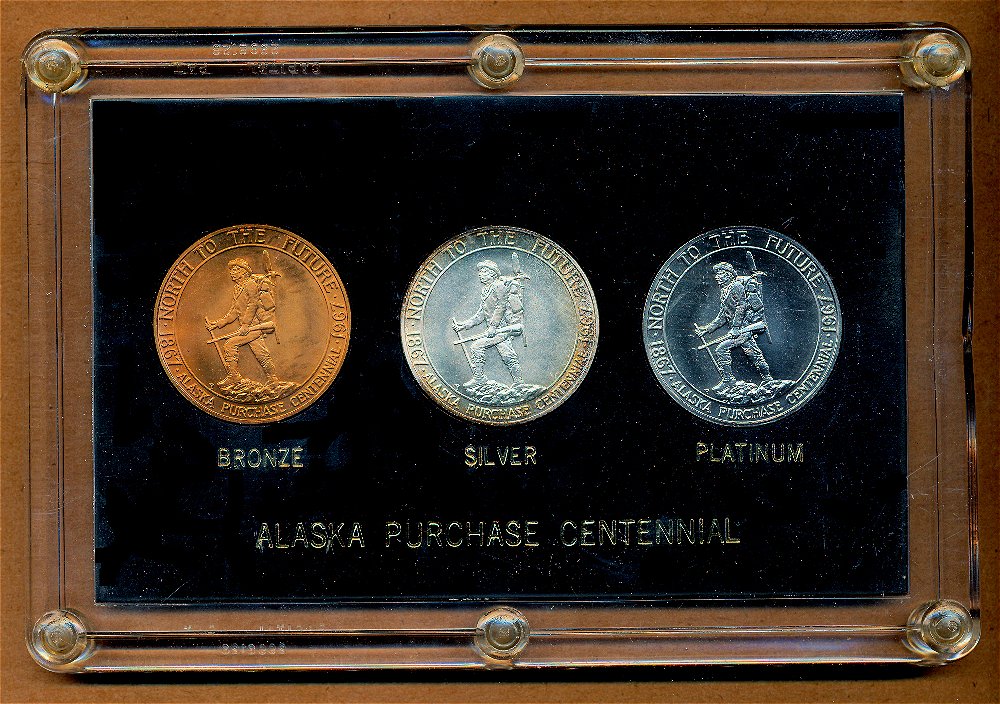
For other of my posts about commemorative coins and medals, including many more What If? stories, check out:
Commems Collection. 









 Posted 12/26/2022 1:42 pm


