I can't believe it was late last year that this thread was begun by newtraffic2, and 8 months ago left unfinished

.
The history of the grosso in southern Italy was left hanging, and as luck would have it, I've been working on the Sicily/Naples sections of Numista recently.
To recap ...
The Norman king Roger II struck a large silver coin (2.5 grams) called a ducalis based on Byzantne designs around 1140 (post of 12/25/2025). In several senses, it could be considered as a sort of prototype for the Venetian grosso which followed it about 40 years later (covered at the beginning of the thread).
The next major development, in 1279 was striking of the first Italian coin to (nearly) match the French gros tournois in size and silver content, the carlino of Charles I of Anjou, called a saluto d'argento (post of 12/23/2025).
In 1303, his son, Charles II replaced the first carlino type with a new design, featuring the enthroned king obverse, and a cross decorated with fleur-de-lis reverse (MIR 24, N#& 71471):
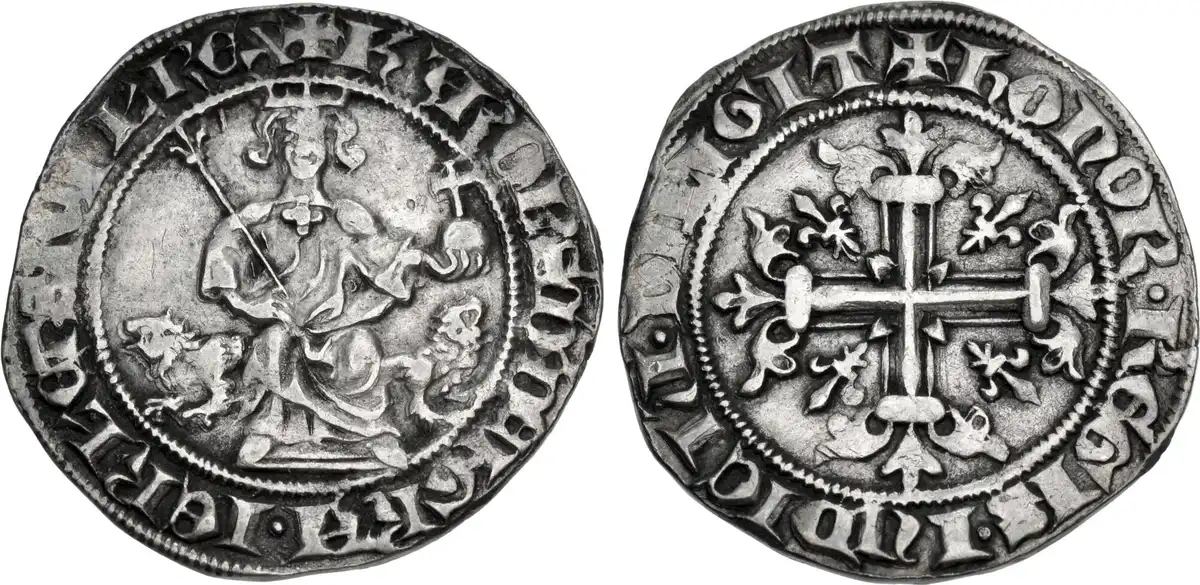
Copyright Classical Numismatic Group 2025
The "Gigliato" named after the profusion of lilies (gigli in Italian, and presumably from a similar latin root) endured in Naples for 150 years. Evidence of its success in Mediterranean trade came from its imitation in the Crusader states:
https://en.numista.com/482155https://en.numista.com/116414In the mid-15th century, Ferdinand I of Naples changed the design again, first to a coronation scene, giving the carlino a new nickname, "coronato" (MIR 66, N#558715), and eventually (1488) to a coin bearing a large Renaissance portrait though the nickname "coronato" remained (MIR 68-71):







 First Page
 Previous Page

 Replies: 67 / Views: 5,010


 Posted 03/07/2026 9:07 pm


