| Author |
 Replies: 23 / Views: 1,128 Replies: 23 / Views: 1,128 |
|
Pillar of the Community
United Kingdom
1607 Posts |
Hi all, as in the title I have Just read something interesting about larger Roman coinage that I didn't know, how they needed something heavier than a strike from a hand held hammer to get the desired effect and was wondering if anyone can go into better detail for me? The info I have is that a 'drop hammer' was used.
Any input greatly appreciated, thank you.
Kev.
|
|
|
|
Pillar of the Community
 United States
1000 Posts |
Where did you read about this?
|
|
Pillar of the Community
United States
2363 Posts |
Interesting. Never heard of this. I'd like to see ancient writings from the time period stating this or archaeological evidence. Does the auther cite any sources?
Edited by livingwater
03/07/2026 12:51 pm
|
|
Pillar of the Community
 United Kingdom
1607 Posts |
Read this in 'A handbook of late Roman bronze coin types, 324-395' by Shawn M Caza.
The book does go into detail about weight per square centimetre and gets very confusing, to me anyway, so was looking for any simple explanation.
From the book :-
[The basic technique of striking late Roman bronze coins was as follows. One die, usually the obverse, was fixed in an anvil. The heated flan was placed on the lower die by a worker (suppostore) using tongs. The second die, usually the reverse, was then placed over the flan and was struck by a hammer, wielded by another worker (malleatore). Sometimes more than one hammer blow was required to sufficiently imprint the design, as witnessed by the striking errors on some coins.]
There is then a short piece about error coins then it continues :-
[Large bronze coins, such as Ptolemaic drachmae and Imperial Roman sestertii, were likely struck using a different technique. A hand-wielded hammer simply could not generate the amount of force required to strike the design to the depth found on surviving large coins. The required force increases significantly with the diameter of the coin. Where a hand-wielded hammer was insufficient, a drop hammer had to be used. Instead of being held by a hand, the upper die was inserted into the bottom of a heavy weight. This weight was then raised using rope and pulleys attached to a frame]
This is when it becomes difficult for me to understand the process so really looking to see if this is correct and if so can anyone explain the ratios of force needed for different Roman coins please.
Thank you, Kev.
|
|
Pillar of the Community
United Kingdom
1607 Posts |
livingwater, yes, he starts off in the next chapter writing about Bouyon, an engraver at the Paris mint who calculated what force was needed for larger coins but this is the point that it goes on about different calculations. I will try and take a few photos of the writing shortly. Kev. 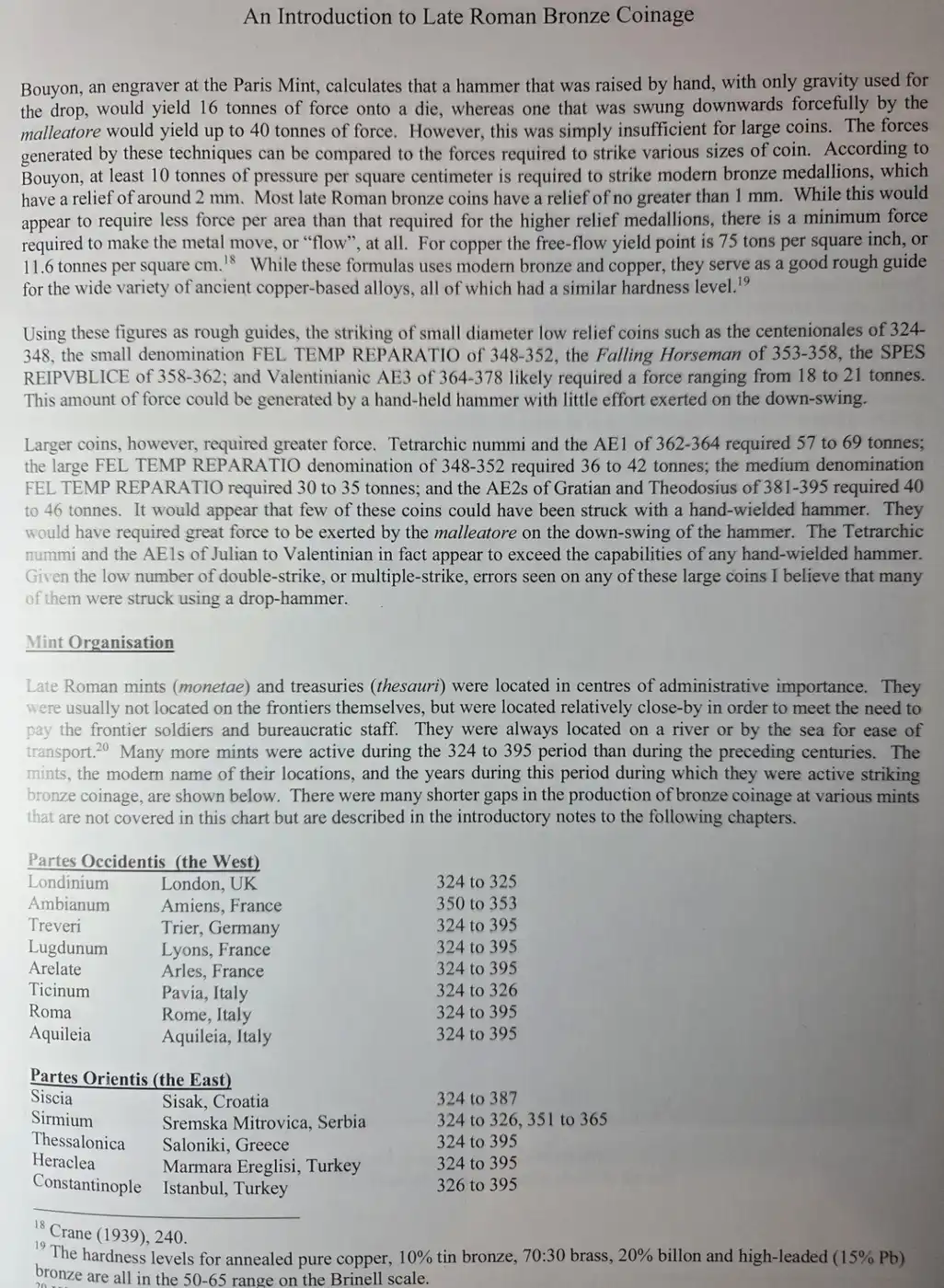 Edited by MetDet71
03/08/2026 07:47 am
|
|
Pillar of the Community
United States
1000 Posts |
This is merely a theory...a theory that is not based on any historical evidence and a theory that no numismatists are debating. From the bit you showed, there is also no mention of whether or not flans were heated prior to striking. This is an actual theory that gets discussion and would also dramatically change how much force is needed to produce coins.
Edited by Victor
03/08/2026 11:04 am
|
|
Pillar of the Community
United Kingdom
1607 Posts |
Thank you for that Victor, I have posted the 2 prior pages, hopefully you are able to make the words out. I was thinking that it is just the view of the author. Kev 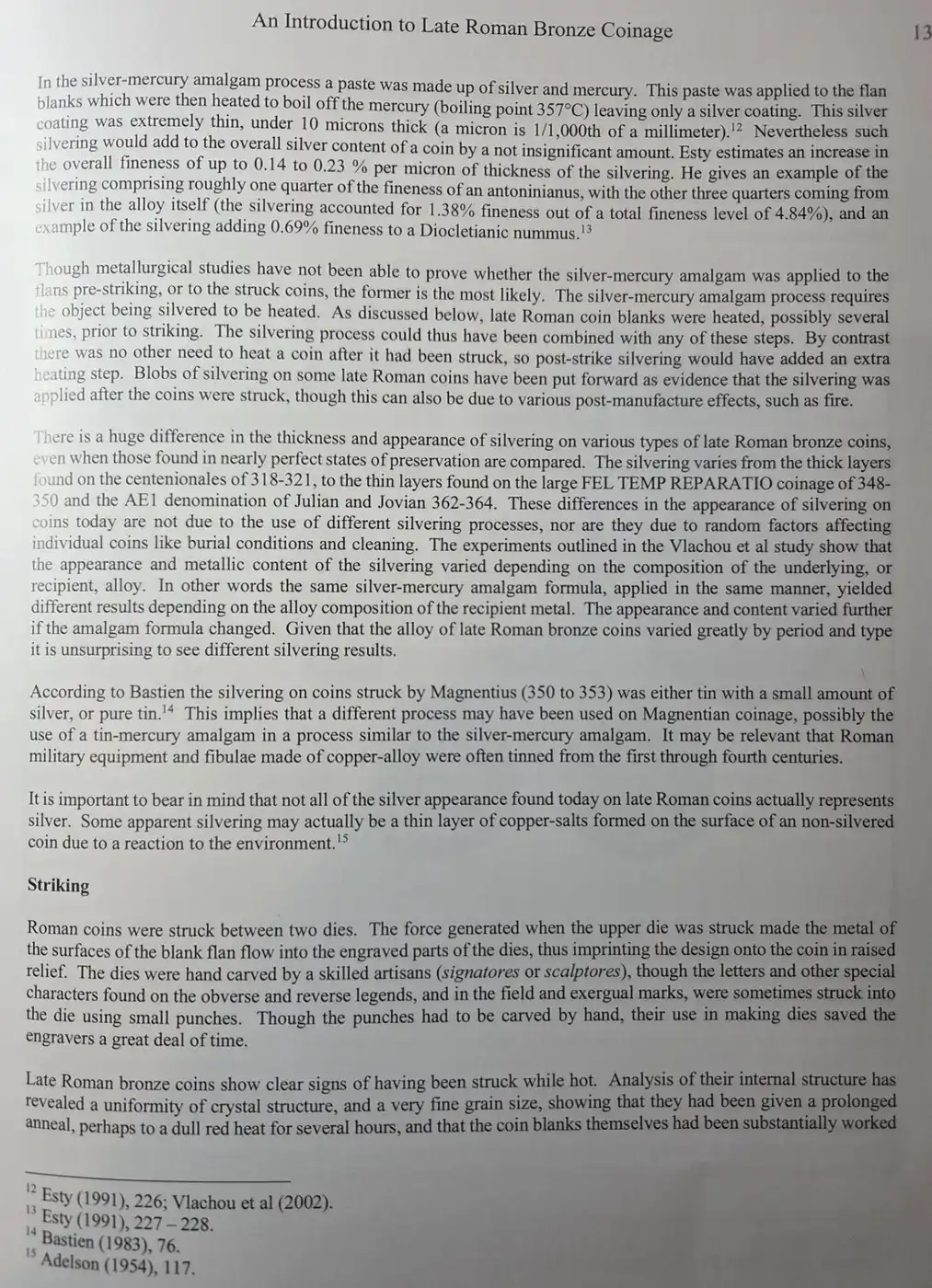 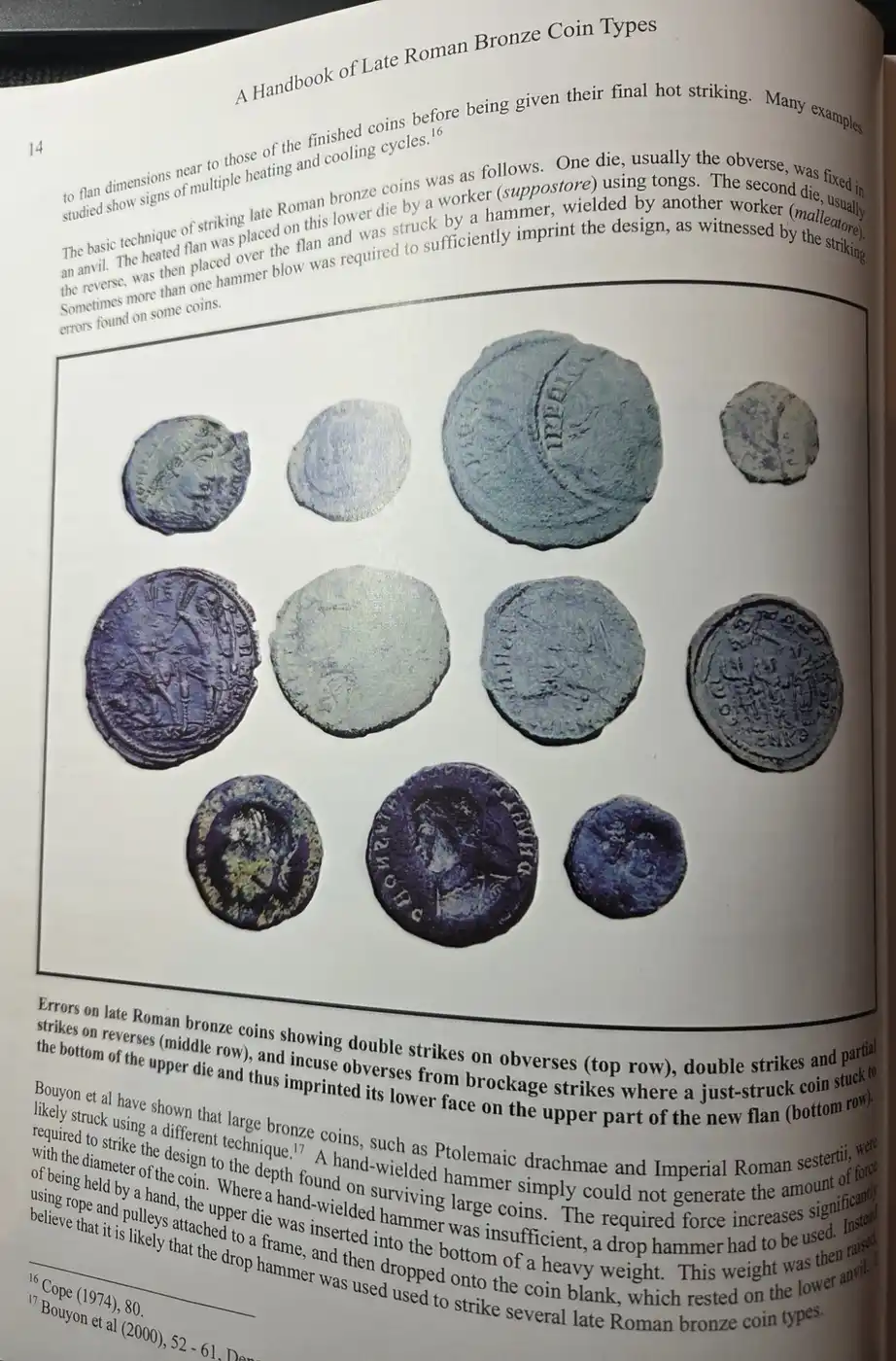 |
|
Pillar of the Community
United States
2363 Posts |
Thanks for posting the pages. As Victor said it is a theory. I'm not aware of any ancient literature or archaeology to support it.. The Greek and Romans mined the metals likely with slaves, melted it, smelted it, made the coin plancets. They likely heated the planchets so they were soft enough to be struck with a hand held hammer even the biggest ones. Finding Roman mint workshops is pretty rare. As far as I know little in the way of equipment to strike coins has been found, maybe tongs, a few dies, coin blanks, fire pits but I'm not very knowledgeable about it. I've seen a few Roman dies on auctions. The Romans were pretty good guarding the mints and destroying the dies or melting them. I have a Julius Caesar denarius that was struck at a traveling mint that followed the soldiers to pay them during Caesar's campain.
The Romans could have made a drop hammer device. The author says a drop hammer "had to be used" with the larger coins. I do not agree. Enough heat can make planchets very soft close to melting point.
As we know modern coins are made with high pressure presses, the planchets don't need to be heated.
Edited by livingwater
03/08/2026 8:30 pm
|
|
Pillar of the Community
 United States
8076 Posts |
Quote:
The author says a drop hammer "had to be used" with the larger coins. I do not agree. Enough heat can make planchets very soft close to melting point. Yes. The metal flows in proportion to the applied stress, and inversely proportional to its modulus. Solid mechanics. As the size of the coin increases, you can increase the stress with a bigger hammer, or you can decrease the modulus with heat. Or do both. The author knows that, but has assumed the former, possibly because that's the variable that was easier to control to get a uniform product. Edited by tdziemia
03/08/2026 9:38 pm
|
|
Pillar of the Community
United States
2363 Posts |
tdziemia, Good point, they perhaps had different weights hammers for various coin sizes.
Edited by livingwater
03/08/2026 10:00 pm
|
|
Moderator
Australia
17031 Posts |
We simply don't know exactly how "the Roman mint" worked at every stage of Roman history, We have a few detailed accounts from specific slices of time, but a full detailed history was either never recorded, or has now been lost. I'd probably lean towards "never recorded", as minting of coins was not only a closely guarded trade secret, but a state secret - after all, if it were widely known how to make coins, then some enterprising criminal types might just try to make their own. That being said, we do have some records of what mint operations looked like at certain time periods - such as during the reign of Hadrian, when large finely detailed bronze and brass coins were being struck. There is no mention anywhere of any device resembling a "drop hammer", or anything other than the sheer brute force of the malliatores ("hammermen"). All of the surviving illustrations and depictions of ancient Roman coin-making show a three-man team at work: the guy who picks up the finished coin and puts down the next blank (the suppostor), the guy carefully placing the hand-held reverse die on top of the blank (the signator), and the big guy with the hammer (the malliator). Some of the surviving illustrations of mint activity (such as this fresco from Pompeii) show workers taking things out of a furnace with tiny tongs. It's debated whether these are coin blanks being heated, or coin dies being forged and hardened. We also have the curious case of "centration dimples", indentations found on certain large bronze coins (both Greek and Roman) which look for all the world as if some tongs had grabbed onto the coin blank while it was so hot it was semi-molten. Numismatists have long argued about what centration dimples are, and how they were made; the "tong-marks" hypothesis is a strong candidiate. There thus seems to be strong evidence that at least sometimes, it was likely that tougher-metal coin blanks were heated to softness before being struck. The main argument against the Romans doing this as routine practice seems to be that it must have been so time-consuming and labour-intensive to heat up each coin blank that much prior to striking, that it doesn't seem it could have been viable from an economic and time-budget perspective. Either way, we are left to speculate about what kind of mysterious magic was at work in the Roman mint: whether it was some powerful drop-press for which there is zero actual archaeological evidence, or an equally evidence-free method of heating a whole bunch of copper blanks to near-melting very quickly and cheaply. Don't say "infinitely" when you mean "very"; otherwise, you'll have no word left when you want to talk about something really infinite. - C. S. Lewis
|
|
Pillar of the Community
United States
2363 Posts |
Thanks Sap for adding more information, history. It really is somewhat of a mystery how ancient coins were made through the centuries. The biggest ancient coin in my collection is a Ptolemy II bronze from Alexandria Egypt, Zeus/eagles, at 40mm 64.4 grams it's huge and with center indentations. I read somewhere these may be centration marks to help keep the coins from becoming off center when struck or are "dimples" made by tongs during the process of forging the planchets. I've seen these cicular indents on some Roman Provincial coins but I only have a couple. Here is my Ptolemy coin and Nicopolis, Thrace, Caracalla/Demeter, 29mm.with dimples or whatever the word to call them is. 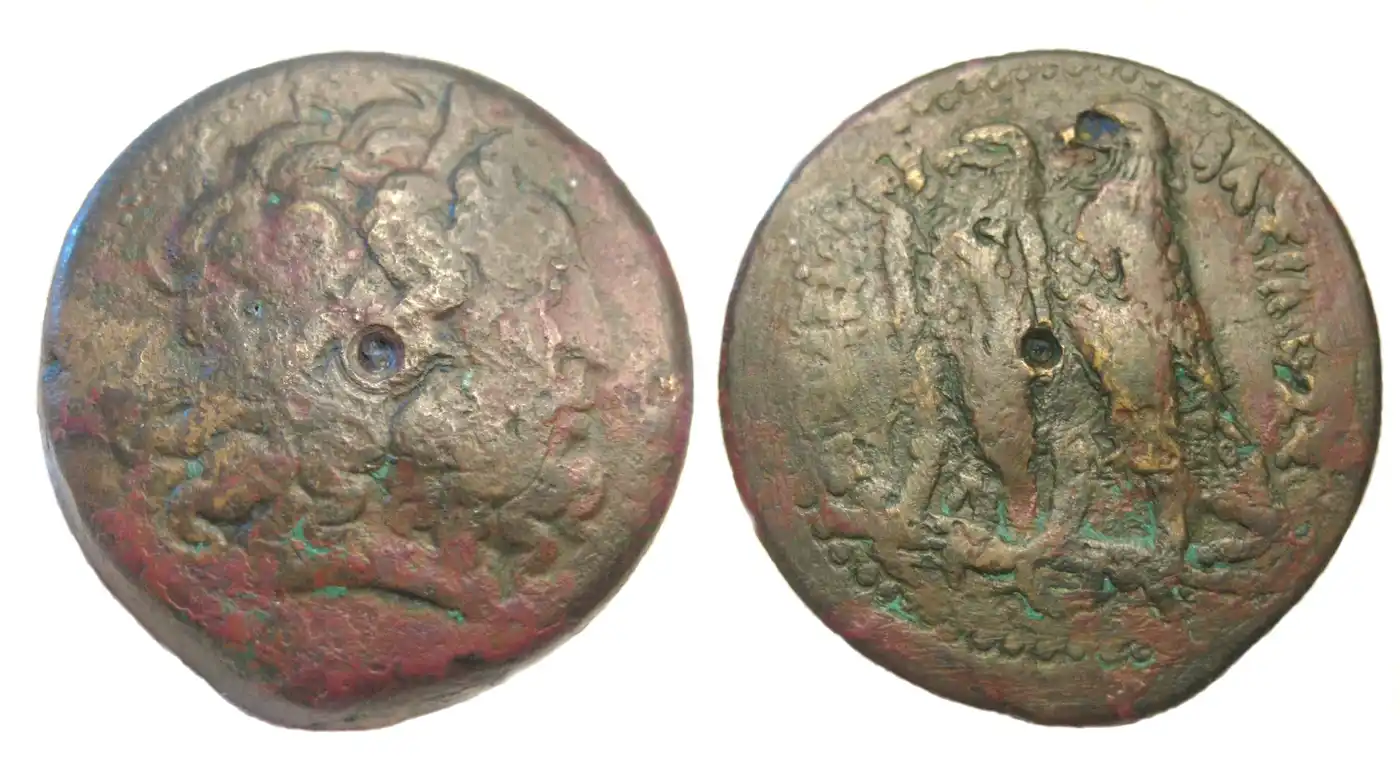 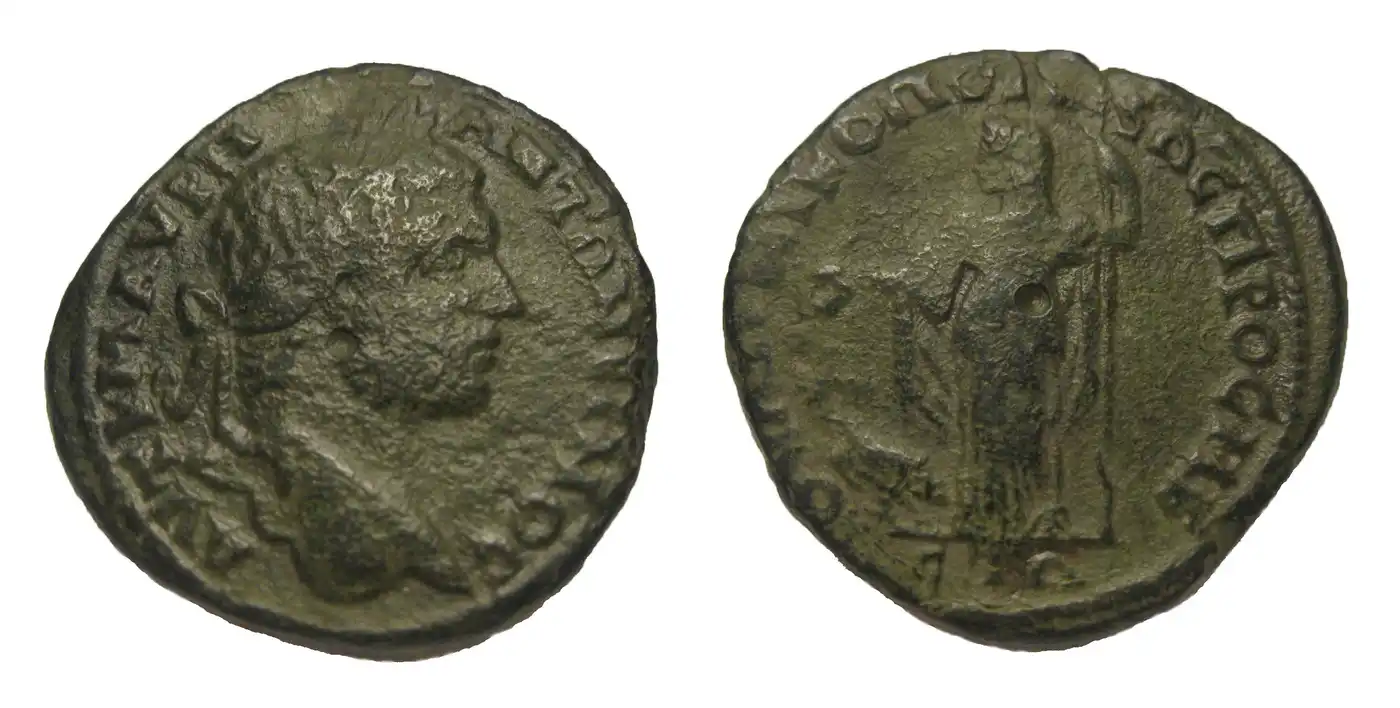 Edited by livingwater
03/09/2026 07:10 am
|
|
Pillar of the Community
United States
8076 Posts |
I would think some smart materials scientist would be able to tell the thermal history of the coin (how hot it was likely heated at the time of forging). But that would mean destroying some coins to prep them for the scanning electron microscope. And if it were a two step process (forming blanks, then reheating to hammer the coin), the interpretation could get kind of difficult.
But it would be shocking if there were never a PhD thesis produced om something like this.
|
|
Moderator
Australia
17031 Posts |
Quote:
I would think some smart materials scientist would be able to tell the thermal history of the coin (how hot it was likely heated at the time of forging). But that would mean destroying some coins to prep them for the scanning electron microscope. And if it were a two step process (forming blanks, then reheating to hammer the coin), the interpretation could get kind of difficult.
But it would be shocking if there were never a PhD thesis produced om something like this. "Destroying coins" isn't the main complication, as archaeology all too often finds coins that are damaged or otherwise in such a poor state that collectors and archaeologists alike are all perfectly fine with slicing them apart for science. The complication here is, the metals that are hard enough to need this kind of treatment (brass bronze and other copper alloys) are also quite prone to change over time. There is usually a thick layer of patina which is where the details of the coin's surface is actually preserved, with surprisingly little raw metal remaining. In that sense, ancient bronze coins are often more like fossilized coins than actual preserved coins. So I'm not sure that the crystalline history of the base-metal alloys remain constant and reliably interpretable after being buried for 2000 years. I do know, for example, that silver "crystallizes" over time, becoming more brittle than the original alloy was. I haven't heard this phenomenon reported for bronzes, perhaps because corrosion and patination outweighs such factors. Don't say "infinitely" when you mean "very"; otherwise, you'll have no word left when you want to talk about something really infinite. - C. S. Lewis
|
|
Pillar of the Community
United States
8076 Posts |
Quote:
tdziemia, Good point, they perhaps had different weights hammers for various coin sizes. A hammer of a given weight in a contraption powered, say, by gravity will always strike with the same force. On the other hand they didn't have thermometers to enable them to always strike the blank at the same temperature. |
|
Pillar of the Community
United States
8076 Posts |
Quote:
The complication here is, the metals that are hard enough to need this kind of treatment (brass bronze and other copper alloys) are also quite prone to change over time. There is usually a thick layer of patina which is where the details of the coin's surface is actually preserved, with surprisingly little raw metal remaining. Agreed, which is another reason the interpretation would get complicated. But heating would affect the center of the coin, too (high thermal conductivity would quickly transfer heat to the interior of the coin, though presumably the desired state for striking is with the surface softened enough to flow but the core still rigid enough to resist too much plastic flow). It's easy to imagine a time-temperature series on a set of bronze blanks to see what kind of internal crystal morphologies develop. Maybe it's even been done already by a corporate R&D lab somewhere that deals in forging bronze (those places do lots of good work that never gets published for intellectual property reasons). |
| |
Replies: 23 / Views: 1,128 |







 Posted 03/07/2026 12:45 pm


