Coin Community Family of Web Sites Join Thousands of Coin, Bullion, & Money Collectors
300,000 items to help build your collection! Royal Canadian Mint products, Canadian, Polish, American, and world coins and banknotes. Vancouvers #1 Coin and Paper Money Dealer Coin, Banknote and Medal Collectors's Online Mall Join Thousands of Coin, Bullion, & Money Collectors Royal Estate Auctions - $1 Coin AuctionsSpecializing in Modern Numismatics


Username:
Password:
Save Password
Forgot your Password?


This page may contain links that result in small commissions to keep this free site up and running.

Welcome Guest! Registering and/or logging in will remove the anchor (bottom) ads. It's Free!

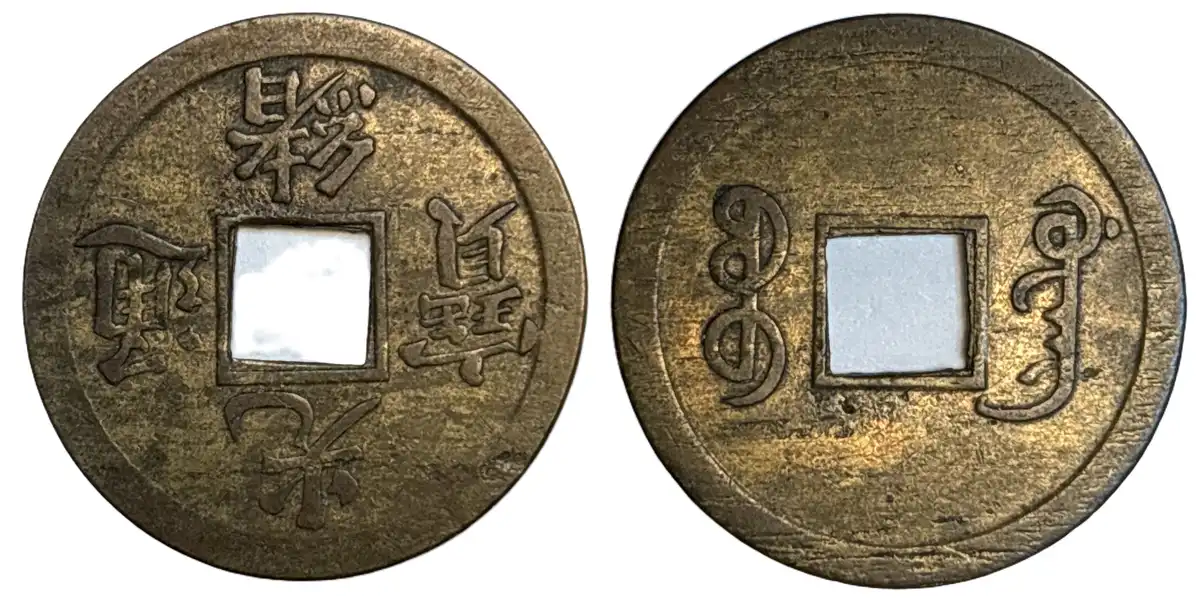
Another Coin I Think, Asian, 24.07 MM And 3g

To participate in the forum you must log in or register.
Author Previous TopicReplies: 7 / Views: 118Next Topic  
Valued Member

Canada
81 Posts
 Posted Yesterday   3:16 pm Show Profile   Bookmark this topic Add lahave56 to your friends list Get a Link to this Message Number of Subscribers
I found this one didn't have a label. In addition to some help with an id I'd like to learn what to look for with these coins to determine the country of origin as I may run across others. Is there anything short of knowing something about the language? Thanks.


Another-Coin-I-Think,-Asian,-24.07-MM-And-3g
Moderator
Learn More...
jbuck's Avatar
United States
188990 Posts
Valued Member
Canada
81 Posts
 Posted Yesterday   4:39 pm  Show Profile   Bookmark this reply Add lahave56 to your friends list Get a Link to this Reply
Thanks jbuck! That sure looks like the right one. How did you id it so quickly?
Moderator
Learn More...
jbuck's Avatar
United States
188990 Posts
 Posted Yesterday   4:51 pm  Show Profile   Bookmark this reply Add jbuck to your friends list Get a Link to this Reply
My pleasure.

Image search on Google found the CCF topic, then I searched Numista for the details.
Valued Member
Canada
81 Posts
 Posted Yesterday   5:14 pm  Show Profile   Bookmark this reply Add lahave56 to your friends list Get a Link to this Reply
Ah yes - image search. Pretty impressive how quickly it finds a match.
Moderator
Learn More...
Sap's Avatar
Australia
16842 Posts
 Posted Yesterday   6:15 pm  Show Profile   Bookmark this reply Add Sap to your friends list Get a Link to this Reply
In my case, identifying it was easy because I have seen a rather large number of this specific coin type. They are quite unique and distinctive, and often turn up in caches of mixed cash coins.

For over 2000 years, Chinese "cash" coins (round coins with square holes in them) were traditionally produced by casting - pouring molten brass into a sand mould. When "western" style coinage presses were first introduced to China in the late 1800s, the Kwangtung mint (and a couple of other provincial mints) tried their hand at using those presses to make cash-shaped coins. Thus were created coins like the one in the OP - a fusion of ancient Chinese design with modern Western production methods. Being restricted to just a couple of mints and a narrow time window, there were only a handful of different designs of machine-struck cash used across the Empire.

While over a billion of these coins were indeed made there this way, in the end it proved unsuitable to continue to produce them. The extra time and labour needed to punch out the central square hole was not justifiable for a coin that was literally only worth 1/10th of a cent. The next generation of machine-struck cash coins were smaller, and had a round hole: https://en.numista.com/22475
Don't say "infinitely" when you mean "very"; otherwise, you'll have no word left when you want to talk about something really infinite. - C. S. Lewis

Valued Member
Canada
81 Posts
 Posted Yesterday   6:56 pm  Show Profile   Bookmark this reply Add lahave56 to your friends list Get a Link to this Reply
@Sap thanks for that background. I wonder if the holes (round or square) in these coins served a similar purpose as holes in some early trade tokens where I've read they made it possible to string together a bunch of them to make them easier to carry around.

[Edit: According to google this indeed was one purpose of the holes]
Edited by lahave56
Yesterday 6:58 pm
Moderator
Learn More...
Sap's Avatar
Australia
16842 Posts
 Posted Yesterday   9:20 pm  Show Profile   Bookmark this reply Add Sap to your friends list Get a Link to this Reply
The original purpose of the square holes on cast cash coins was part of the production process.

When you cast a coin, the edge is quite rough - the casting seam is there, and there's also a "sprue" where the coin was attached to the "tree". To make the coins nice and round, they need to be lathed. But rather than lathe each coin one at a time, they would push the rough coins onto a long metal rod with a square cross-section, so they can then lathe a hundred or more coins all at once.

You can sometimes find coins with "star-shaped" holes; this originally happened if a coin fell off the rod during the lathing process, and had to be pushed back onto the rod at a different angle to lock it in place. https://en.wikipedia.org/wiki/Huachuanqian Later collectors began to appreciate the (relative) rarity of star-shaped hole coins, which then led to such holes being deliberately made in various charms and amulets.

Over time, the round-coin-with-square-hole acquired mystical symbolism (the square hole is "Earth", and the round coin is "Heaven"). But originally, the hole was put there for purely practical reasons. A machine-struck coin, of course, has no practical need or use for such a hole as part of the production process; on the OP coin, the hole is there purely out of tradition - people "expected" their coins to have square holes in them, so square holes had to be put there.

But the holes did indeed serve another important function: tying them together in bundles, to make them easier to count and transport. Under the Imperial system, 1000 coins would be tied together to make a "string", and 1 string was worth 1 tael (an amount of silver worth slightly more than one silver dollar). In the late Imperial period, the silver dollar was adopted as the standard unit of currency instead of the silver tael, and one string of 1000 cash were retariffed to 1 dollar - making the cash worth exactly 1/10th of a cent.
Don't say "infinitely" when you mean "very"; otherwise, you'll have no word left when you want to talk about something really infinite. - C. S. Lewis

  Previous TopicReplies: 7 / Views: 118Next Topic  

To participate in the forum you must log in or register.


Disclaimer: While a tremendous amount of effort goes into ensuring the accuracy of the information contained in this site, Coin Community assumes no liability for errors. Copyright 2005 - 2026 Coin Community Family- all rights reserved worldwide. Use of any images or content on this website without prior written permission of Coin Community or the original lender is strictly prohibited.
Contact Us  |  Advertise Here  |  Privacy Policy / Terms of Use

Coin Community Forum © 2005 - 2026 Coin Community Forums
It took 0.31 seconds to rattle this change. Forums