A few tidbits about the 1936 Landing of the Swedes in Delaware Tercentenary Half Dollar...Tidbit #1The Delaware Swedish Tercentenary Commission - the sponsor of the 1936 Landing of the Swedes in Delaware Tercentenary Half Dollar - announced in July 1937 that it had acquired 'The Rocks' which it described as the "site of the first white settlement in the Delaware River Valley." It was the landing spot for the first Swedish explorers/settlers.
The site was to become a Delaware State Park and host Delaware Tercentenary festivities in June 1938.
The Commission noted:
"In 1688, a Swedish colonizing expedition landed on a ledge of rock on the Christiana River, within the present limits of Wilmington, and there built a fort, named Fort Christina, after the Queen of Sweden.
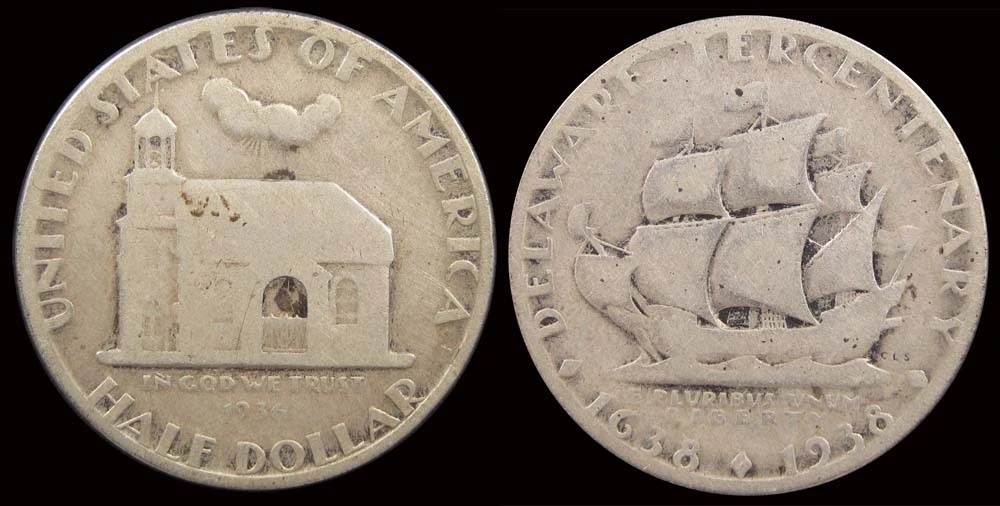
"A few years later, the first village, Christinahamn, was laid out behind the fort and in 1699 the Old Swede's Church, now the oldest Protestant church in the United States, was built close by. To the Swedish people and all Swedish-Americans, 'The Rocks' are the object of sentimental veneration. For all the territory between New York and Maryland they are what Plymouth Rock is to New England."Note: Old Swede's Church appears on the obverse of the commemorative half dollar. The Kamar Nyckel,
the ship that brought the first explorers/settlers from Sweden, is depicted on the coin's reverse - side designations as per the Commission vs. United States ("US") MintTidbit #2It was announced in February 1937 that the designs - by Carl M. Schmitz - for the Delaware Tercentenary half dollar were approved by United States Secretary of the Treasury Henry Morgenthau. Jr.
Note: The Delaware coin was mandated by Congress to bear the "1936" date even though its design was not approved and/or struck in 1936.The approval was announced by Colonel George A. Elliott, Chairman of the Delaware-Swedish Tercentenary Commission.
Tidbit #3Schmitz won a design competition for the honor of having his designs used for the coin; the competition was open to artists/sculptors across the country - Schmitz was from New York.
Entries were judged by an appointed committee within the Delaware-Swedish Tercentenary Commission. The committee consisted of: Colonel George A. Elliott, Dr. George H. Ryden and Christopher L. Ward. They were assisted by noted professional sculptors Dr. R. Tait Mckenzie (University of Pennsylvania) and Joseph Sinnock (Chief Engraver US Mint).
For more about the design contest:
1936 Delaware Tercentenary - Design ContestTidbit #4In March 1937, the first Landing of the Swedes in Delaware Tercentenary half dollar was presented to Delaware Governor Richard C. McMullen by Colonel George A. Elliott in the Commission's office within the Equitable Trust Company - the agent for the coin.
At the time of the presentation, Col. Elliott stated:
"It has been many months since we planned the designing of these coins after having been duly authorized both by the Legislature of Delaware and the Congress of the the United States.
"Your Commission feels that the coin is most appropriate in its design for our three-hundredth anniversary of the settlement of the State of Delaware, showing as it does, on one side, the ship which brought the Swedes, our first settlers, to what was then a wilderness, and on the other side the old church built by them a few years later, which is one of Delaware's most prized possessions."1936 Landing of the Swedes in Delaware Tercentenary Half Dollar

For other of my posts about commemorative coins and medals, including other US classic-era commemorative coin Tidbits , see:
Commems Collection 






 Posted 08/03/2026 11:57 am





