| Author |
 Replies: 32 / Views: 5,984 Replies: 32 / Views: 5,984 |
|
Valued Member
Canada
367 Posts |
I just thought it would be interesting topic I think mine is a 1911 vf 50 cent piece. Or my 1907H EF large cent Edited by cazzuey
09/26/2010 1:10 pm
|
|
|
|
Valued Member
Canada
250 Posts |
I have this 1917 penny image in "coin grading" but it is my nicest by far, however I am a new collector. $0.02 Worth 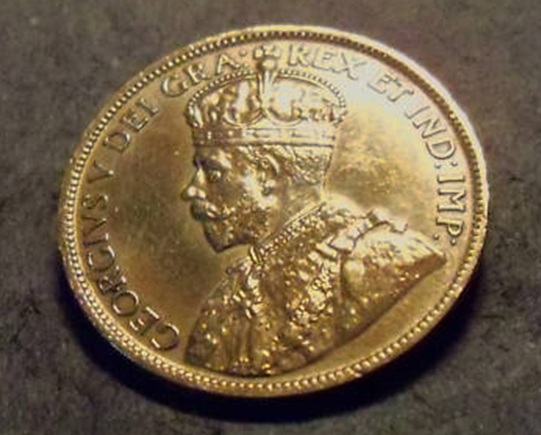 |
|
Pillar of the Community
 United States
2448 Posts |
Best by looks, grade, cost? Actually I'd say my 2009 UHR Eagle. I love the St. Gaudens design, there's not a mark on this coin, and the price was right when I bought it.
|
|
Valued Member
United States
343 Posts |
Here's my nicest Canadian piece!  |
|
Bedrock of the Community
Australia
21794 Posts |
I once had an Adelaide Pound of 1852, Australia's first gold coin in good VF. About 200 or so exist today. That item would be worth perhaps $20,000 on the market today. It is much rarer than the king of Australian coins the famed 1930 Penny.
The Adelaide Pound has an integral part in Australia's history. The Governor of the (then) Colony of South Australia, Sir Robert Richard Torrens, authorised it's release. He was also responsible for a completely different system of land tenure, known as Torrens Title, which is used in many countries today.
It had all of the attributes to make it a coin: A statement of value, ('value one pound') a statement of it's weight ('weight 5dwt 15 grs'), which is 5 pennyweight 15 grains, a statement of it's purity ('22carats'), and the issuing Authority ('Government Assay Office Adelaide'). There was also a crown depicted on the coin, helping to give it an air of authority.
There was only one problem regarding it's issue: It was issued without Royal Assent from Queen Victoria in Great Britain. Because of this, about 18 months after it's issue, they were recalled, and almost all of them were melted down.
The gold for the coins came from the Bendigo / Ballarat gold fields, in State of Victoria, in the early period of the Gold Rush days in Australia. It was transported on the backs of mules under police guard over a distance of 500 or so miles, in country that had no roads at all.
I had to sell it; it came part of the deposit on my first house.
|
|
Valued Member
United States
76 Posts |
|
|
Valued Member
 Canada
367 Posts |
|
|
Pillar of the Community
United States
4846 Posts |
Ive got a couple, an 1854 large cent in VF-EF, 1896 Indian head in XF-AU, 1934 Lincoln Cent in MS-63-64, 1909 V.D.B. in VF-EF, 1868 2 cent piece in F-FV, and a 1943 Mercury dime in MS-64-65, 1962 Franklin half dollar in PR-66-68 and last but not least, a 1997 rotated capped die strike error cent that I found roll searching Edited by Adam_E
09/26/2010 1:32 pm
|
|
New Member
United States
19 Posts |
@yarm >>> Very Nice Brotha. Lovely example. Thumbs up.
|
|
Pillar of the Community
Canada
1051 Posts |
"Nicest" is somewhat subjective. I think this one is nice, in fact I find all the pre-1976 coins to be quite pretty when they have the UHC contrast.  |
|
Pillar of the Community
United States
2408 Posts |
1cent, that's an outstanding coin!
Just curious, what's the grade?
Edited by canadian_coins
10/04/2010 9:48 pm
|
|
Pillar of the Community
Canada
1051 Posts |
CC, I don't have a full scan of the holder on the computer it seems, but I am pretty
sure it's graded as PL-65 by ICCS. I remember being quite happy with the price paid, likely
because the super-gem hunters passed it over because of the "lowly" 65 grade.
|
|
Bedrock of the Community
Australia
21794 Posts |
1cent: The cameo effect shown is nicely acceptable to me. Proof coins do not necessarily have to have a cameo effect. The 1902 British matte proof set is an example. To be honest, I am not particularly keen of the presentation of these coins. As far as I know, this is the first and last time The Royal Mint produced matte proof coins. On the other hand, I am also not keen of presentation of current proof coins by the Royal Australian Mint. The ultra high polish of the fields looks OK but the details in relief are so heavily sand blasted to produce the ultra cameo effect, that much of the fine detail is removed. I find that quite disappointing. The earlier proof sets produced during the period of pre decimal coinage in Australia reveals a much finer detail of the relief surfaces. The problem with this series is that the fields were not polished, and so makes it difficult at first glance to distinguish an MS65 FDC coin from a genuine proof. I have a 1959 proof Florin of this series. I also have a nice example of a British George 1V proof 5 Pounds of 1937 in FDC. This coin has mild cameo relief, with all of the fine detail remaining and with moderately polished fields. |
|
Valued Member
Canada
367 Posts |
|
|
Valued Member
United States
380 Posts |
Mine is a LDS 1923-P VAM-1C "Tail on O" Peace dollar. (actually I have 2... but 1 is MUCH nicer) Notice the big break on the O of DOLLAR on the reverse!   |
|
Valued Member
Canada
367 Posts |
|
| |
Replies: 32 / Views: 5,984 |




 Posted 09/25/2010 10:09 pm





