Coin Community Family of Web Sites
Shop for APMEX Bullion on eBay!Specializing in Modern Numismatics Vancouvers #1 Coin and Paper Money Dealer 300,000 items to help build your collection! Royal Canadian Mint products, Canadian, Polish, American, and world coins and banknotes. Shop CCF Members on eBay! Coin, Banknote and Medal Collectors's Online Mall


Username:
Password:
Save Password
Forgot your Password?


This page may contain links that result in small commissions to keep this free site up and running.

Welcome Guest! Registering and/or logging in will remove the anchor (bottom) ads. It's Free!

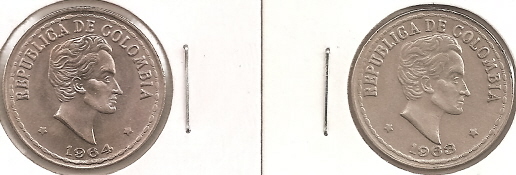
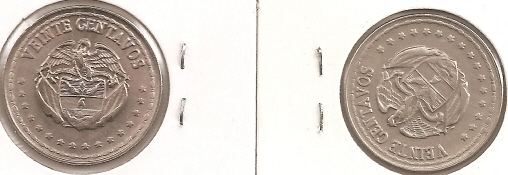
1963 Colombia 20 Centavo Die Rotation

To participate in the forum you must log in or register.
Author Previous TopicReplies: 1 / Views: 1,646Next Topic  
Pillar of the Community
snowman's Avatar
United States
1840 Posts
 Posted 04/26/2008  10:56 am Show Profile   Bookmark this topic Add snowman to your friends list Get a Link to this Message Number of Subscribers
I posted the 1964 coin as reference. Would this be considered about a 225 degree rotation? How does an error like this occur?

1963-Colombia-20-Centavo-Die-Rotation

1963-Colombia-20-Centavo-Die-Rotation
Bedrock of the Community
Conder101's Avatar
United States
17884 Posts
 Posted 04/29/2008  7:09 pm  Show Profile   Bookmark this reply Add Conder101 to your friends list Get a Link to this Reply
Well it depends on how you measure the rotation. It could be called 225 degree cw rotation, or 135 degree ccw rotation. This is assuming that the coins normally have what we call coin orientation.

How does it happen? Well assuming we are dealing with cylinder body dies, the die is normally locked in place in the press by having a flat area ground on the side of the die and then a set screw tightened against it.

If the flat is ground in the wrong place the die will be rotated from where it should be.

If the setscrew works loose the vibration of the press can cause the die to rotate.

The body of the die can crack (split) parallel to the die face and then the die between the die face and the crack can rotate.

We normally say that it is the reverse that has rotated but it could actually be either die that is out of place. Although it will normally be the lower or anvil die because if the setscrew on the upper die becomes loose enough for the die to rotate, it is also loose enough to fall out of the press.

There are other types of dies and oter ways of locking them into the press but that explanation will hold for most US rotated reverse coins.
  Previous TopicReplies: 1 / Views: 1,646Next Topic  

To participate in the forum you must log in or register.


Disclaimer: While a tremendous amount of effort goes into ensuring the accuracy of the information contained in this site, Coin Community assumes no liability for errors. Copyright 2005 - 2026 Coin Community Family- all rights reserved worldwide. Use of any images or content on this website without prior written permission of Coin Community or the original lender is strictly prohibited.
Contact Us  |  Advertise Here  |  Privacy Policy / Terms of Use

Coin Community Forum © 2005 - 2026 Coin Community Forums
It took 0.14 seconds to rattle this change. Forums