The following is reposted here with permission from the original author, Ken Potter.Here is the lead end of copper cent coinage strip once owned by CONECA member Al Raddi. You'll note that there are a number of partially punched out blanks. There is also evidence that seems to suggest that two of the partially punched out blanks would have exhibited "Straight Clips" and we can see that one that was punched out completely was also a so-called straight clip. However, the area of strip where these straight clips occur is tapered and there is a bit of sheared off metal from the left top about half way in at which point it is straight. This was done for reasons unknown. Normally this taper shouldn't be there. Strip is not tapered to make it easier to feed into a blanker.
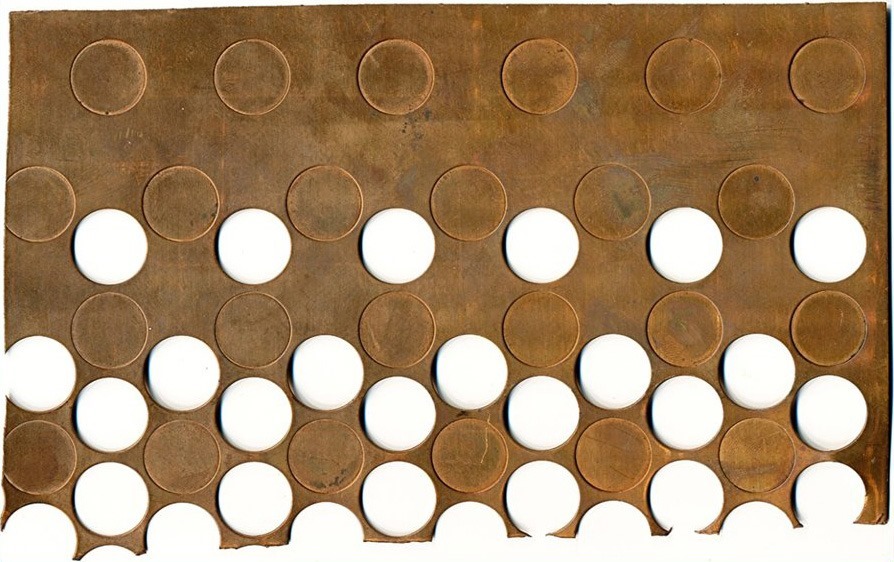
Strip is fed through guides into a straightener and then into the blanker with no need to trim the lead end. I speculate it may have occurred after the strip was punched, possibly in an effort by a previous owner of this strip to enhance its value by creating "straight clips" or maybe the lead end showed some band marks.
However, the most interesting feature with this piece of strip is where the second row of blanks might have otherwise been punched out (either partially or completely). There is no evidence of any of the punches making contact with the strip at all. This "missing row" is what occurs with the lead (or end) of all strip when fed through a blanker.
It takes two cycles of the press to punch out a given area. This is achieved by using two sets of blanking dies (called gang punches) assembled to maximize the number of blanks that can be punched from a given area of strip. After the first cycle the strip inches forward by one row and the second cycle punches out the areas between the rows of the first cycle. After the second cycle the strip moves forward the entire length of the webbing and the process repeats itself. This process will always leave the second row of the lead (or from the end) of strip blank with no holes.
Two gang punches are required not only to maximize the number of blanks that can be punched from the strip but to also create enough room for buttons to be assembled into the lower die.
The buttons are the cutting tool through which the blanks will be sheared and pass. They are a necessary part of the blanking process because it is the buttons that are replaced when one dulls, chips or even breaks in half (I've often found buttons broken right in half when I worked at Sterling Stamping and had to shut down lines to have them replaced). If there were no buttons then you'd be repairing an entire lower die at a cost of untold thousands of dollars rather than a cheap button that can be made in the die shop or ordered from companies like Lane.
https://www.daytonlamina.com/pdf/la...BallLock.pdfYou may have noted that I mentioned that a "missing" row occurs at the lead or end of strip. In this case we may ascertain that it was the lead because of the partially punched out blanks. This is normal as the die setter inches the dies a bit at a time in order to obtain the correct shut height (spacing) to fully punch out the blanks. If the missing row is at the end of the strip the areas from where blanks are punched will be fully punched out.
Other than that, there is no real way to tell if it is from the lead or end. Strip is cut to very specific lengths and there are no ragged ends as some suggest. Ragged Clips come from "blow holes" that can occur anywhere in the strip due to impurities or lamination. I've seen these "blow holes" countless times in my days as a press operator and because I always ran a draw press (the first press in an assembly line), I was the one who had to scrap these panels out. And now you know the rest of the story!







 Posted 08/03/2022 07:58 am





