The Mint's 1991 commemorative Silver Dollar (SD) pays tribute to the steamship
Frontenac, and its launching on Lake Ontario in 1816. The SD marked the 175th anniversary of the ship's launch - an atypical anniversary for a coin (at least to that point), but I guess 1991 was a "slow" anniversary year for Canada!
 Steamship Frontenac, circa 1815
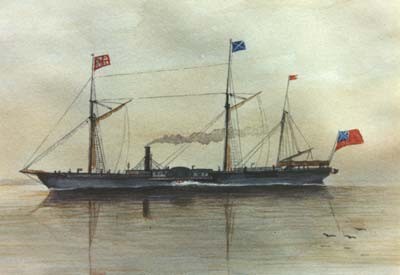 (Image Credit: Public Domain. Artist: James Van Cleve.)
The
Frontenac was the first Canadian-built commercial steamship to ply the waters of Lake Ontario, covering a regular passenger/freight route between Prescott, Ontario (on the St. Lawrence River opposite Ogdensburg, NY), and multiple stops on Lake Ontario, including Kingston, ON; Ernestown, ON (where the ship was built); New Castle,ON; York, ON (Toronto); Niagara-on-the-Lake, ON (bordering New York State) and Burlington, ON.
The ship was sponsored by several businessmen in Kingston, ON and was in service from 1817 to 1826 - the ship did not turn a profit for either of its two owners. The ship was destroyed by fire in 1827 while awaiting scrapping.
The coin's commemorative reverse was designed by the acclaimed artist-illustrator David Craig (b. 1945 - d. 2019), an artist who had designed previous non-circulating legal tender (NCLT) commemorative silver and gold coins for the Mint. His coin designs had included: 1984 Toronto Sesquicentennial SD, the 1990 Henry Kelsey Expedition Tercentenary SD and the 1989 Sainte-Marie Gold $100 coin. He went on to design 12 additional coins for the Mint, ultimately being credited with 15 designs. Sheldon Beveridge, a Mint Engraver, handled the engraving of Craig's design.
1991 Frontenac Silver Dollar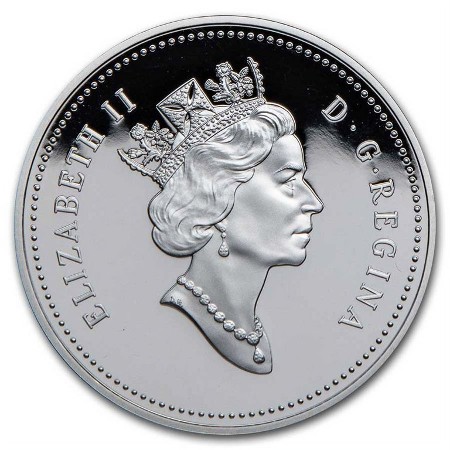
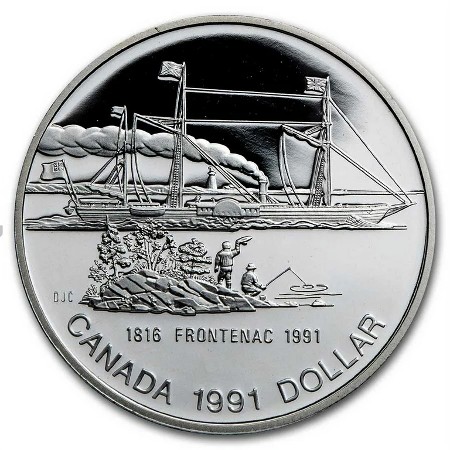 (Image Credit: Royal Canadian Mint, Media Image.)
The design presents the
Frontenac sailing on Lake Ontario as it passes Gibraltar Point Lighthouse on Toronto Island (far background; initial construction 1808). In the foreground is a small islet upon which is seen a pair of fisherman - one with his pole in the water!
The coin was launched in February 1991. The SD was struck on a planchet that is 50% silver and 50% copper (as were each of the Canadian SDs issued between 1971 and 1991 inclusive; the planchet's composition changed to sterling silver / 0.925 fine in 1992), with a diameter of 36.07 millimeters and a weight of 23.33 grams; the SD has a reeded/serrated edge.
The issue price for the Proof version of the coin was $22.95 CAD; $16.75 for the Brilliant Uncirculated version. I initially purchased the BU version for my collection, but later added the Proof version as well.
The maximum mintage of the coin was open-ended, with the final total being the result of orders received by December 31, 1991; SDs included in the Mint's annual Double Dollar Proof Set were added into the figures reported. In total, the Proof version sold 222,892 examples and the Uncirculated version 82,642.
Though fairly simple in its design execution, I find its overall detail to be outstanding and the work of a true master engraver.
For more of my posts about commemorative coins and medals, including other Canadian commemorative stories, see:
Commems Collection.






 Posted 11/25/2024 1:26 pm





