| Author |
 Replies: 26 / Views: 3,720 Replies: 26 / Views: 3,720 |
|
|
|
Pillar of the Community
 United States
7983 Posts |
Quote:
Since making this post, I've located an early Venetian ducat, and have bids in on a couple of Aragon dinero. One thing leads to another.... Congats! I think those Venetian zecchinos /ducats are a bit "under the radar" compared to the Florentine florins. I chased one (a florin) at the recent Elsen auction, but dropped out (I think you are a bad influence since I hadn't done that in a while). On the origins ... I know a lot has been written on these things. For instance, the first large northern Italian silver coin, the Venetian grosso, is known to have been struck in 1202 to pay the workers who were building ships in Venice fof the fourth crusade. There was also a Byzantine coin in use for Adratic trade in the 13 rh c. when Florence decided to release their florin, but I forget the details (or was tht the debased solidus?) |
|
Pillar of the Community
 United States
3348 Posts |
There were a few others, but the systematic debasements of the existing ones made them useless for trade after centuries of use. What's remarkable is that the florin/ducat weight standard persisted while the solidii and dinars faded away in history. Maybe it was the tremendous production of Spanish gold escudos.
"Two minutes ago I would have sold my chances for a tired dime." Fred Astaire
Edited by thq
03/28/2023 2:36 pm
|
|
Pillar of the Community
Sweden
2124 Posts |
Quote:
There was also a Byzantine coin in use for Adratic trade in the 13 rh c. when Florence decided to release their florin, but I forget the details Are you thinking of bezants, perhaps? Which could denote a Byzantine hyperperon, a Crusader state dinar, and maybe at times any dinar. The declining quality of the Byzantine and Arabic gold coins during the 13th century was an important reason for Genoa, Florence, and eventually Venice, to begin minting their own gold coins. International trade was growing and needed a trustworthy medium of exchange, a slot the florins and ducats filled as trusted trade coins due to their stable weight and fineness. The first French ecu d'or was more or less contemporary (ca 1270) but weighed slightly more, 4.0 g and pure gold. The first issue was limited and maybe mostly symbolical, but in the mid 1300s it was followed by a 4.5 g version with lower fineness (that varied for different issues). Not being as stable as the florins/ducats, it didn't really obtain trade coin status, although local and regional use was extensive. Several other French gold coins were issued, but none that really matched the florin/ducat standard (at least not consistently over time). The Spanish escudo introduced in the 16th century was more successful, as it was close to the florin/ducat standard and stable over a long time. A double escudo was called a pistole in France and some other countries, and was copied by the French king Louis XIII to become the first louis d'or, roughly equivalent to 2 florins/ducats. Other countries made similar "copies" of the pistole and that too became a trusted coin that lasted into the 1800s. The Portuguese cruzado, introduced in 1457, copied the florin/ducat standard (but not the design). It was widely used for trade in the 15th and 16th centuries. Its 10-fold multiple portugaleser became a prestige and presentation coin and was minted by several European rulers (even the Swedish king minted some). It is an interesting subject, no doubt.  |
|
Pillar of the Community
United States
3348 Posts |
The other common name for the pistole is the doblon or doubloon, except in America where a doubloon was 8 escudos.
I won my Aragon dineros. Another story for another thread.
"Two minutes ago I would have sold my chances for a tired dime." Fred Astaire
|
|
New Member
United States
3 Posts |
Hello and thank you for this amazing information!
I'm new to this forum. I'm a fiction writer doing research for a novel set in 1300s Poland.
Based on my initial research, given that gold florins were found in the Sroda treasure, it seems that, while they would be extremely rare & valuable, these types of gold coins could be used in Poland in the first half of the 14th century.
Would you say that seems likely? Would they likely be Hungarian florins, or not necessarily? Specifically, I have a scene set in 1331-2 in the Krakow area. The person who has the coin is Casimir III, shortly before he becomes king.
Also, I'm trying to figure out the approximate diameter of the florin, if anyone can help with that, I would very much appreciate it.
If the florin seems like a stretch, what other type of gold coin might he have access to?
Thanks so much!
|
|
Pillar of the Community
United States
7983 Posts |
Very nice that you are writing about medieval Poland! The easy question: the florin had a diameter around 20 mm, just a bit larger than a modern dime. The other question ... If Casimir held a gold coin, it could have been a number of things. A Bohemian florin like this one: https://en.numista.com/91048Poland had close political ties to Bohemia (they had been ruled briefly by Bohemian monarchs of the Przemslyd dynasty at the turn of that century)... ... or a Hungarian one: https://en.numista.com/49299 Remember that Casimir was linked by marriage to the Hungarian royal family: his sister married king Charles Robert of Hungary in 1320, and Poland would be ruled by a Hungarian monarch (their son) after Casimir's death. So there would undoubtedly have been contact between the Polish and Hugarian courts by 1331, and the notion of florins being used for gifts, dowry, etc is possible. ... but most likely an Italian one as these would have been available in vastly larger quantity, and had become a common medium for international trade, or other large cash transfers (ransoms of kings or nobles, buying a small principality, etc.). The Bohemian and Hungarian versions were much newer, so fewer would have been in circulation by 1331. Lastly, there is evidence that some small principalities in Italy were also striking imitation florins by around 1315. Apparently the two famous Polish hoards/treasures dating to the first half of the 14th century contain a mixture from various sources, including imitations. It almost doesn't matter, because if you plan only to describe the coin ... THEY ARE ALL THE SAME! A lily on one side, and Saint John the Baptist on the other. Probably the next most common gold coin in wide circulation at this point would have been the gold Genovino https://en.numista.com/417484 . Genoa had a well established trade in the eastern Mediterranean and Black Seas. Casimir would eventually gain territorial access to the Black sea later in his reign (1349) at which point contact with Genoese gold coin woud have been more likely. Yes, any gold coins would have seemed rare and valuable to 95% of people, but not to the upper class (just like today... how many Americans have ever possessed a one ounce gold coin like a double eagle, krugerrrand or maple leaf?). An aside ... His predecessor, Wlasyslaw Lokietek, had struck the first Polish gold coins, but based on their exceeeding rarity, probably relatively few were ever sruck. https://en.numista.com/138147https://en.numista.com/138147This type was NOT mentioned in the accounting of the gold coins in the Polis hoards. Edited by tdziemia
04/05/2026 5:52 pm
|
|
New Member
United States
3 Posts |
Absolutely, amazingly helpful. Thank you so very much @tdziemia! Just wondering, what part of the US are you based in? I'm in California.
I was reading up some on the various types of currency that would have been commonly used by everyday people starting in 1331-2 and throughout Casimir's reign. I found the Kingdom Of Poland Coins By Century (963 - 1586) thread on this forum and that was really helpful. I see that Casimir introduced some coins himself (Kwartnik & cwiercgrosz and Kraków Grosh) mid to late in his reign, but am I right in thinking that the coins that would have been most in circulation before this were the silver denarii and Prague groschen? It seems like the Prague groschen were pretty standardized (?), but I'm not very clear on what the denarii would have looked like in that time & region.
Thank you again!
Edited by rebeccadavis
04/05/2026 4:15 pm
|
|
Pillar of the Community
United States
7983 Posts |
I am originally from Philly, where my grandfather arrived from Poland in 1907. In Ohio since 2011. Yes on the denari and prager groschens. The silver denars were tiny coins, about half the diameter of a U.S. Lincoln Cent, and only 1/10 the weight. These photos are lacking scale (something for comparison) but give an example of what they looked like (Casimir''s portrait on one side, and the Piast eagle on the other) 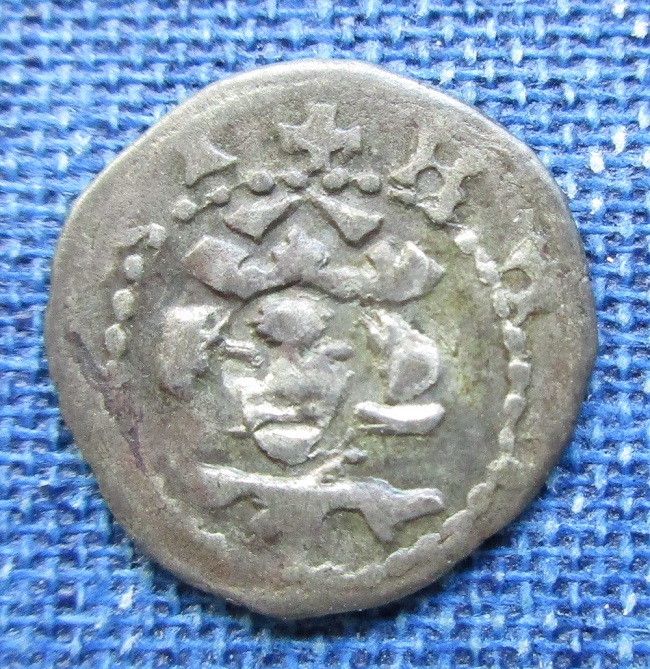 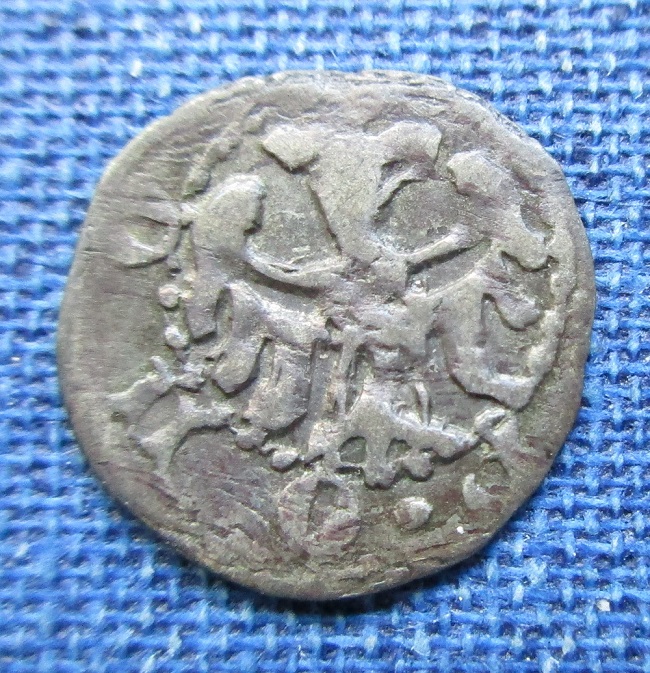 Possibly the design was copied from a Hungarian denar like this: https://en.numista.com/51215...taking into account that the fleur-de-lis device on the Hungarian coin represented the House of Anjou, but the eagle on the Polisch coin stood for the Piasts. Again, maybe evidence of the Polish-Hungay connection of that era. I will try to get a photo of some of these coins with a U.S. coin for comparison and post later. Edited by tdziemia
04/06/2026 08:09 am
|
|
Pillar of the Community
United States
7983 Posts |
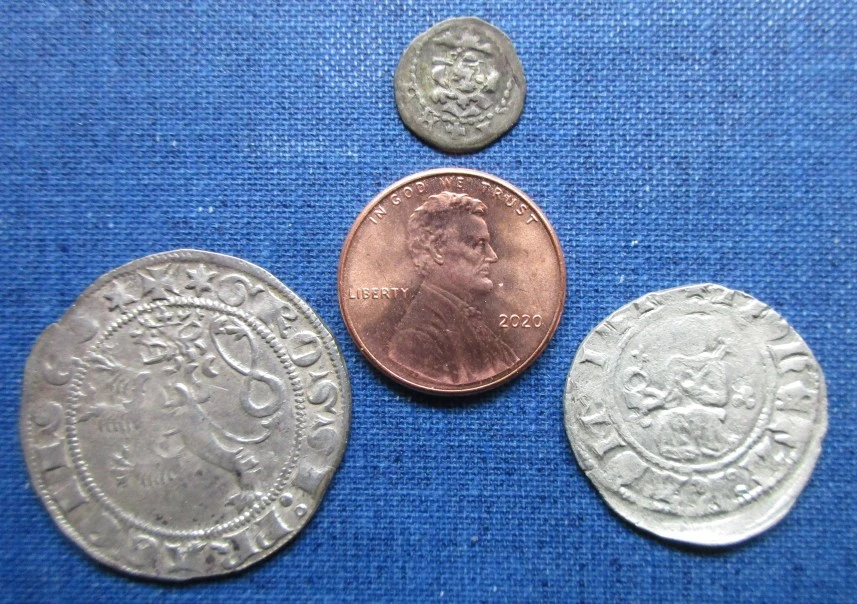 The denar is at 12:00 (inverted ... I should have looked more closely) The kwartnik is at 4:00 The prager groschen is at 8:00 The Polish grosz introduced by Casimir might not have been successful due to the well-established Prager groschen. Very few examples have survived, and this denomination was not produced again in a Polish mint until the 1520s. IN addition to Bohemian coins, probably Silesian, Pomeranian Hungarian, Lithuanian and Teutonic Order coins also circulated in various parts of Poland at that time (mostly small silver types like the denar). Edited by tdziemia
04/06/2026 09:02 am
|
|
Moderator
 United States
191721 Posts |
 to the Community, rebeccadavis! |
|
New Member
United States
3 Posts |
Another big thank you, this is so very helpful!!!
I really appreciate you taking the time. The for scale photograph with the penny is really useful too.
|
| |
Replies: 26 / Views: 3,720 |








 First Page


 Posted 03/28/2023 2:35 pm


