| Author |
 Replies: 18 / Views: 2,878 Replies: 18 / Views: 2,878 |
|
Pillar of the Community
United States
4778 Posts |
I have this Constantius II fallen horseman AE2, minted in Constantinople. I have this attributed as RIC 82, but I've never been 100% sure about it. What do you think? Am I spot on with it's attribution? Thanks guys!  |
|
|
|
Pillar of the Community
United States
2044 Posts |
I also have a Constantius II fallen horseman. Those are fun to attribute with the great variety. lol
|
|
Valued Member
Netherlands
409 Posts |
Your coin could be RIC 81 or RIC 82, check it out at "the horseman description". Ed 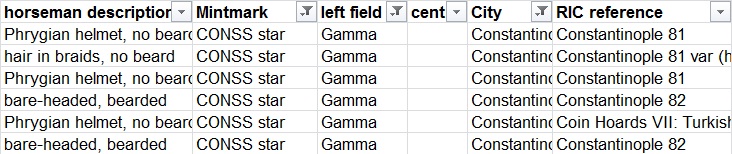 |
|
Pillar of the Community
 United States
4778 Posts |
Which one would the horseman on my coin be? Phrygian helmet and no beard, hair in braids no beard, or bare-headed bearded?
|
|
Pillar of the Community
United States
4778 Posts |
Anyone?  |
|
Pillar of the Community
United States
2044 Posts |
I believe it's similar to: Constantius II RIC 79 (VIII, Constantinople) AE2 Obv: DNCONSTANTIVSPFAVG - Diademed, draped and cuirassed bust right. Rev: FELTEMPREPARATIO Exe: Î"/CONS - Soldier spearing falling horseman. 348-351 (Constantinopolis). Even though the exergue is different. Dirty Old Coins Photo:  |
|
Pillar of the Community
United Kingdom
2838 Posts |
|
|
Pillar of the Community
United States
1549 Posts |
Details like beard or not need clear photos of clear coins to be certain what you see. RIC did not bother with such separations instead concentrating on the poses of the horseman. More recently people have realized that the enemies shown bore the look of specific tribes that Romans encountered in battle. In time we will have a better grasp on which are Goths, which Persians and which other more minor foes.
|
|
Pillar of the Community
United States
1549 Posts |
I need to work on a new portrait gallery of falling horsemen faces.  |
|
Pillar of the Community
United States
2044 Posts |
|
|
Valued Member
Netherlands
409 Posts |
That person is Dane Kurth, she is also the administrator of www.wildwinds.com. A great person with a warm heart for Roman coins and the community.  |
|
Pillar of the Community
United States
4778 Posts |
Very interesting. From looking at bobby's link, for the 81's, looks like 81 -S (with CONSS*) or none of the other 81's have the horseman reaching backwards, like how it is on mine. If that really is the case, then I'd have to say it's either RIC 79 or 82A. |
|
Pillar of the Community
United States
4778 Posts |
What matters more in helping to determine the RIC of a particular coin: the slight differences in style, or the slight differences in exergue, such as CONSA and CONSS?
Edited by VisigothKing
12/08/2011 9:38 pm
|
|
Pillar of the Community
United States
2044 Posts |
There are also design considerations such as with this fallen horseman coin. Various helmeted soldiers with the spear, what the fallen soldier looks like, if wearing a helmet or not, belonging to a certain nation or tribe, etc.
What Eddop posted is a handy little chart and can probably apply to other fallen horseman types besides the coins from Constantinople.
I had a hard time with mine as well because there are a lot of different die variations as such is common with ancient coins.
As you all know, I am a beginner. Although, I look at as much as I can figure out. Legends, device types, bust/head types, crown types. On the reverse, over-all design, legends, mint marks and officina, etc.
I downloaded ERIC I and I also read it often but it is mostly incomplete and doesn't have as many photos and descriptions as needed, I would imagine. Of course, I also use Wildwinds, Dirty Old Coins and FORVM for identification. Perhaps one day I will also get a hard copy of a book. Still using online as a starting point to identification.
|
|
Pillar of the Community
United States
2044 Posts |
Yes and there is always a possibility of running into a coin that is not in RIC or other identification books.
|
|
Pillar of the Community
United States
1549 Posts |
It is not that clear cut. RIC always gives a different number when an issue included both FH3 reaching and FH4 clutching poses at the same time and here the FH4 clutching pose is RIC 81 while FH3 reaching makes it RIC 82 (page 454, volume VIII). Within each of those numbers, all coins will have mintmarks in exergue CONSx* where the x is any number in the Greek numeral series between one (A) and eleven (IA). The OP coin is workshop S (6) while the photo Gil-galad posted is H (8). If the coin does not have the CONS part of the mintmark, it does not belong in the Constantinople section of RIC. If it does not have the star following the workshop letter, the coin is not 81 or 82 but an earlier number from the preceding issue. If, however there is a dot in the field right of the gamma above the horseman or if there is a letter behind the bust on the obverse, it belongs to a later group. Most of these other types are mostly FH4 poses so most FH3 CONS coins you will find will be RIC 82. For the record I'll post my FH4 pose RIC81 from workshop eleven (IA). 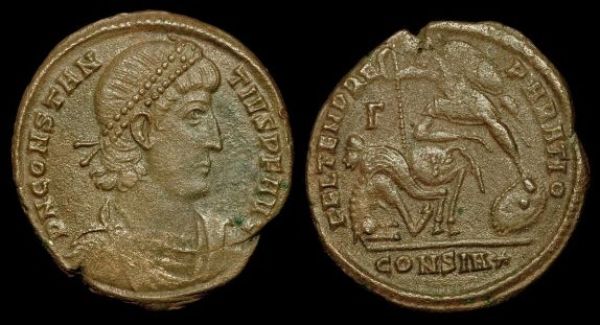 RIC does not list these randomly but attempted to order the issues in the same order they were released based on whatever evidence they could find (weight standards, hoard finds etc.). I do not pretend to understand the process they went through to figure out this order and have no idea if any more recent studies have changed any of it. Neither do I understand why the mint felt the need to change poses or enemy styles on the coins. Perhaps they received word of a victory over a specific tribe and changed the coin to show the current events. Perhaps? |
| |
Replies: 18 / Views: 2,878 |




 Posted 12/07/2011 11:34 am





