The country we now call Romania has historically been divided into three parts: Moldavia in the northeast, Wallachia in the south and Transylvania in the northwest. For most of the last 500 years, these lands have been the frontier between East (the Ottoman Empire) and West (particularly the Austro-Hungarian Empire). Moldavia and Wallachia were Ottoman vassal states; Transylvania was normally under Hungarian rule. The princes of Moldavia and Wallachia (including the notorious Vlad III Dracula, the Impaler) issued their own coins until the mint right was withdrawn in the 1500's; unfortunately, I don't have any for either state.
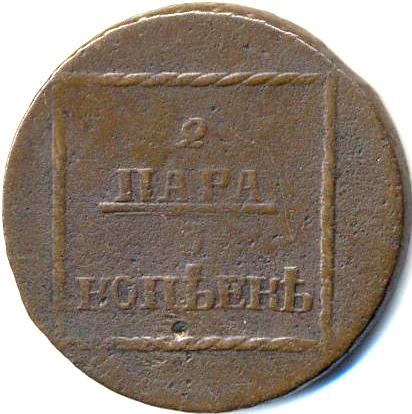
In 1768, the Russian Empire invaded Moldavia and Wallachia as part of their war with Turkey; they were handed back to the Ottomans in 1776, but in the meantime, coins for the Russian "protectorate" were struck. Here is my example, a recent acquisition.

The coin shows the coats of arms of the two principalities: the arms of Moldavia (
an aurochs head) is on the left, Wallachia (an eagle perched on a mountaintop) on the right. The legend reads (in Cyrillic characters) MON. MOLD. E. YALOSK. The reverse simply shows the denomination, in both Turkish units (mine is a 2 para) and Russian units (3 kopeks).
Today, most of these lands are united into the modern republic of Romania - except for the eastern half of Moldavia. After WWII, the Soviet Union decided to "punish" the Romanians for siding with the Axis by re-annexing a little (33,843 km²) piece of Romania. They declared this piece the "Moldavian Soviet Socialist Republic". When the Soviet Union collapsed, Moldavia became independent as the Republic of Moldova. Though there was initially some noise regarding reunification with Romania, the Moldovans are used to their independence now. Their currency is denominated in Romanian units, 100 bani to the leu, and the designs are very similar to Romanian coins.


To complicate matters further, a small region (4,163 km²) on the right bank of the Dniester River, on Moldova's eastern border, refuses to recognise the authority of Moldova. This region, Transnistria, was the only part of Moldova to have been in the Soviet Union before World War II; most of the population there seems to be die-hard Communists who would prefer to rejoin Russia (even though "Russia" is now several hundred kilometres away, on the far side of the Ukraine).
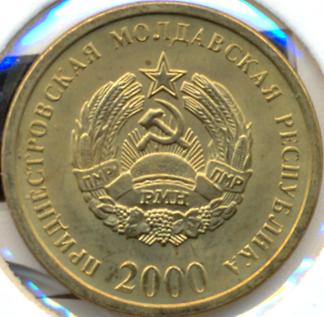
Transnistria's unilateral declaration of independence remains unrecognised by the rest of world. This hasn't stopped them from issuing their own coins, denominated in kopeks and roubles, which are very "Soviet" in design - I believe they are the only coins made during the 21st century to bear the Hammer and Sickle.

Don't say "infinitely" when you mean "very"; otherwise, you'll have no word left when you want to talk about something really infinite. - C. S. Lewis










 Posted 01/14/2007 12:08 pm


