| Author |
 Replies: 7 / Views: 2,702 Replies: 7 / Views: 2,702 |
|
|
Pillar of the Community
United States
746 Posts |
My screen name comes from the German military commander from WWI, General Paul von Lettow-Vorbeck. He led the German forces in East Africa playing a cat-and-mouse game with the English armies that pursued him. It is a fascinating and little-known piece of WWI. Here he is on the back of a piece of notgeld: 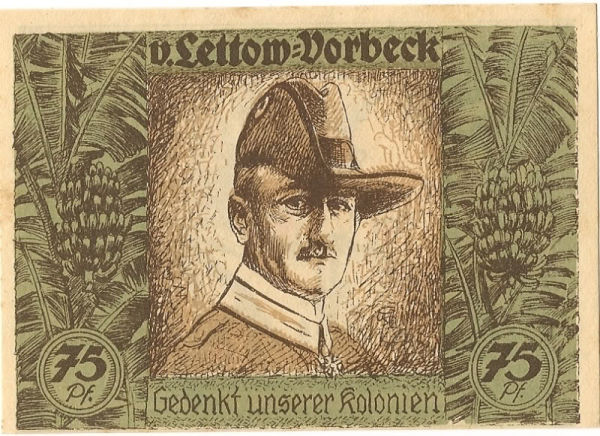 |
|
|
|
Pillar of the Community
Australia
2830 Posts |
thanks for that.
what an unusual denomination: 75 pfennig.
|
|
Pillar of the Community
United States
2605 Posts |
Interesting piece of history. Are you related, lettow, or just a fan?
|
|
Valued Member
Australia
146 Posts |
nice piece lettow - and you are right about not much being known about how WWI played out in Africa - I must admit I am a bit of a WWI buff due to "family" connections but my interest has always centered around the battlefields of France Quote:
One of the most remarkable figures to come out of the Great War was German Major General Paul von Lettow-Vorbeck. He came from a distinguished family in the minor nobility of Pomern, entered the army and saw service in China during the Boxer Rebellion. Prior to World War I he was posted to command the colonial forces in German East Africa (modern Tanzania). When war broke out some wanted to offer little to no resistance but von Lettow was having none of that. He determined to fight and to tie down as many Allied troops as possible so that these forces could not be employed on more vital fronts and throughout the war he did precisely that.
Securing his reputation as one of the most brilliant irregular warfare commanders in history von Lettow defeated, evaded and tied down hundreds of thousands of Allied troops. As impressive, if not more so, than his strategic genius was his ability to supply and sustain his tiny army entirely by living off the land, improvising their own homemade materials and capturing enemy supplies. The combined forces of the British Empire, the Belgian Congo and Portuguese East Africa all failed to corner and defeat von Lettow and his ragged force of African soldiers and German officers. He ended the war with a spotless record, the only German commander to successfully invade British territory, laying down his arms only after he was informed that the German Empire had collapsed.
It was, however, his actions after the war that prompt his inclusion here. General von Lettow was an officer of the old school and while still with the post-war German army he placed his forces at the disposal of the monarchist leaders of the Kapp Putsch. The failure of this effort ended his army career though he could still be prominently seen on military occasions wearing his wide-brimmed colonial hat. The Great War in East Africa was fought with great chivalry and mutual respect and von Lettow became good friends with many of his former enemies. Because of this, Adolf Hitler offered him the post of ambassador to the UK but von Lettow refused to serve the Nazi regime in any capacity.
Because of this Hitler had him placed under strict surveillance (one can also imagine that Hitler was not as enthused as some others about the old general's war record considering that the bulk of his army were Black African soldiers). The Second World War left von Lettow destitute but his former enemies in Great Britain came to his rescue and donated enough money to pay him a pension in his final years. When West Germany recovered he was able to enjoy a comfortable living again and even visited East Africa one last time where he was warmly received by the veterans who had once served under his command. He died in 1964 a celebrated war hero, admired by friend and foe alike and a loyal servant of his king and Kaiser http://madmonarchist.blogspot.com.a...aul-von.htmlEdited by huckles888
02/22/2012 11:12 pm
|
|
Valued Member
Sweden
71 Posts |
Excellent history lesson, and nice note, too.
|
|
Pillar of the Community
 United States
746 Posts |
No, he is not a relative. I was stationed in the middle of nowhere in Korea with the US Army. One of the few books in the library on post was titled Battle for the Bundu which is an account of WWI in East Africa. It led me to collect notes from that colony.
|
|
Pillar of the Community
United States
746 Posts |
As an Australian with an interest in WWI, this coin (I know its one of those hard metal disks, please forgive me) should be of interest. The legend indicates it was part of the stash of Mexican dollars on board the SMS Emden when it was sunk by HMAS Sydney off Keeling in November 1914. The Australians confiscated over 2,000 of the coins and turned many of the into souvenirs. This is a German souvenir. 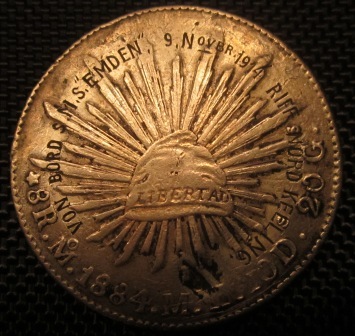 |
|
Valued Member
Australia
146 Posts |
thanks for showing the "metal disk" - an interesting aside - I remember being taught about the sinking of the Emden at school - I believe it was the first (and only) major naval victory for Australia
|
| |
Replies: 7 / Views: 2,702 |
|







 Posted 02/22/2012 6:22 pm





