| Author |
 Replies: 38 / Views: 11,099 Replies: 38 / Views: 11,099 |
|
|
|
Bedrock of the Community
 United States
10045 Posts |
VK, I had a group of those in similar condition--glad it found a home!  This coin is more massive than I expected--it helps me appreciate the presence it had in commerce. TJsCoins, yours is a nice example of the intermediate type, after 393 BC. Mine is older, but I haven't narrowed down a date range yet. Nice centering and details on yours! What does yours weigh? Mine may not be that much larger--24mm is the max width--here's a comparison pic:  |
|
Bedrock of the Community
Australia
21792 Posts |
As can be seen from the size comparison pictures, the tetradrachm is quite a thick coin.
In the hand, a chunk of pure silver like that feels like an honest, real piece of money. That no doubt, helped to contribute to the confidence of Athenian tetradrachms being accepted throughout the ancient Greek World.
|
|
Pillar of the Community
United States
3229 Posts |
Mine is pretty thick. Like I am sometimes.  Below is all the info I have I my coin. And yes its weight does feel really nice in-hand.  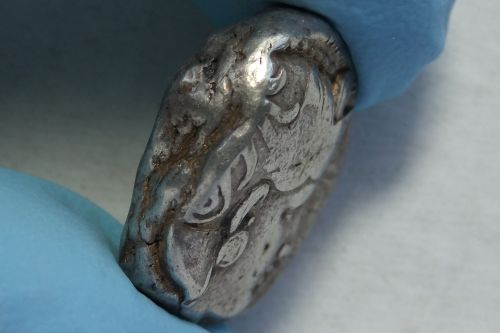 Obverse Greek Silver Tetradrachm, Mint: Attica, Athens, 393-300 B.C.E., wt.: 17.07 g., 22.1 mm: Head of Athena, Goddess of Wisdom, Rt. Facing wearing a crested helmet ornamented w/ three olive leaves & floral scroll Reverse: Owl Standing Rt., Olive Leaves in the Left Field, AOE in Rt. Field Info.: The Greeks commemorated the forming of a democratic system by issuing this type of coin. |
|
New Member
United States
22 Posts |
|
|
Bedrock of the Community
United States
10045 Posts |
Your coin is thicker--and it's full weight! Many of the intermediate style are lighter thank yours. |
|
Bedrock of the Community
United States
10045 Posts |
I took a new picture. I think this better captures both the details and the highlights.  |
|
Pillar of the Community
United States
5155 Posts |
That is truly a gorgeous piece.  I have a special place in my heart for this coin. This is everything you could want in an ancient coin. Its the standard. Magnificent in both size and impression. Your example, of beautiful archaic style. The surface does not detract from the coin at all.  The shear age and numismatic implication of the coin is unparalleled. The mere sight of a such a piece commands respect, loved and copied by all, circulated, tied to the famous building projects of the ancient world its awesome in every way. The coveted bust of Athena, Goddess of Wisdom, Knowledge and War, on the obverse,..on the reverse the beloved owl, patron animal to the Athenians. I enjoyed looking at everybody's tets.  I would also like to share my favorite Athens tet. Attica, Athens 393-294BC AR Tetradrachm 16.90g NGC Certification # 4100608-001 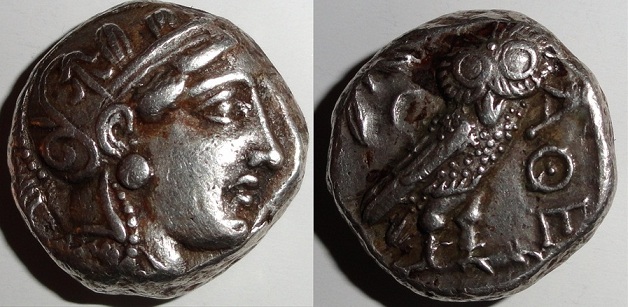 Edited by Ancientnoob
08/15/2012 02:12 am
|
|
Bedrock of the Community
United States
10045 Posts |
Ancientnoob--that's a very nice Athenian tet! It's beautifully centered to capture the whole profile plus some of the crest! |
|
Valued Member
Canada
472 Posts |
|
|
Pillar of the Community
United States
4253 Posts |
|
|
Pillar of the Community
United States
5155 Posts |
That new style is super dee-duper nice , that must have set you back quite a bit.  Very very nice. Edited by Ancientnoob
08/15/2012 12:50 pm
|
|
Pillar of the Community
United States
1316 Posts |
Dionysos, Wow,that's the coin that brought me to Ancients, haven't got one yet....Very nice.... ... you and stevex6 most buy from the same dealer.....  |
|
Bedrock of the Community
United States
10045 Posts |
Wow is right! I especially like the centering and details on the first coin! |
|
New Member
Australia
5 Posts |
Hi Folks
These Attica, Athens coins are certainly one of the most famous coins that collectors can easily find. While for the most part they are not cheap for the high end specimens - there are many affordable examples around. Many people do not realise that these coins were struck abroad in places far from Athens such as Egypt. Because they were minted over hundreds of years its fascinating to track the style changes, minting variations and metal changes throughout history.
Regards
Cameron
|
|
Pillar of the Community
United Kingdom
2121 Posts |
I haven't bought an "old style" that wasn't damaged by test cuts or bankers marks yet let alone gone for a decent example.  I did purchase a decent early intermediate type which bridges the gap between the "old style" and the masses of "intermediate style" coins. The following information was provided by the dealer:- "Transitional style tetradrachms include all of the wide spectrum of variants with the eye in profile issued after the classic "old style" almond eye tetradrachms but before the broad thinner flan "new style" tetradrachms. Recent research has classified variations of the transitional style - Pi Type, Quadridigité Style, Heterogeneous Style and sub-groups of the styles, and proposed chronologies for the different styles and groups. This coin is the earliest transitional type, the first Pi style type, essentially identical to the "old style" with the exception of the eye in profile. The "Pi" designation is based on the P shape of the floral spiral and palmette ornamentation on the helmet bowl. The coin can be classified as Pi style, group 1. The floral ornament on examples this early do not yet resemble Pi."  The intermediate style coins tend to be on smaller flans and thus seem to be more difficult to obtain with full design detail on both sides. Mine was a placeholder.  The non-Athens, imitative coins fascinate me and I had the opprtunity to purchase one from Egypt (with test cut). I am always on the lookout for others but have never been able to obtain one as yet. From the Harald Ulrik Sverdrup Collection. Ex CNG. From a small hoard of 5 Athenian and 4 Athenian imitative issues. Comment provided by dealer- "Athenian tetradrachms with this droopy eye and bent back palmette have been identified as Egyptian imitative issues because they are most frequently found in Egypt and rarely in Greece. Early in his reign the Egyptian Pharaoh Hakor, who ruled from 393 to 380 B.C., revolted against his overlord, the Persian King Artaxerxes. In 390 B.C. Hakor joined a tripartite alliance with Athens and King Evagoras of Cyprus. Persian attacks on Egypt in 385 and 383 were repulsed by Egyptian soldiers and Greek mercenaries under the command of the Athenian general Chabrias. Perhaps these coins were struck to pay the general and his Greek mercenaries."  Martin (not yet an owl-aholic) |
| |
Replies: 38 / Views: 11,099 |








 First Page


 Posted 02/24/2012 4:48 pm


