| Author |
 Replies: 14 / Views: 1,916 Replies: 14 / Views: 1,916 |
|
|
Rest in Peace
1988 Posts |
Hi guys I have two 1966 Canadian fifty cent pieces that have different edges to them...Did not know there were 2 types. I weighed both of them (not with a super accurate scale). 1 - Square edged coin weighs......12 grams. 2 - Bevelled edge coin weighs.....11 grams. Did a CAST (Coin Analysis System Test) that I have been working on and there is not too much difference in frequencies as the pictures below show. 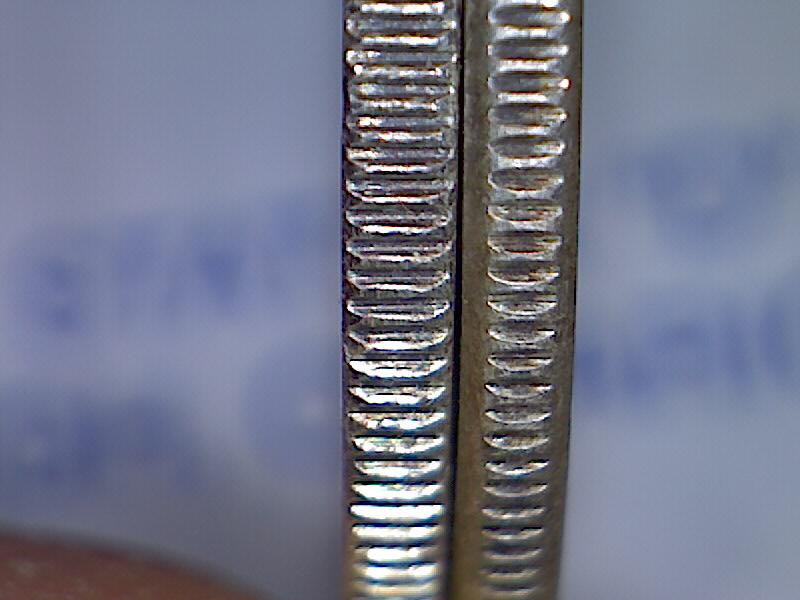 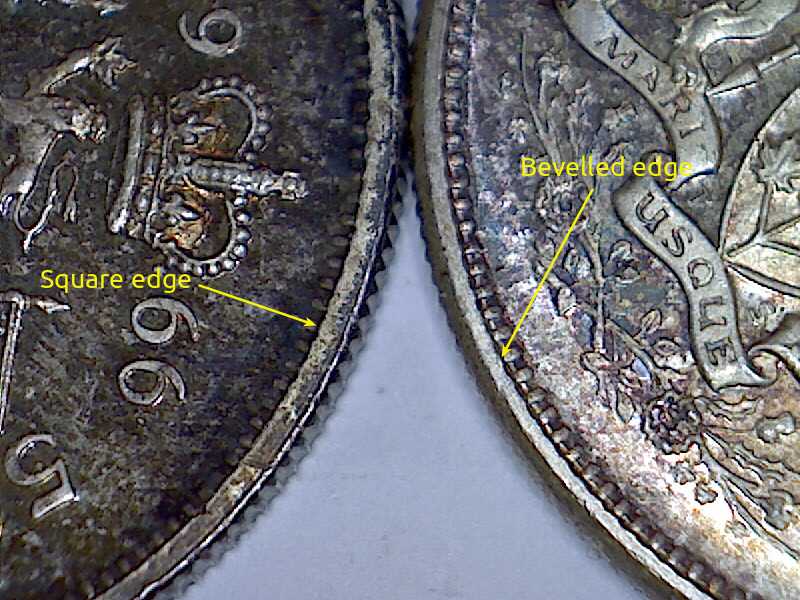 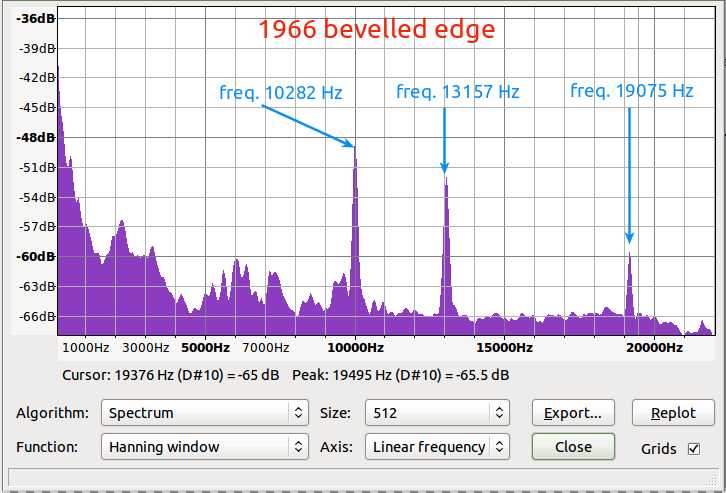 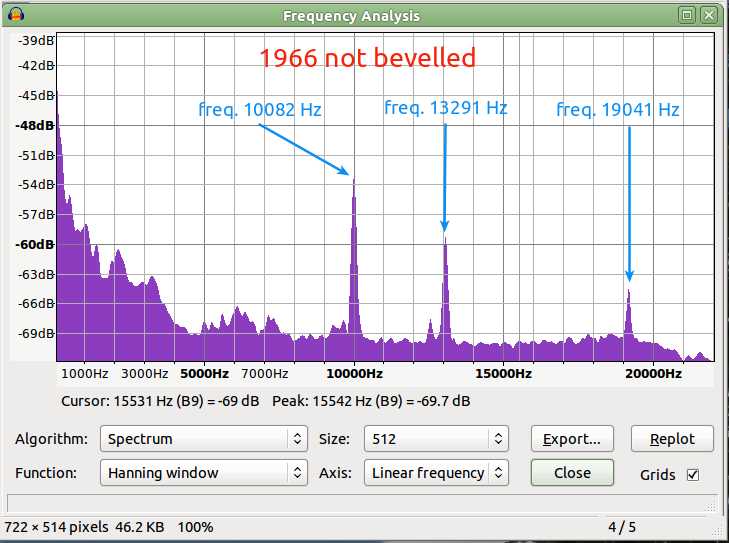 ANY THOUGHTS WOULD BE APPRECIATED. |
|
|
|
Bedrock of the Community
Australia
21794 Posts |
I would rely much more on your ring analysis testing than your admittedly not super accurate scales.
I have some Australian sterling silver florins which exhibit the same bevilled edge characteristic, where most of them do not. On close inspection, the bevilled ones appear to have been bevilled AFTER they were struck, by the Mint.
My guess is that they were adjusted for weight.
On the other hand, it may just be an illegal recovery of silver.(post Mint)
Are there definite stop or start marks on the circumference? My coins show this up quite well.
I note that this pair are silver as well.
The bevilled edging has intrigued me, but not enough to ask why, until now.
|
|
Rest in Peace
 1988 Posts |
Hi sel_69l... I looked at what you wrote about the coin..The only problem is that these coins were collected by my Father from the 40's, 50's, etc...He would not have known to do what you imply..Not being sarcastic, just stating a fact. You are correct about the weigh scale though...  |
|
Bedrock of the Community
Australia
21794 Posts |
I really have no idea if my coins were bevilled by the Mint or that was done later on. My sterling silver florins were issued by the Melbourne mint in 1940. I have not weighed my coins. I am curious enough to have that done now.
Your inquiry had re invigorated my curiousity. Now, I would really like to know as well.
|
|
Rest in Peace
1988 Posts |
Hi sel_69l
My one question is, would silver have been in such a demand back in the 60's as to have some one even try to bevel off pieces...?
|
|
Pillar of the Community
Canada
2303 Posts |
You may consider that 1 is a circulation strike...beveled, and 1 is a PL strike....squared rim.
|
|
Rest in Peace
1988 Posts |
nickelsguy...That is a thought....No big deal then...Well, better luck next time..Eh...
|
|
Bedrock of the Community
Australia
21794 Posts |
From what I can figure, the price of silver in 1960 was approximately $2.50 per ounce. Factored for inflation from that time into current dollar values, that works out to around $20 to $25 per ounce. There was no obvious peak in prices around the early 1960's, that didn't happen until the failed speculation by the Hunt Brothers later on.
In terms of the silver price history around the 1960's per se, I can't see that as the reason for bevelling silver from the edge of silver coins.
Edited by sel_69l
04/02/2012 10:06 am
|
|
Rest in Peace
1988 Posts |
Well said sel_69lI can't see anyone at time time frame chiselling off pieces of silver, when they had the whole coin in their hands to melt down...So I will have to go with nickelsguyQuote:
You may consider that 1 is a circulation strike...beveled, and 1 is a PL strike....squared rim.
|
|
Bedrock of the Community
Australia
21794 Posts |
I now tend to think that the edges were bevelled by the Mint.
That leads to a question:
The 1940 florins I have are bevelled and they were definitely are issued for circulation pieces ONLY. That leads to a question. If the mint bevelled them,
WHY?
|
|
Pillar of the Community
Canada
2303 Posts |
Beveling of circulation strikes is to ease pressure on the dies. PL, Specimen and Proof strikes have much sharper edges to the legends and designs. Different press speeds and pressures etc. etc.
|
|
Moderator
 Canada
10479 Posts |
I concur with nickelsguy, you see the same phenomena with nickel dollars in the 1970s, when comparing business strikes with specimen or PL strikes.
"Discovery follows discovery, each both raising and answering questions, each ending a long search, and each providing the new instruments for a new search." -- J. Robert OppenheimerContent of this post is licensed under a Creative Commons Attribution-NonCommercial 3.0 Unported License. See: http://creativecommons.org/licenses...0/deed.en_USMy eBay store
|
|
Rest in Peace
1988 Posts |
So...Let me get this straight...Both "squared" and "bevelled" edges were put out into circulation...?
If so, what would be the ratio...?
|
|
Pillar of the Community
 Canada
9909 Posts |
Is the edge bevelling done when the planchet is rimmed? If so why does the metal not flow to fill the collar? The bevel can't be in the die or collar. Where's Ugly when needed?
|
|
Bedrock of the Community
Australia
21794 Posts |
It seems that in the case of my coins of 1940, my first guess re weight adjustment could be right. I have seen quite a few florins around this time with the same characteristic.
With my coins, the bevelling appears to have been done by the Mint after striking but before issue, by reason of the way the markings left behind by the bevelling process. However I am still open to the idea that the the planchets were prepared that way before striking.
Edited by sel_69l
04/03/2012 03:23 am
|
| |
Replies: 14 / Views: 1,916 |
|







 Posted 04/01/2012 5:19 pm


