| Author |
 Replies: 273 / Views: 40,455 Replies: 273 / Views: 40,455 |
|
|
|
Pillar of the Community
 United States
1549 Posts |
Ranking 24th on my list as of the moment is a Greek bronze from Pergamon in Mysia. The 2nd century BC AE18 shows a head of Aesculapius (Asklepios) and a snake (his animal of choice later shown wrapped around a staff as the sign of the medical profession). Here, however the snake is wrapped around the omphalos (navel of the world) but that feature is hard to see on my coin due to the countermark of an owl which is what elevated this coin to position 24 on my list. I like the coin and I like the countermark but what I really like is the positioning of the countermark so perfectly on the snake that it looks like an x-ray of the swallowed owl. I like countermarked coins but prefer my countermarks well placed. This does flatten a bit of the god's face but we can not expect perfection in every regard on a $20 coin (1998 price). I'd pay more today. I'll offer a link that shows a few other examples with the same countermark to make the point that mine is well placed. http://www.acsearch.info/search.htm...iew_mode=1#0The Greek legend reads "to Asklepios the Savior" and is interesting in that it names the god sacred to the city rather than the city itself or a ruler. Unfortunately my specimen is missing the first letter of both words but you may note that this type is not common on a broad flan. I do not know why the owl countermark was applied. If someone can find that answer, please post. This is not the best countermarked coin that made my list and not the only Greek bronze. It is not the nicest condition coin; it is not the rarest. It is just an example of how all the factors that might make a coin appealing can work together to elevate a coin in many ways ordinary to a special position (if only #24). 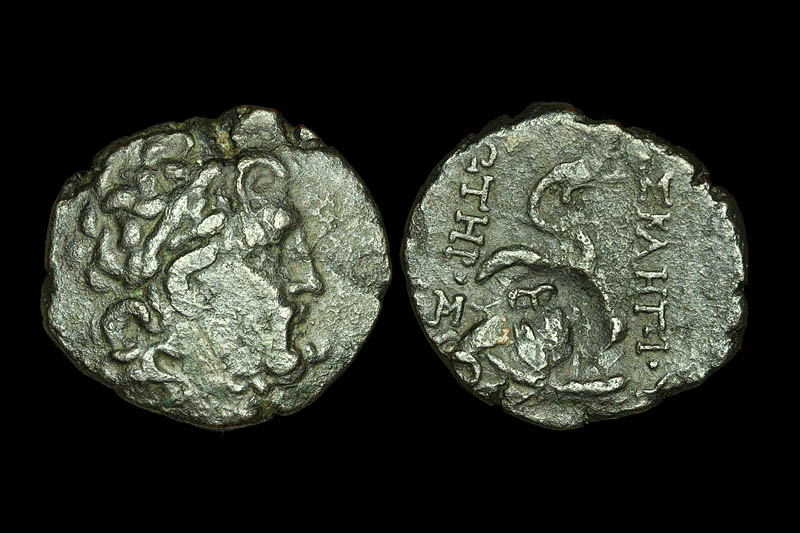 |
|
Pillar of the Community
United States
4253 Posts |
An interesting coin and most interesting description.
|
|
Pillar of the Community
3352 Posts |
 I agree that the owl countermark is extremely cool, even if it does make Asklepios' face look like it's pressed-up against the car window!! ... and honestly, even that is pretty cool!! ==> awesome coin!! Asclepius <=> Asklepios Edited by stevex6
05/10/2012 9:38 pm
|
|
Bedrock of the Community
United States
10045 Posts |
I like the owl countermark too  Interesting how Pergamon and Athens depict owls on their coins. |
|
Pillar of the Community
3352 Posts |
Quote:
Asclepius is the god of medicine and healing in ancient Greek religion. Asclepius represents the healing aspect of the medical arts; his daughters are Hygieia ("Hygiene", the goddess/personification of health, cleanliness, and sanitation), Iaso (the goddess of recuperation from illness), Aceso (the goddess of the healing process), Aglæa/Ægle (the goddess of beauty, splendor, glory, magnificence, and adornment), and Panacea (the goddess of universal remedy). Quote:
Asclepius was associated with the Roman/Etruscan god Vediovis. He was one of Apollo's sons, sharing with Apollo the epithet Paean ("the Healer"). The rod of Asclepius, a snake-entwined staff, remains a symbol of medicine today. 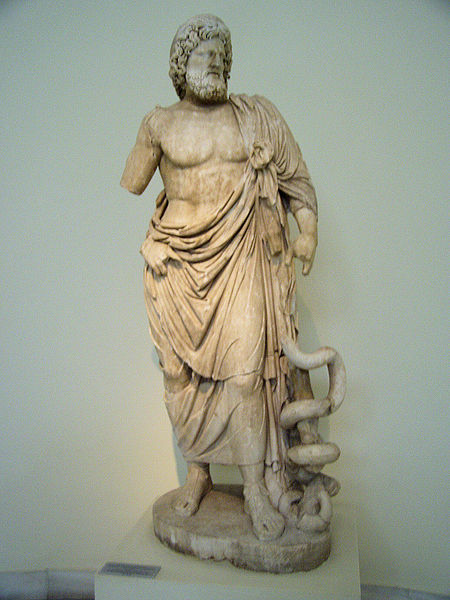 |
|
Valued Member
United States
422 Posts |
I'm going to interject a correction here that I remember reading about the rod of Asclepius as it is known here in US. We see the rod emblazoned on doctor's offices and different medical insignias in many areas that deal with the medical profession. But look closely. The snake is not singular, but plural. Another words there are two snakes, not one as on the rod of Asclepius. Here lies the rub: Quote: ' The caduceus is sometimes mistakenly used as a symbol of medicine and/or medical practice, especially in North America, because of widespread confusion with the traditional medical symbol, the rod of Asclepius, which has only a single snake and no wings.' This rod is actually the rod of Hermes, the god of merchants, thieves, robbers, and was a messenger of the gods! It is called the 'Caduceus'. I believe it was first used by the US medical corp during World War II and the person that designed it didn't do his homework or he thought it look more symmetrical with two snakes. So the Caduceus has taken the place of the rod of Asclepius in the modern era. How very interesting!  Actually after researching this a little further it seems like the medical corp started using the caduceus back as far as 1902. The split between using the caduceus and asclepius is about even between the different medical associations today. And of course the coin shown Doug is very nice. Being on the bottom of the list, I can't wait to see your favorites! Edited by oxos
05/10/2012 11:58 pm
|
|
Moderator
 United States
23731 Posts |
|
|
Pillar of the Community
United States
2596 Posts |
Another nice coin. I like the color and that's a neat counter mark.
|
|
Pillar of the Community
United States
1549 Posts |
I'll go off the menu here to show two coins that relate to oxos' post but did not make the 25 list. Both are Provincials of Gordian III. One from Nikopolis shows Hermes while the other from Hadrianopolis shows Asklepios. The snake count difference is clear. 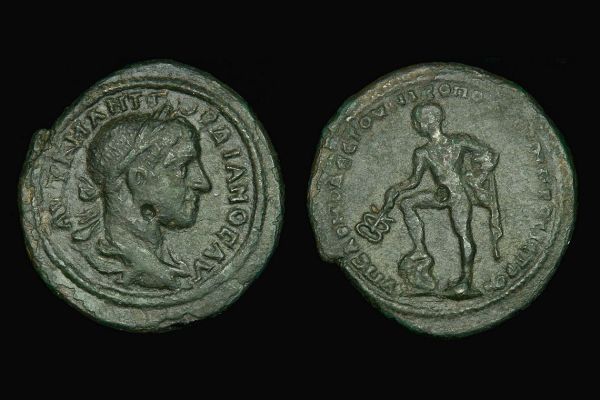 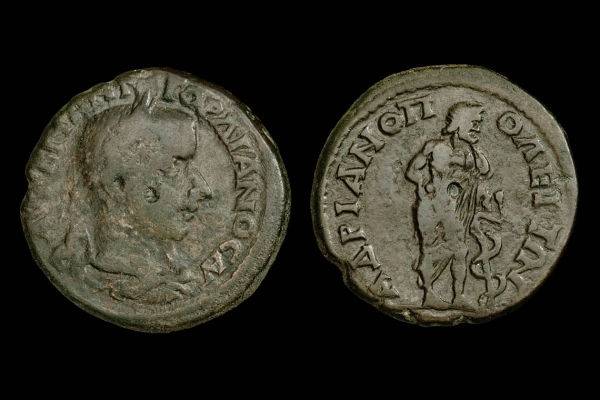 |
|
Pillar of the Community
3352 Posts |
darn that wikipedia => it led me astray!! (good catch, oxos)
|
|
Pillar of the Community
United States
1315 Posts |
About the countersmark on the Aesculapius coin above: The countermark on the coin was carefully placed as to not completely alter the image of the snake and to blend in with it, and also to minimize the damage to the obv. image (i.e. only the cheek not the nose, mouth, eyes etc). I have a Pergamon coin with the owl countermark https://goccf.com/t/111037&SearchTerms=pergamon that is also carefully placed as to not damage the face on the obv. and minimize the the effect on the rev. Why? I have the opinion that, in our times today we see the images on these coins, statues, art ,etc. as symbols that 'represent' the Gods, but in ancient times they saw the images 'as' the Gods (the word for this escapes me at the moment) thus they went to great care to place the countermark in an area not to insult the God or his/her attributes on the opposite side. Whether this opinion holds water I don't know. Nevertheless whoever counterstamped the coins seemed to be quite careful to make the countermark an integral part of the coin. |
|
Pillar of the Community
United States
4253 Posts |
Quote:
Whether this opinion holds water I don't know Sounds likely to me. |
|
Bedrock of the Community
United States
10045 Posts |
Quote:
but in ancient times they saw the images 'as' the Gods (the word for this escapes me at the moment) thus they went to great care to place the countermark in an area not to insult the God or his/her attributes on the opposite side. Your theory sounds true to me too. Our use of classic Greco-Roman gods today is largely decorative, but in ancient times they were taken seriously; they did not want to offend them. There were strict rules of behavior at temples too. Two nice examples that show the difference of the rod of Hermes and the rod of Aesculapius--I get it now. Edited by DVCollector
05/11/2012 12:29 pm
|
|
Valued Member
United States
422 Posts |
Both examples of Gordian III could easily be included in ones 25 best Doug. Very nice detail. I believe your theory on why the counter marks were placed where they were is very sound Doucet. These folks held their god's in high regard and wouldn't want to get cursed by sticking the mark on them! As to the rod's of Asclepius and Hermes (caduceus), it was one of those things I remembered reading about not too long ago. I have so very limited knowledge of these coins, I just couldn't help but want to add something to the thread. BTW the quote I used came from Wikipedia Steve! So you never know what you find there!  Edited by oxos
05/11/2012 4:27 pm
|
|
Pillar of the Community
United States
3229 Posts |
Nice Asklepios! I am in a health related field and have had an eye out for one that I like. BTW...cool thread! I dig the history, mythology, etc! |
| |
Replies: 273 / Views: 40,455 |






 First Page


 Posted 05/10/2012 9:09 pm





