There were roughly 6 denominations minted. The screwy part of hacienda pieces is most people think backwards when dealing with tokens, and assume there are more lower denomination pieces than there were large. That actually isn't the case. The owners would mint as few lower denomination pieces as possible, so that they would be unable to make change, and the peasant would have to buy more. For example, if the peasant worked for 6 days a week, and made a half a real a day, you didn't want to give him any halves. You wanted to give him 1 coin of 3 reales, if possible, or a 1 real coin and a two. That way, he was forced to buy more than he probably wanted, in a captive market.
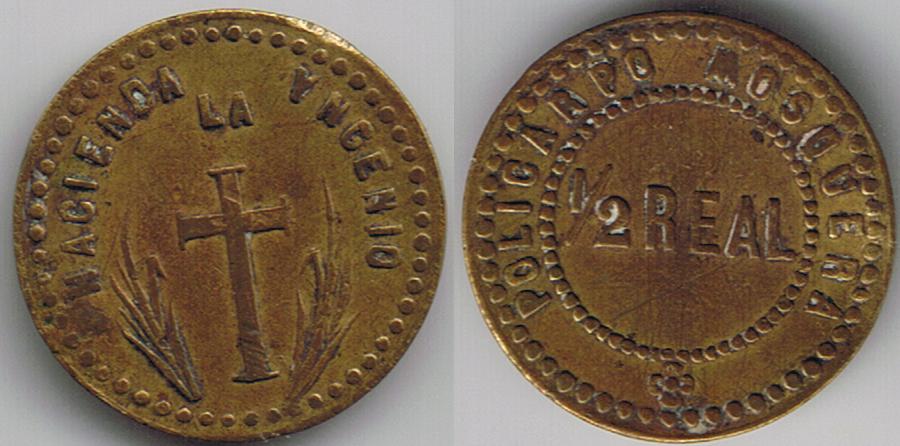
Your example is definitely better than those 2 reales I see being listed right now, and by all rights, should be worth more than they are, both because of condition, and frankly, because the lower denominations are rarer. Unfortunately, you have an awesome piece, that I would be thrilled to own, but you have to deal with the quirkiness of the market, where people "think" a higher denomination is better.
Here is a cut and paste, and basic translation from the site I mentioned above that shows the information from the book on Venezuelan tokens...
SHEET CROSS YNGENIO HACIENDA
REAL 2
no date
on page 80 of "tokens, signs and webs of Venezuela"
Lagoven book, the author geologist Gorgias Garrigue, it states:
"with the cross. this Mosquera Polycarp was owned
and remained in the population of the council.
issued with a series of at least 6 tokens of different denominations of excellent workmanship and beautiful design.
the tokens are made of brass, decorated with a cross,
name of wit and surrounded by cane palms sugar. "
While I can't back it up right now, I have a strong suspicion that this hacienda was in the Mosquera family, which included presidents of Gran Columbia, and Columbia. If such an association can be established, the value is certainly much, much higher.
Edited by JMerrick
08/06/2012 1:05 pm









 Posted 08/06/2012 01:49 am





