Coin Community Family of Web Sites Join Thousands of Coin, Bullion, & Money Collectors
Coin, Banknote and Medal Collectors's Online Mall Vancouvers #1 Coin and Paper Money Dealer Royal Estate Auctions - $1 Coin AuctionsJoin Thousands of Coin, Bullion, & Money Collectors Royal Canadian Mint products, Canadian, Polish, American, and world coins and banknotes. Specializing in Modern Numismatics 300,000 items to help build your collection!


Username:
Password:
Save Password
Forgot your Password?


This page may contain links that result in small commissions to keep this free site up and running.

Welcome Guest! Registering and/or logging in will remove the anchor (bottom) ads. It's Free!

Ferdinand VII 8 Reales - 1821 - Zacatecas. Or ... ?

To participate in the forum you must log in or register.
Author Previous TopicReplies: 24 / Views: 6,084Next Topic
Page: of 2
Pillar of the Community
wonghinghi's Avatar
Hong Kong
1270 Posts
 Posted 09/08/2012  02:12 am  Show Profile   Bookmark this reply Add wonghinghi to your friends list Get a Link to this Reply
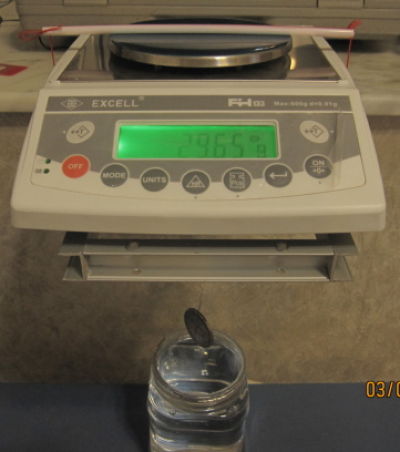
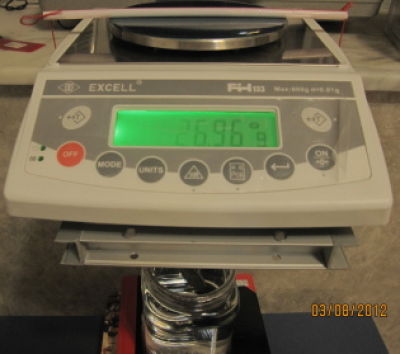
Pertinax, I am happy to tell you how I can measure the S.G. of my coin. This is the method learned from swamperbob. The principle is based on Archimedes's law of buoyancy.

Hardwares (shown below):

1)An electronic scale with two decimal places
2)Distilled water
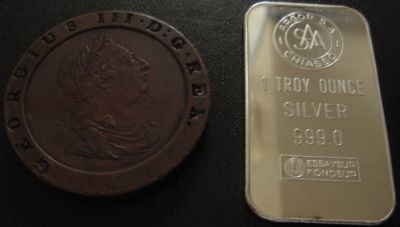
3)Two standards: 1797 2D cartwheel (0% Ag) and a .999 Sterling silver (100% Ag)

Ferdinand-VII-8-Reales---1821---Zacatecas.-Or-...-?

Ferdinand-VII-8-Reales---1821---Zacatecas.-Or-...-?

Ferdinand-VII-8-Reales---1821---Zacatecas.-Or-...-?

Data:
1)Weight of the hanger 1.72g
2)Weight of the iron wire 0.23 g

In air(A) Net wt(N) In H2O(W) A-W S.G. %Ag

100%Ag 33.11 31.16 30.12 2.99 10.46 100

0% Ag 57.0 55.05 50.79 6.21 8.88 0

My 1820 28.8 26.85 26.17 2.63 10.248 86.8

Calculations:

N = A - 1.95 1.95 = Weights of hanger + wire

SG = N/(A-W-0.01) Suppose the floating effect caused by
wire wound around the coin
Pillar of the Community
wonghinghi's Avatar
Hong Kong
1270 Posts
 Posted 09/08/2012  02:46 am  Show Profile   Bookmark this reply Add wonghinghi to your friends list Get a Link to this Reply
Sorry for a careless mistake in posting my reply, I re-list my data here to explain my calculations

Data:
Hanger+wire = 1.95g

Std 1 : 100% Ag ;
Std 2 : 0% Ag
My 1820 : ?%

In air (A)-- measured by the scale dirctly
Std 1 :33.11g
Std 2 :57.0g
My 1820 : 28.8g

Net wt (N) N=A-1.95
Std 1 :31.16g
Std 2 :55.05g
My 1820 : 26.85g

In water (W) --measured by the scale directly
Std 1 :30.12g
Std 2 :50.79g
My 1820 : 26.17g

A - W
Std 1 :2.99g
Std 2 :6.21g
My 1820 : 2.63g

S.G. {SG=N/(A-W-0.01)}
(There is an assumption that the wire winding the coin exerts a floating effect to the system, so we suppose it is 0.01g arbitrarily)

Std 1 :10.46
Std 2 :8.88
My 1820 : 10.248

As this is a linear graph so I don't plot a st. line to read the %Ag of my coin but to calculate it by the following formula:

%Ag = (SGtest-SGSTD2)/(SGSTD1-SGSTD2)
So the %Ag of my 1820 : 86.80%

I am sorry that I can list it as a table (I don't know how to do that), I hope you can put your patience to read my data and calculations.

Pillar of the Community
swamperbob's Avatar
United States
5362 Posts
 Posted 09/08/2012  4:04 pm  Show Profile   Bookmark this reply Add swamperbob to your friends list Get a Link to this Reply
For XRF tests to be useful they must disclose trace elements to the level of 10 or 20 parts per million. A tester that reads to 1% plus or minus is WORTHLESS for authentication.

The theory behind XRF testing is that there are elements in any coin that are "contaminants". A silver / copper alloy will contain far more than 2 elements when analysed. That is simple fact. But there are some elements that should or should not be present based on the origin of the silver and the methods employed in extracting and refining the silver. These factors change over time AND when forgers get involved they usually vary WIDELY.

While tests on specific coins still need a good deal of experienced interpretation there are elements always found in early 8Rs from Mexico that are missing in later made coins and those made in Spain or South America even in the same period.

What specifically all those trace elements are is not, nor should be public knowledge. Once published that data changes the playing-field and counterfeits made AFTER the data becomes well known - could be corrected.

At present there is one very common contaminant that is extremely well known to forgers and authenticators BOTH because of previous publication of data. That contaminant is GOLD. Silver mined anywhere that was extracted using the patio process and refined by cuppellation did not remove all the gold from the silver. Therefore to have been made in Mexico in say 1820 a silver coin MUST contain some gold. How much? I am not saying.

The study results that define the upper and lower limits of this range are at present being retained as proprietary data to protect the integrity of the process. If the forgers want to get the same information let them spend a few $100,000 and get it themselves.
Pillar of the Community
Pertinax's Avatar
United Kingdom
2134 Posts
 Posted 09/08/2012  4:33 pm  Show Profile   Bookmark this reply Add Pertinax to your friends list Get a Link to this Reply
That's interesting and useful to know, and I can
see why it you want to hold onto it.

However, I doubt it's worth anything like $100,000.

If I wanted the information badly, I could buy 50 known genuine coins and do the analysis myself.

If I could be sure of a sufficiently random sample, I could reduce my sample to 30 specimens.
Pillar of the Community
swamperbob's Avatar
United States
5362 Posts
 Posted 09/09/2012  2:48 pm  Show Profile   Bookmark this reply Add swamperbob to your friends list Get a Link to this Reply
Pertinax I think 50 would be a bare minimum unless you were planning to do just one very brief period at one mint. As I noted there is a range of variance seen even in coins of the same date from the same mint. The limit of the permissible range of variance is the most critical factor when you view several elements in relation to one another.

Also the apparatus to do the testing will run near $100k without training. As an alternative you can of course hire the testing to be done. A professional XRF test in a lab still runs near $50 for each test - it may come down with volume.

So even if your 30 tests was enough to establish the range accurately that would cost you $1500 just to discover a proper mix.

Then you would need to test each of your component metals to see what trace contaminants you get in each of them. By mixing "pure" silver and "pure" copper today you still end up with that digit AFTER the .999 fine which consists of impurities. Silver is 0.999 fine commercially - but you should do an XRF to see if it actually that close. That 0.001 is one ten thousandth or 10,000 millionths or 10,000 ppm. It could theoretically contain 50 different contaminant elements each at a density of 200 ppm or more. How many of those DO NOT belong in your mix and how do you get rid of them? That is a lot of area to hide a 10 ppm contaminant that does not belong. So getting the elements pure enough is a hurdle. Copper being less valuable is commensurately less pure.

In addition, remember that a typical original 8R has a list of anywhere from 7 to 12 contaminant elements (excluding the lighter elements like Aluminum). You might need to add one or two of those to any random batch. Where do you get pure Tungsten or Iridium or Cadmium and who can make a mix that contains only 50 ppm Cadmium anyway?

And on top of this you need to cast, roll, laminate, cut, adjust, edge, pickle and anneal your metal before you get to strike it. Each step has the threat of contamination which could void your work up to that point.

The technical issues of creating the perfect alloy from raw metals currently available is at present nearly insurmountable. That is why some specialists do advocate FULL RELEASE of test data.

But for now we are not to the point of release.

Of course, in doing the foregoing you would have missed a far cheaper solution.

Anyone care to hazard a guess?
Pillar of the Community
Pertinax's Avatar
United Kingdom
2134 Posts
 Posted 09/09/2012  3:23 pm  Show Profile   Bookmark this reply Add Pertinax to your friends list Get a Link to this Reply
Well,
the forgers could just buy worn specimens. melt and cast or restrike, but that wouldn't be so profitable.
Pillar of the Community
swamperbob's Avatar
United States
5362 Posts
 Posted 09/09/2012  3:28 pm  Show Profile   Bookmark this reply Add swamperbob to your friends list Get a Link to this Reply
That is the solution but for obvious reasons the target would of necessity be common date coins NOT the rare stuff and the margin is very low.

But isn't that the objective of authentication - to leave no place for the forgers to operate at huge profits?

The junk fakes that pass today cost as little as 1 cent to make and bring $30-50. That is what NEEDS TO GO.
Pillar of the Community
wonghinghi's Avatar
Hong Kong
1270 Posts
 Posted 09/10/2012  09:13 am  Show Profile   Bookmark this reply Add wonghinghi to your friends list Get a Link to this Reply
Thank you, swamperbob, your two latest replies are so knowledgeable, they let me know more about XRF. If I am a forger, I don't think I would buy the old coins to re-make them. It is so cumbersome! I would make some popular species and sell them at the tourist spots. This is the way of getting largest marginal profit.
Pillar of the Community
swamperbob's Avatar
United States
5362 Posts
 Posted 09/10/2012  7:41 pm  Show Profile   Bookmark this reply Add swamperbob to your friends list Get a Link to this Reply
Henry - Forgers are doing what they do for profit.

If the profit margin can be reduced there will be fewer forgers attracted to the business.

Now all we need is a cheap way to do just that.
  Previous TopicReplies: 24 / Views: 6,084Next Topic
Page: of 2

To participate in the forum you must log in or register.


Disclaimer: While a tremendous amount of effort goes into ensuring the accuracy of the information contained in this site, Coin Community assumes no liability for errors. Copyright 2005 - 2026 Coin Community Family- all rights reserved worldwide. Use of any images or content on this website without prior written permission of Coin Community or the original lender is strictly prohibited.
Contact Us  |  Advertise Here  |  Privacy Policy / Terms of Use

Coin Community Forum © 2005 - 2026 Coin Community Forums
It took 0.34 seconds to rattle this change. Forums