| Author |
 Replies: 18 / Views: 2,488 Replies: 18 / Views: 2,488 |
|
Pillar of the Community
United States
5155 Posts |
Roman Empire Severus Alexander?  (2.88g) Appears to be silver.  obv. Severus Alexander ? SEVERVOAVO? PART ? MAX rev. Athena Spear/ Shield ? IMP LIIII ? OIII PP Maybe someone can tell me something about this one, I have about six of Roman coins I just haven't got to attributing, they all appear to be silver but greatly vary in weight. from about a gram to like 3 grams. This one is def attributable. I know there is a bunch of guys here who live for this stuff  Thanks guys...gals 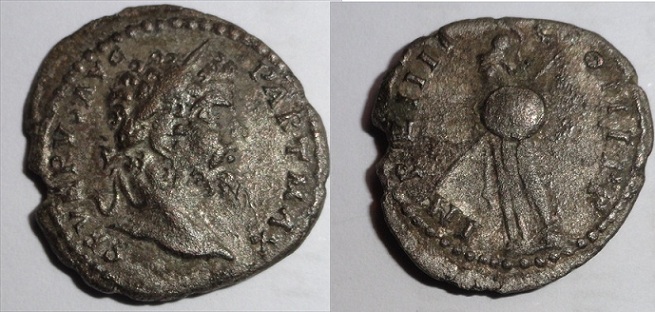 Edited by Ancientnoob
08/11/2012 6:36 pm
|
|
|
|
Pillar of the Community
United Kingdom
2838 Posts |
Looks like Severus to me - the reverse is probably Minerva.
Not got a 100% ID for it yet though.
|
|
Pillar of the Community
United Kingdom
2838 Posts |
I should add, Septimius Severus not Severus Alex  |
|
Moderator
 United States
23731 Posts |
A denarius of Septimius Severus: SEVERVS AVG PART MAX. I can't make out the reverse legend or match any of the letters to a reference. The reverse is Minerva stand left hold shield and spear.
|
|
Pillar of the Community
United States
1549 Posts |
Certainly Septimius Severus but from the style, I suspect a barbarous copy.
|
|
Pillar of the Community
 United States
5155 Posts |
Interesting Barbarous copy. Maybe that explains the odd legends. I too looked and came up empty handed.
|
|
Pillar of the Community
United States
4253 Posts |
I have searched through RIC and cannot seem to put the obverse legend with the reverse legend. Perhaps Doug is correct.
|
|
Pillar of the Community
United States
5155 Posts |
The art looks rather nice for a barbarous copy don't you guys think. Most of these things are traditionally pretty crude, eh? Is it possible to pin down the source if it is barbarian. Is there a good book that covers barbarous types?
Edited by Ancientnoob
08/11/2012 7:30 pm
|
|
Pillar of the Community
United Kingdom
2838 Posts |
Its sometimes difficult to tell where the official / unofficial line is on barbarous coins. The space between black and white is occupied by all different shades of grey! Some can no-doubt pass as official whereas others jump out at you. I guess its due to who made them and why they were made, undoubtedly some will have been made by the same 'Roman' celators who produced the official coins whereas others were made by untrained, none Latin speakers who didn't understand what they were copying. I found these examples posted by Martin on another forum: http://www.ancients.info/gallery/sh...php/cat/3414 |
|
Moderator
United States
23731 Posts |
The reverse legend doesn't match the reverse design, though the coin doesn't have the crude appearance of a barb and doesn't look like a fouree it could still be an unoffical issue. It's could also be one that has not been listed in RIC.
|
|
Pillar of the Community
United States
5155 Posts |
Maybe this one was made by a disgruntled employee? That's wild too.
Unlisted- that would be desirable also.
Edited by Ancientnoob
08/11/2012 9:38 pm
|
|
Pillar of the Community
United States
5155 Posts |
So any body know what this high quality Barbie is worth? IS it comparable with a official denarius or does this carry a premium for being "UNLISTED" in good shape and of semi-high quality?
|
|
Pillar of the Community
United States
4253 Posts |
I'm not convinced it's a barb. I'm more inclined to say it is unlisted or "not in RIC". On forumancientcoins.com there is a discussion board for "not in RIC". Perhaps you can find something about it there.
|
|
Pillar of the Community
United States
5155 Posts |
Yea maybe I will head over their with the coin and see what people have to say.
|
|
Pillar of the Community
United States
5155 Posts |
Well I got on one response from FORVM and the gentleman said it was what he believed to be a "LIMES" denarius. Now to my understanding LIMES refers to low quality "silvered" coinage used by the garrisons in the far fringes of the empire. If anyone can add anything to that, it would be appreciated. Do others disagree with this "LIMES" Assumption. If so would it be possible to place the coin at a location or with a particular region and or legion?
|
|
Pillar of the Community
United States
4253 Posts |
I found this reference in Numiswiki: Quote:
These are thought to be coins minted either officially or pseudo-officially on the fringes of the empire out of necessity. Perhaps they were used to pay soldiers on the extreme frontiers of the Roman territories or maybe to bolster the economy of regions far from the normal means of monetary distribution. Whatever the reason, many of these coins exist.
According to Doug Smith's postscript to The Vocabulary of Classical Numismatics, many Roman coins can be classified as "coins of necessity":
Of uncertain status are thousands (millions?) of surviving bronze coins of the Severan era that copy silver denarii. Some examples still bear traces of a very thin silver wash... Termed Limes (Lim-ace) or coins of the borders, these may be another example of coins of necessity. They may also be officially sanctioned issues for use in regions where political unrest made it hazardous to ship large amounts of silver. These low value issues could have served troops on the front and been redeemable for good coinage when they returned to the stable regions.
The name "Limes Denarius", although a misnomer, has been applied to these so often that it has stuck. Here again, although we know that these AE denarii are more or less faithful copies of silver prototypes, and we know that they were both struck and cast in various places - we even have numerous molds and forgers' dies - we don't understand the role, if any, they may have played in the official monetary system. Were they copies made by semi-Romanized folks just outside the reach of empire? - folks who had become accustomed to the use of coin but who did not have access to official supplies? Were they a form of military scrip meant to keep large quantities of precious metal from falling into enemy hands in the event of a defeat - and presumably redeemable in good coin at some future date? Were they out-and-out counterfeits? Were they particularly debased official issues? (well, the cast ones probably weren't) Or did they fill some, as-yet unknown function? They might have done any or all of these at various times and places. I also found this reference on forumancientcoins.com from one of the contributor's there named BeastCoins: Quote:
This enigmatic little piece belongs to a group of coins referred to as limes denarii, limes falsa or AE denarii. There are numerous theories as to their purpose. Some believe they were minted in the outskirts of the Roman Empire to circulate there. Some contend they are non-Roman imitative (barbarous) types. One theory I have is they were made for the soldiers defending the outer regions of the empire, paid to them in lieu of silver, in the event the territory was lost. This would not have not enriched an enemy victor of a lost region with silver or gold. With my theory, these AE pieces could, if a soldier returned to a main part of the empire in retirement or if an area was forfeited, could in turn be redeemed for equivalent AR denarii, just as US soldiers used scrip during foreign wars. We will probably never know their purpose, but they can be found in excellent condition and are very collectable.
Another unusual aspect of this piece is the obverse legend. No such legend was used on official Roman coins, but it has been proposed this piece may have meant to read IMP ALEXAN_DER PIVS AVG, but the P is missing in PIVS.
Something to keep in mind is that some limes denarii do not have official Imperial equivalent types. Or, perhaps, they simply have not been found yet, but I have had examples that if they were silver, they would be unlisted in RIC.
The last paragraph is interesting when applied to your coin. |
| |
Replies: 18 / Views: 2,488 |







 Posted 08/11/2012 6:44 pm





