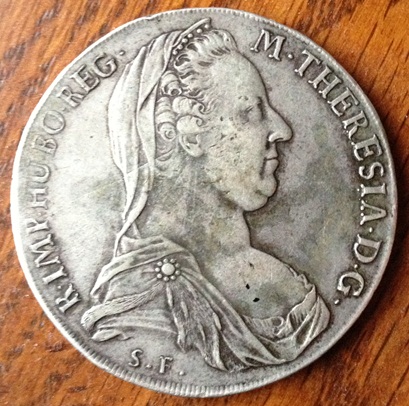
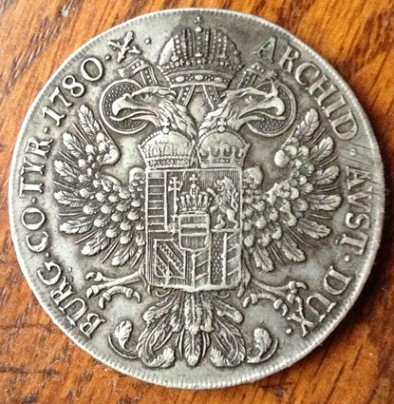
Your coin is from the Venice mint and is a rare sub variety ( well done) Have a look at the obverse. First off you will see the brooch is round ( Modern re-strikes have an oval Brooch) that is the first Italian mint indicator. Now look at the reverse: you will see ( it may take a little bit of thinking about to understand what I write here) the tail feather formation is 1-2-1
meaning: 1 feather to the left, then two feathers arranged vertically on the center line and then one feather to the right. the next identifier is the saltire ( X after the date) there are dots either side (also an Italian mint indicator) Now how do you know its Venice? Look at the Obverse specifically the "M" in the 1 O'clock. The legs of the M are angled outwards And this is regarded as being the Venice indicator ( Milan has non-angled legs ie: "Perfectly" vertical).
Now the important part: why is yours a rare sub variety Again on the obverse count the pearls in the diadem ("Tiara" if you like) there are 6 on your coin the standard at the time this coin was minted (1817-1833)was seven. So your MTT is Hafner 37b
http://www.theresia.name/cgi-bin/To...&Language=enThe value on the link above is a little out of date Your coin could, in Europe, fetch the UNC value listed in the Link ( although it,IMHO, rates a grade of VF tending to XF)
Now a comment of caution on the attribution: I have just outlined the accepted attribution to Venice however my research ( extensive)
Suggests this Venice type actually started being produced in Guenzburg in 1793. This doesn't effect the market value of your coin. Have a look at Hafner 5 in the link (above), a 19th century Expert quoting now lost mint records reported that that coin was produced in the third quarter of 1793.
Additional note:
There is further identification information on the edge of MTTs. On your discovery look at the cross like device....that is a Guenzburg specific decoration(continued on Milan and Venice strikes until around the 1840s when the Vienna mint edge decorations took over. The currently accepted( not necessarily correct) view is the Italian mints have a dot in the center of that small device.










 Posted 01/10/2013 8:50 pm


