| Author |
 Replies: 12 / Views: 3,663 Replies: 12 / Views: 3,663 |
|
|
New Member
United States
9 Posts |
I keep losing my post before it is submitted. I'll try again. Can somebody please help me identify this medal. Probably Jesus on the front or Moses. The back (reverse) is the Ten Commandments. Era? It is about the size of a US quarter.   |
|
|
|
Pillar of the Community
United States
864 Posts |
The NI Bulletin for July 1998 has a brief piece about a medal or amulet picturing Moses with the Commandments, but it's substantially different from this one. And I don't read Hebrew, so I'm not sure if the lettering & language are correct.
My gut feeling is Germany or Italy, 19th century, carried as a sort of "luck piece" by Christians (not Jews). But that's almost pure speculation.
|
|
Pillar of the Community
United States
3253 Posts |
The image is indeed Moses, as is evident from the horns visible on the figure's head, a commonly-encountered depiction of Moses in medieval and Renaissance art, based probably on a mistranslated Bible verse. Here are a few examples: 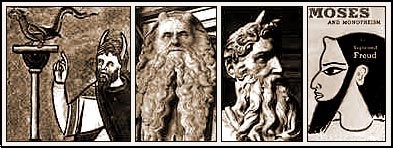 This medal was likely made long after the practice of picturing Moses with horns came to an end, so it's likely a rendering of a much older Moses portrait. Specifically, the ropy beard makes me think this is very likely a depiction of the most famous horned Moses, the statue by Michelangelo. That's the third one from the left. |
|
Pillar of the Community
United States
864 Posts |
It's less "mistranslation" than some combination of "confusion", & the basic difficulty of portraying the intended subject. "Cornus" in Latin signifies either "horns" or "rays", so the phrase "he knew not that his face shone" could be read as "he knew not that his face was be-horned". Now, given that a sculptor wouldn't be able to show a shining face very easily, adding horns would be a kind of rebus for the other meaning of the word. Of course, there would always be some less sophisticated people who wouldn't understand the reference, & once the portrayal had passed into artistic convention, the artists themselves might not be entirely clear on the iconography.
|
|
Moderator
 Australia
17006 Posts |
It's definitely a "Christian", rather than a "Jewish", item as only Christians (specifically, Catholics) and not Jews used the Latin translation where the "mistake" occurred. Nor would Orthodox Jews depict a human figure at all, given the strict laws against making graven images in man's likeness.
Being "Christian" does not necessarily make it religious, especially given that few Christians can recognize Hebrew, let alone read it. It could be Masonic or some similar organization.
As for age, I'm not sure we could narrow it down any further than 18th-19th century.
Don't say "infinitely" when you mean "very"; otherwise, you'll have no word left when you want to talk about something really infinite. - C. S. Lewis
|
|
Pillar of the Community
United States
3253 Posts |
Quote:
As for age, I'm not sure we could narrow it down any further than 18th-19th century. That is, unless that's a date in the Hebrew calendar below the tablets. Can anyone translate it? |
|
Moderator
Australia
17006 Posts |
It's not intended to be read as a number; there's no gershayim. There's no gershayim in any of the other words, either. All Hebrew text can be converted into numbers, but without the gershayim to indicate "this is supposed to be a number", you're just playing with numerology. If hardly anyone likely to own this medal could read Hebrew, even fewer people would have been able to decode the numbers of a Hebrew-coded date. If this medal has secret coded messages, the date of issue is not likely to be one of them. Don't say "infinitely" when you mean "very"; otherwise, you'll have no word left when you want to talk about something really infinite. - C. S. Lewis
|
|
Valued Member
Israel
60 Posts |
Edited by bdahab
07/17/2013 04:48 am
|
|
Valued Member
Israel
60 Posts |
SAP, I read Hebrew fluently but the date of the medal, in the current state is unreadable.
I was sure it's ×"קלו, thats 5136, while it's תקפ×-, that 577 (5577). Current Hebrew date is ×"תשע×' , that's 5773.
In most cases the thousands are omitted.
|
|
Pillar of the Community
United States
3253 Posts |
From bdahab's Hebrew auction site: Quote:
Moses and the Tablets. Cast brass [Made in Barre, Paris], 1827. On one side a portrait of Moses and the inscription "Moses Lord all the prophets"; Across tablets this year - Tkf"z [1827]. Diameter 3.5 cm. Good condition. Perforation, minor damages. |
|
Pillar of the Community
United States
3253 Posts |
Is the auction site saying this medal is the work of French medallist Jacques-Jean Barre? A date of 1827 would be just right. Was he being commissioned to craft Judaica? Might explain why Michelangelo's Moses was used on a Judaic medal.
|
|
Valued Member
Israel
60 Posts |
Edited by bdahab
07/17/2013 2:02 pm
|
|
New Member
 United States
9 Posts |
You "guys" are great in identifying this medal. Wish I were fluent in ancient languages. My son is studying both in seminary, but isn't up to par yet.
|
| |
Replies: 12 / Views: 3,663 |
|










 Posted 07/16/2013 10:40 pm


