| Author |
 Replies: 8 / Views: 3,698 Replies: 8 / Views: 3,698 |
|
|
New Member
United States
4 Posts |
I have two pennies that are a little weird. One, from 1917, has a blank reverse with concentric circular grooves, and a hole drilled through the middle of it. My first thought after a little research was that someone had ground down the back to make some kind of charm or curio, but the penny is the same width as other pennies. The other is from 1938, and has a slice taken out of the top that can fit another penny perfectly. Sorry; these are the best pics I could come up with using my camera: 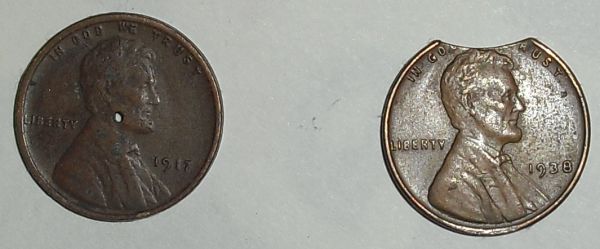 This picture shows the face of both coins; obviously someone drilled a hole through the 1917, and the 1938 has a chunk taken out of it. 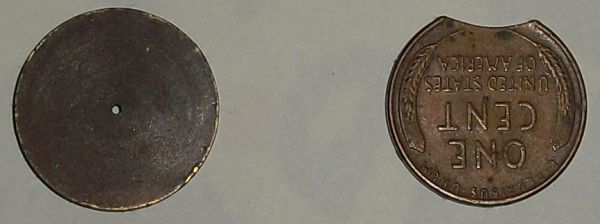 This is the reverse of both coins: it's not very visible in this pic, but the 1917 has concentric circular markings on the back, like grooves on a record. 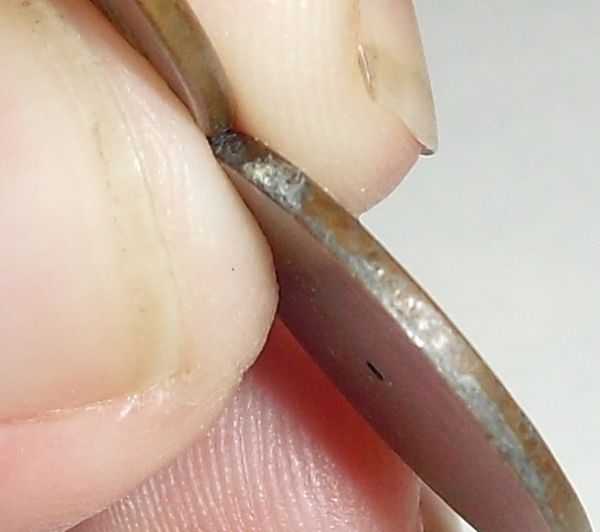 These next few pics are just my attempt to show that the 1917 penny is the same width as other pennies (it's the one on the right; the penny on the left is a normal one). The other coins are only in there to help prop them up. 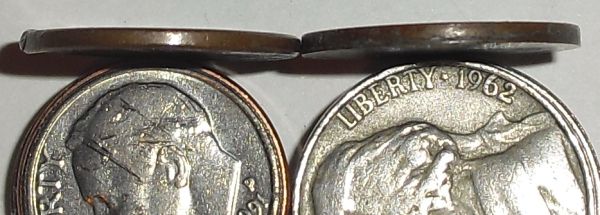 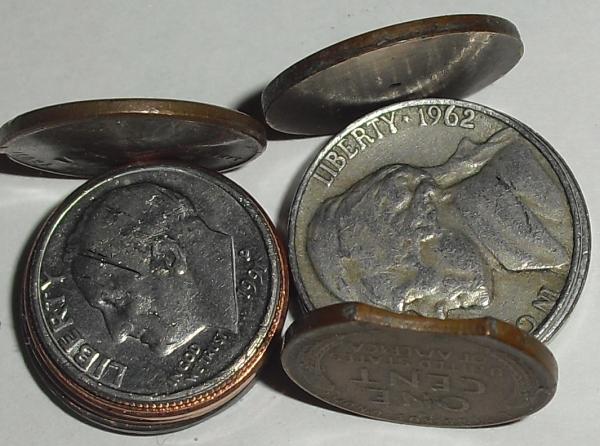 Trying to show the edge of the cut on the 1938. 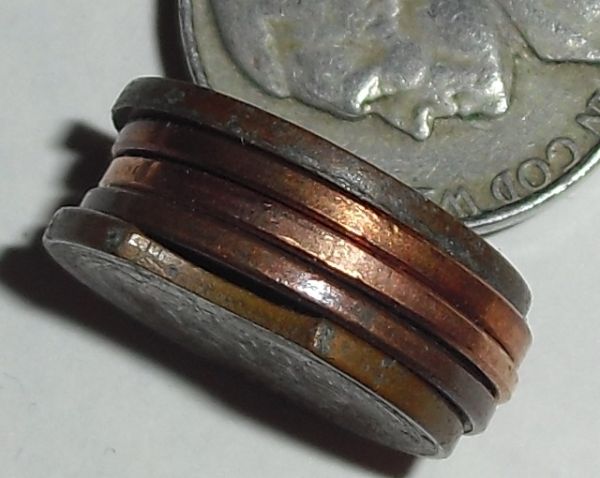 Once more showing the width; the 1938 is on the left; 1917 on the right; three normal pennies in the middle. 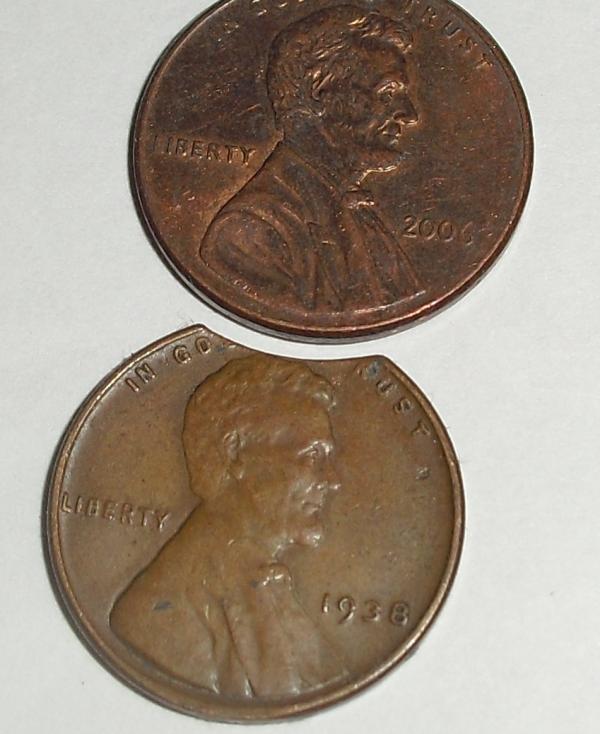 Showing that the cut in the 1938 fits perfectly with another penny. |
|
|
|
Pillar of the Community
Canada
4227 Posts |
The '38 looks like a legitimate clip - incomplete planchet. The other looks as though it was machined at some point, though I'm uncertain as to why.
|
|
Pillar of the Community
United States
1944 Posts |
the hole in the center of the 1917, is almost certainly where someone attached the coin to a device that was used to grind the reverse smooth.
the 38 is a clip as stated, and a quiet nice one too.
Edited by dbrablec
07/22/2013 07:15 am
|
|
Moderator
 Australia
17005 Posts |
Given the unchanged thickness, I'm wondering if the 1917 has actually been filled in with some foreign metal, rather than simply being ground down. The edge in particular seems to show a clear seam running between two different coloured metals. I'm thinking it might have been soldered onto something.
Don't say "infinitely" when you mean "very"; otherwise, you'll have no word left when you want to talk about something really infinite. - C. S. Lewis
|
|
Pillar of the Community
United States
4212 Posts |
It appears to be a lathe-job & a legitimate clip, a nice one.
|
|
Pillar of the Community
United States
901 Posts |
Way back in my youth I was a machinist. Power presses make a mark in the center like on the 1917. Maybe the reverse was pressed flat? Soft material was placed on obverse to keep image.
|
|
New Member
 United States
4 Posts |
Thanks for the info. I'm looking more closely at the edge of the 1917, and I think Sap is right about the seam; there must've been something added onto the back, since if the coin was simply pressed or ground flat on the reverse, it would be thinner.
Are clips like the 1938 worth anything, or just curiosities?
|
|
Moderator
United States
56855 Posts |
|
|
New Member
United States
4 Posts |
|
| |
Replies: 8 / Views: 3,698 |
|










 Posted 07/22/2013 07:15 am


