| Author |
 Replies: 11 / Views: 3,142 Replies: 11 / Views: 3,142 |
|
|
Pillar of the Community
United States
3498 Posts |
The Decline and Fall of the Roman Empire
Chapter XIIIntroduction and settlement of the barbarians.
Among the useful conditions of peace imposed by Probus
on the vanquished nations of Germany was the obligation
of supplying the Roman army with sixteen thousand recruits, the bravest and most robust of their youth.
The emperor dispersed them through all the provinces,
and distributed this dangerous reinforcement,
in small bands of fifty or sixty each, among the national troops;
judiciously observing that the aid which the republic derived from the barbarians should be felt but not seen.
Their aid was now become necessary.
The feeble elegance of Italy and the internal provinces
could no longer support the weight of arms.
The hardy frontier of the Rhine and Danube still produced minds and bodies
equal to the labours of the camp;
but a perpetual series of wars had gradually diminished their numbers.
The infrequency of marriage, and the ruin of agriculture,
affected the principles of population,
and not only destroyed the strength of the present,
but intercepted the hope of future generations.
The wisdom of Probus embraced a great and beneficial plan
of replenishing the exhausted frontiers by new colonies of captive or fugitive barbarians,
on whom he bestowed lands, cattles instruments of husbandry,
and every encouragement that might engage them to educate a race of soldiers for the service of the republic.
Into Britain, and most probably into Cambridgeshire,
he transported a considerable body of Vandals.
The impossibility of an escape reconciled them to their situation,
and in the subsequent troubles of that island they approved themselves the most faithful servants of the state.
Great numbers of Franks and Gepidae were settled on the banks of the Danube and the Rhine.
An hundred thousand Bastarnae,
expelled from their own country, cheerfully accepted an establishment in Thrace,
and soon imbibed the manners and sentiments of Roman subjects.
But the expectations of Probus were too often disappointed.
The impatience and idleness of the barbarians
could ill-brook the slow labours of agriculture.
Their unconquerable love of freedom,rising against despotism,
provoked them into hasty rebellions,
alike fatal to themselves and to the provinces.
Nor could these artificial supplies,
however repeated by succeeding emperors,
restore the important limit of Gaul and Illyricum
to its ancient and native vigour.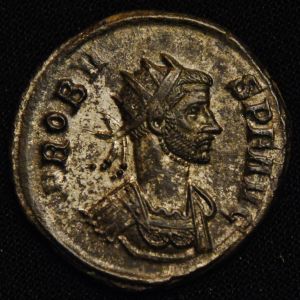 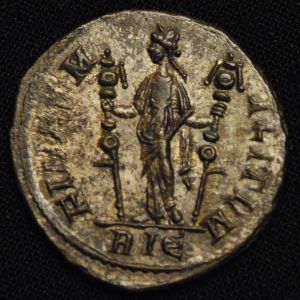 Ex. Jimbo777 Coll. My favorite emperor from when I began collecting in 1977 And worthy of a five minute Gibbon "cut and paste" !
|
|
|
|
Moderator
 United States
23731 Posts |
Very nice coin, he is one of my favorites also.
|
|
Pillar of the Community
United Kingdom
2121 Posts |
Probus is one of my favourites. This coin comes from the coded AEQVITI series of Rome (the first I).
|
|
Pillar of the Community
United States
5010 Posts |
who doesn't like some probus? nice bust details...row dots below the jaw line...neck stubble? neat.
|
|
Pillar of the Community
United Kingdom
946 Posts |
Probus is an amazingly popular Emperor to collect.  RIC V, part II Siscia 711 RIC V, part II Siscia 711Aurelian, who did all the work reuniting the Empire, is nowhere near as popular it seems for collectors. I guess it is about the variety of obverse and reverse styles. |
|
Valued Member
United Kingdom
201 Posts |
Great FR, glad you received it in one peice. As you know I am a big Probus fan also. Will take some pics and post some of the others that I have later when I get home ..
|
|
Valued Member
United Kingdom
201 Posts |
Attached are three coins from my Probus collection that I am rather fond of. 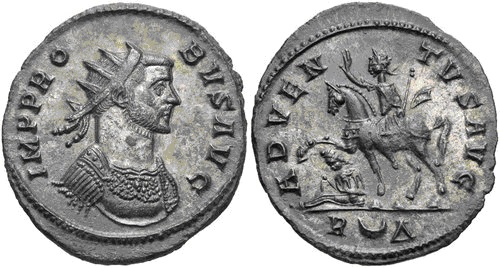 Antoninianus (21mm, 3.24 g, 6h). Rome mint, 4th officina. Radiate and cuirassed bust right / Probus on horseback left, rasing right hand and holding scepter; captive under raised foreleg; R(crescent)Î". RIC V 157 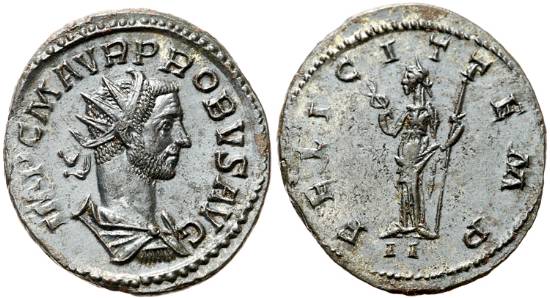 Antoninianus (22mm - 3.74 g). Lugdunum mint. 8th emission, late 281 AD. IMP C M AVR PROBVS AVG, radiate, draped and cuirassed bust right, seen from behind / FELICIT TEMP, Felicitas standing right, holding short caduceus in right hand, scepter in left; II. RIC V 74; Bastien 346 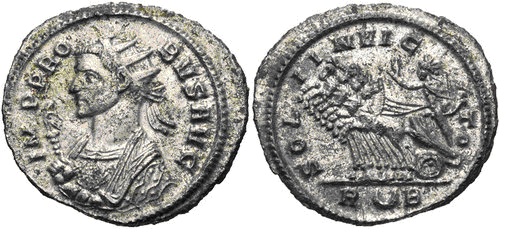 Antoninianus (24mm, 4.46 g, 6h). Rome mint, 2nd officina. Radiate and mantled bust left, holding eagle-tipped scepter / Sol driving galloping quadriga left, raising hand and holding whip and globe; R(crescent)B. RIC V 202 |
|
Pillar of the Community
 United States
3498 Posts |
I especially enjoy the great variety of bust types which Probus used. He was truly "A Man For All Seasons". Soldier, statesman, emperor and generalissimo extraordinaire. He must have had an amazing reserve of energy to have been in so many different places and dealt with so many issues during his 'eventful' reign.
As I have mentioned before my wife (the lovely Brunilda) is Albanian (right off the boat !).
When she was a in school as a young girl they were taught that these 'Illyrian' emperors were of course 'Albanians'.
The point is quite debatable .......
but don't tell that to an Albanian !
|
|
Pillar of the Community
United Kingdom
946 Posts |
|
|
Valued Member
United Kingdom
201 Posts |
Thanks Masis.
Yes, I agree about the great variety of bust types FR. He was certainly in many ways an impressive emporer though I have read he was also very strict which was probably a good thing for the empire at that time but ultimately also one of the key reasons behind his demise. There is a great book available about his life by the author James Crees. Worth checking out.
|
|
Pillar of the Community
United States
3498 Posts |
These emperors were almost all 'army brats' who had been raised from their earliest years to be soldiers first politicians last. By talent and abilities they were promoted and carried a no nonsense attitude which saved the Empire when the future looked very dark. Generalissimo's ..... Military Dictatorship without the sunglasses. Even Diocletian was just a common Illyrian peasant at heart who was more comfortable wearing a uniform or growing cabbages in his garden.
Yet it was Diocletian who realized that the system would not go on as constructed. An assassins blade was inevitable and so he changed the whole concept of Emperor. Unapproachable inviolable and sacred. Anyone approaching would have to walk 100 yards past rings of guards and then prostrate themselves before an elevated throne. And look at the Follis ! What was the message conveyed by that style of portraiture ?
"Don't mess with me .... don't even think about it"
Edited by FVRIVS RVFVS
10/08/2013 10:07 am
|
|
Valued Member
United Kingdom
201 Posts |
Hmmm yes, good points. I wouldn't mess with anyone with a neck that big.
|
| |
Replies: 11 / Views: 3,142 |
|




 Posted 10/07/2013 3:51 pm





