| Author |
 Replies: 16 / Views: 9,373 Replies: 16 / Views: 9,373 |
|
Valued Member
United States
462 Posts |
|
|
|
|
Bedrock of the Community
United Kingdom
18895 Posts |
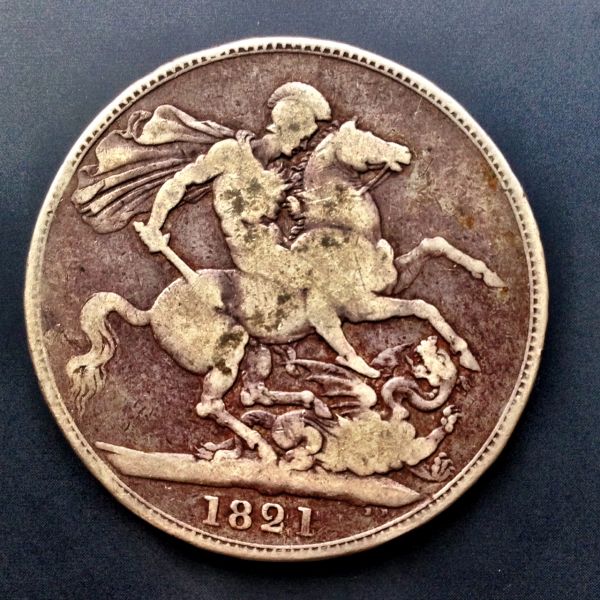
That's very interesting. I have your coin's twin brother!  Left: 1820 crown (George III) with counterstamp Right: 1821 crown (George IV) with counterstamp For ages I've just considered these as PMD - it would be nice to know their origins! |
|
Pillar of the Community
United Kingdom
2145 Posts |
I'd like to declare my interest, too.
I had a very worn 1816 2/6 stamped MB and a VG 1818 1/- stamped LP (or possibly IP) and I have a crown stamped GR in the same style.
The 2/6 and 1/- were given to a girl-friend many years ago to be made into jewellery.
I think I still have the crown but I don't know where it is.
|
|
Pillar of the Community
United Kingdom
2490 Posts |
MB must have been quite prolific. I wonder if he was also the artist on this coin, or are we looking for another party? This carving seems to have been done years later, when the coin was quite worn.  |
|
Pillar of the Community
United Kingdom
2490 Posts |
Two things have just struck me. Are there any threepennies out there, and did MB try his hand at copper?
|
|
Pillar of the Community
United Kingdom
4208 Posts |
Curious...another Crown on ebay has this countermark. Someone did this to a LOT of coins. Could this have been a single guy with a stamp? My father's initials are MB. Might look out for a cheap one, nice curio. Interesting that it shows up on an 1821 and 1829. COuld they have been doing this to all their change for 8 years, makingit so common? Theories for the MB: 1. Initials 2. Test Mark, showing the coin has passed 3. Organisation, I would suggest the B to stand for 'Bank' 4. Closed circulation - these coins being used as tender within a certain group, this being an identifying mark for legal tender coins for this group, stopping the coins being spent elsewhere and stopping external coins entering the pool (such as a workhouse). |
|
Pillar of the Community
United Kingdom
2490 Posts |
I've not thought about this coin for a long while, but tonight it was part of a tray I was reviewing. What struck me tonight was that although my coin looks to be a shilling, it is in fact a sixpence that has been carved with a shilling reverse. Curioser and curioser.
|
|
New Member
United Kingdom
1 Posts |
Shame I am almost 5 years late to the party :D Sorting through very large collection of coins passed down to me and this 'MB' has stamped an 1826 shilling of mine!!  https://ibb.co/nfd657*** Edited by Staff to add images to post. *** https://ibb.co/nfd657*** Edited by Staff to add images to post. *** |
|
Moderator
 United States
196100 Posts |
Better late than never.   to the Community! |
|
Bedrock of the Community
United Kingdom
18895 Posts |
I notice that my original photo disappeared in the Photobucket inferno, so I'm re-posting it!  |
|
Moderator
United States
196100 Posts |
Quote:
I notice that my original photo disappeared in the Photobucket inferno, so I'm re-posting it! I edited your earlier reply to include it. Hopefully alganbagerap will come make this topic whole again.  |
|
New Member
United Kingdom
2 Posts |
Mystery of initials MB - SOLVED!? I realise this is an old post, but I've recently bought what was supposed to be a silver medal which has turned out to be a silver-plated electrotype copy. The medal also had the small initials MB stamped on the reverse. After some research I believe the initials stand for Museum Britannicum (British Museum) and identifies the medal as one of the copies made by Robert Cooper Ready or one of his sons, who were employed to make copies of coins and medals in the British Museum between 1859 and 1931. More info here: https://www.coinbooks.org/v21/esylu...1n11a12.htmlhttps://collections.museumsvictoria...ticles/13517 |
|
Forum Dad
United States
24232 Posts |
|
|
Pillar of the Community
United Kingdom
735 Posts |
Yes, but the coins shown here are not copies.
Edited by Hogarth
10/29/2023 10:25 am
|
|
Pillar of the Community
United Kingdom
2145 Posts |
I don't think these are MB replicas.
a) these look like circulation coins
b) the MB is not on the edge
c) In In the 19th century, George IV silver would have relatively common, there would be no point in making replicas. My granny could remember collecting George III silver for the Laird (he wasn't interested in George IV or William IV and I presume he had all the dates)
|
|
New Member
United Kingdom
2 Posts |
The above examples might well be originals and have nothing to do with the BM/MB replicas, however Mr Ready and his sons made over 22,000 official replicas of British Museum coins and medals as study examples for museums around the world and some of these have now entered the secondary market. Here are two examples of British Museum replicas with the MB on the face: https://www.noonans.co.uk/auctions/...ults/180131/https://www.noonans.co.uk/auctions/...logue/463164The E-Sylum: Volume 21, Number 11, March 18, 2018, Article 12 Back to top ROBERT READY'S BRITISH MUSEUM REPLICAS Dick Johnson submitted these notes about the coin replicas of Robert Ready. Thank you! -Editor This statement was in a recent E-Sylum [Italics added]: "In the past, the British Museum shared numismatic knowledge with other museums, in what could be seen as an early numismatic network, by making and distributing replicas of coins from its own collection. The examples chosen were considered by the Museum to be particularly fine examples of coins from different periods, and their distribution enabled other institutions to share the Museum's collection. The British Museum shares numismatic knowledge in different ways today, through projects like the Money and Medals Network." These replicas were electrotypes created by a museum employee. Hired in 1859, Robert Cooper Ready (1811-1901), replicated objects - including coins - in the Museum's collections. After first casting these Ready turned to electroforming the coins, because of the sharper detail he could obtain by this process. In his lifetime Ready made over 22,000 of these coins; his sons, Augustus P. and Charles Joseph Ready carried on after him. Each signed their electrotypes, RR by the father R and MB (Museum Britannicum) by the sons. Ready's replicas were so exquisite it was hardly possible to distinguish from the originals. (It is rumored that collectors occasionally paid more for his replicas than the originals.) The practice of electrotyping coins was halted and replaced by plaster casting in the 19th century. Using plaster casts was satisfactory for studying the image, but of course, unsatisfactory for studying the metal surface, toning and patina. Many books, however, were illustrated with photographic plates, composed entirely of plaster casts. Perhaps this should be discussed in a future E-Sylum. But for now we should recognize the Ready family for their outstanding lifetime achievement. Their replicas rest in museums for generations to view, to study, and advance numismatic science." |
| |
Replies: 16 / Views: 9,373 |












 Posted 01/02/2014 07:03 am


