







 First Page


 Posted 03/02/2014 5:57 pm


Quote:
My theory is that by using the name of a country that doesn't exist the person producing this coin lowered his risk of being charged with forgery.
My theory is that by using the name of a country that doesn't exist the person producing this coin lowered his risk of being charged with forgery.
That might be true in other countries, but not China. It is not illegal to make fake coins in the PRC (unless they are fake PRC coins, in which case they're in big trouble if they get caught).
I think the "Maxxico" coins came about originally from someone with little command of English, or the Western alphabet generally. But tourists kept buying them, so they kept making them.
And in case you're wondering what shanew is on about, he recently bought an entire album of "silver dollars"; sadly, every single one of them was fake.
Back to Helen's questions.
Passing the magnet test does not mean they are genuine, only that they are not steel. There are plenty of other tests you can try. If you have access to an electronic balance or scales that can weigh to the nearest 0.1 grams, weigh them; genuine silver dollars weigh around 27 grams. The fakes can weigh as low as 18. Again, passing the weight test does not mean they are genuine, only that they are not underweight fakes.
There aren't any general rules to apply as to appearance; you sort of have to go through them case-by-case.
Set 1 top left is actually a copy of a Japanese silver yen from 1870. While the pic is too small to be absolutely sure, even from this distance the details do not look right; the leaf-wreath, in particular, looks too coarse. Here's a genuine one on NGC.
Set 1 top right also claims to be an 1870 Japanese yen, but it is a "fantasy dollar"; no such genuine coin was ever actually made in Japan, though a few were apparently made in China as local copies a hundred years ago. Those "contemporary fantasies" have been given a listing in the "Unusual World Coins" book of unofficial coins and so also appear on NGC.
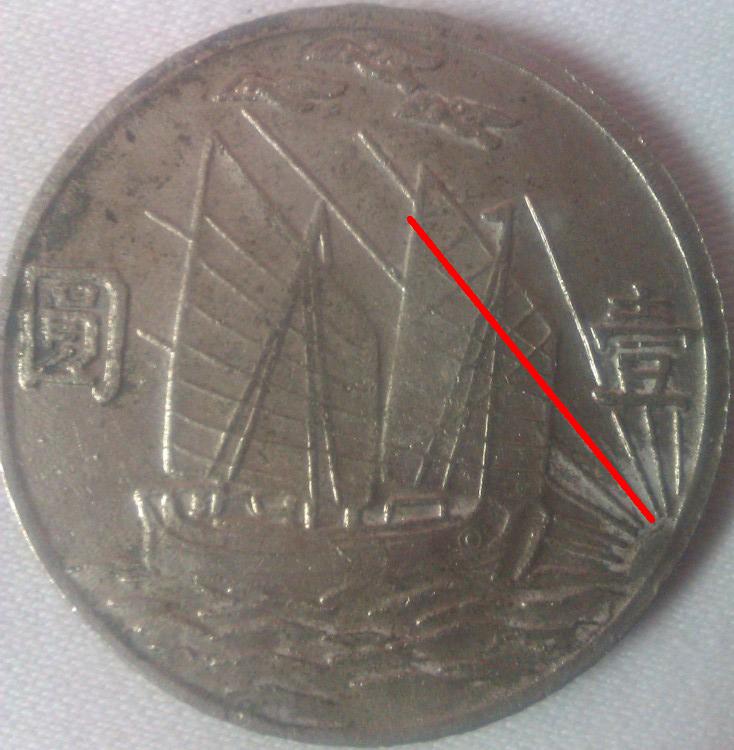
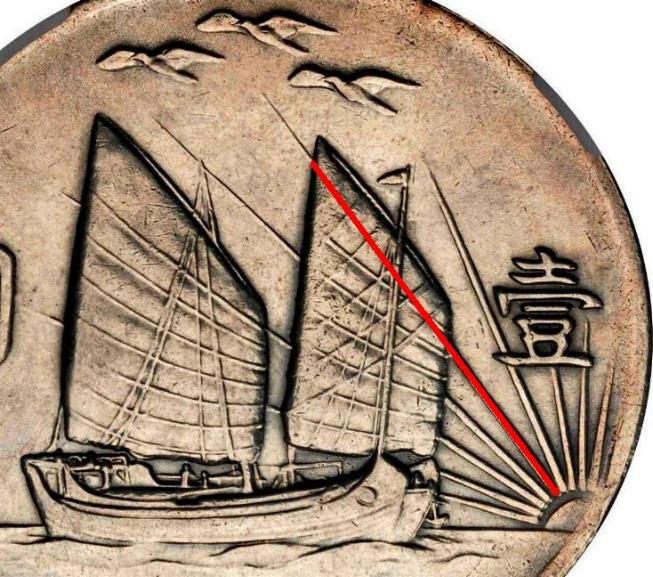
Set 1 bottom left is an early Chinese "Junk dollar" (that's "junk" as in the type of boat, not "junk" as in rubbish) known as the birds-and-sun type. This particular design was unpopular when it was in circulation: made in 1932, the Rising Sun and the birds flying overhead reminded too many people of the Japanese bombers (Japan invaded China in 1933); subsequent Junk Dollars had the birds and sun removed. Here it is on NGC. I can tell yours is not genuine because the two Chinese characters on either side of the boat are too close to the rim, but another way to tell many of the fake birds-and-rays dollars is this: the "rays" are supposed to form straight lines that carry through from one side of the ship to the other, but on the fakes there are often discontinuities. Here's some pics I made to illustrate, based on a pic of another fake Junk Dollar someone posted earlier on the forum.
Junk Junk: ray on far side of sail does not line up with the same ray coming out of the sun. Also note how the two characters are nearly touching the rim, and the general crudeness of the design.
Good Junk: ray lines up perfectly.
Set 1 bottom right is another "fantasy dollar"; this one is based on patterns made in Europe in an effort to convince the Chinese government to order coins from them. The original unofficial patterns are listed in UWC and the listing (unfortunately without pictures) can be seen here. Genuine examples never made it to China so are very, very unlikely to be sold from there.
The stories for the coins in your other Sets are similar: a mixture of possibly-genuine coins with impossible fantasies.
Don't say "infinitely" when you mean "very"; otherwise, you'll have no word left when you want to talk about something really infinite. - C. S. Lewis


 Meanwhile, I'll go trawl through NGC to try to find genuine versions of the coins in the other sets.. :) Many thanks for your help in solving some of the mysteries which surrounded these coins!

 I would be so mad!!


