Quote:
were there any different designs in this year because if the transaction into the 3rd reich?
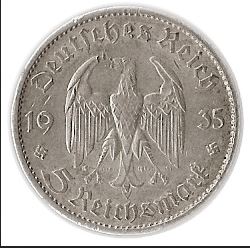
Given their later history, the Nazis were surprisingly slow at making their imprint on German coins; coins from 1935 are relatively "safe". There is a circulating-commemorative 5 mark coin issued in both 1934 and 1935 with two small, almost decorative swastikas on it, but all the other coins remain much the same as they did under the Weimar Republic. The 1 reichsmark was revamped after the Nazis took over in 1933, with the old Weimar motto replaced by the Nazi motto (as it was on other coins, where it appered as an edge inscription) and the Latin script replaced with Fraktur, but no other overtly "Nazi" symbolism was added. They also tried to introduce an aluminium 50 reichspfennig to replace the old Weimar-era pure nickel coin, but it doesn't seem to have taken off as it was a one-year-type. The German State Eagle on the obverse of German coins was still refreshingly swastika-free until 1936.
Now for your other questions.
Quote:
What denominations are there for this year of German coins?
1, 2, 5, 10 and 50 reichspfennig and 1 and 5 reichsmark. 2 reichsmark coins circulated but none were made that year. The 5 reichsmark coin is a circulating-commemorative for the death of German president Hindenburg.
Quote:
What mints are there for this year of German coins?
Germany in 1935 had six coin-issuing mints. I believe all six produced all denominations that year. The mintmarks are:
A = Berlin
D = Munich
E = Magdeburg
F = Stuttgart
G = Karlsruhe
J = Hamburg
Don't say "infinitely" when you mean "very"; otherwise, you'll have no word left when you want to talk about something really infinite. - C. S. Lewis










 Posted 03/11/2014 6:31 pm