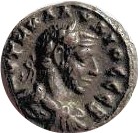
The receipt of an ancient coin from a Gazette reader created great interest recently when it was handed over to Berkhamsted Local History and Museum Society, as requested by reader 84-year-old James Fellowes, of North Walsham, Norfolk.
Mr Fellowes told us how the coin had been given to him by a friend, Alf Frampton, when he worked in Hemel Hempstead, shortly after the war.
Dacorum Heritage Store was unable to date it, but sent it to expert Peter Clayton (vice-chairman of Dacorum Heritage Trust and Expert Adviser for Coins and Antiquities to the Department for Culture, Media and Sport).
And from such a notable source we have the following explanation:
The coin is a Billon Tetradrachm from the mint of Alexandria in Egypt.
It was struck under the reign of Roman Emperor Claudius II Gothicus (reign September 268 - August 270), at that time Egypt was part of the Roman Empire.
On the obverse is the Laureate and draped bust of the emperor.
On the reverse an Eagle standing right, head turned back left, with wreath in beak.
The letters in field either side of the eagle: L A mean struck in year 1 of Claudius' reign (Alexandrian coins are all dated by the Emperor's regnal year).
Since Claudius came to the purple in September, his first regnal year at Alexandra runs from September 268 - August 269 - the coin was struck during this period.
The letter L on the coin stands for the ancient Egyptian demotic sign for the year.
The eagle is a common reverse type for coins from Alexandria, having a military connotation.
This is a very common coin and if sold to a collector today would fetch about £12.
Peter says: "Take no notice of the provenance - it was probably brought back and lost by a Second World War serviceman who had visited Egypt.
"Many coins of these late third/early fourth Century emperors were brought back and are found fairly frequently.
"A friend of mine, stationed in Egypt during the war, told how, like many servicemen, he was inveigled into climbing the Great Pyramid at Giza (you could then!)
"Halfway up with his guide he stopped for a breather at which point the guide produced a handful of these coins, explaining that they were 'very ancient genuine Roman coins, very valuable' and that most people bought their coins at this point on the pyramid.
"As Frank, my friend, remarked, looking down some 250 feet, he could see reason in buying coins at that point. Many did likewise. He never did tell me how much he paid - no doubt an exorbitant sum then, in relation to service pay.
"These coins have been found in the strangest places in this country. One I know of was found in Scotland inside a limpet when the fisherman knocked it off the rock and broke it open.
"These tetradrachms (four-drachm pieces) did not circulate outside Roman Egypt - it was a closed currency.
"The emperor Diocletian (AD284 - 305 reformed the mint in AD 286 and thereafter Alexandria struck on the normal Roman style, using letters in the exergue (date space) as a mint mark.
"Alexandria was the last of the mints of the Roman empire striking on the Greek Module.
"The early coins of the first century were of good quality and had the same amount of silver as a Roman denarius, plus the bronze making up their weight, but inflation over the years led to their debasement - the last issues have only about 1 to 2 per cent silver in them."









 Posted 07/19/2007 11:52 am


