| Author |
 Replies: 11 / Views: 12,937 Replies: 11 / Views: 12,937 |
|
|
New Member
United States
6 Posts |
i was going through my change today, and was surprised to find this 1970 d Black Nickel. I have been trying to find more information on it, but can't seem to find anything about 1970 nickels being minted like this. It looks authentic and not painted. Coin is also in mint condition to my eyes, but I am not a collector of coins, so I wouldn't know much about the condition. Any info would be much appreciated. 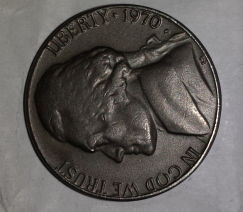  |
|
|
|
Valued Member
United States
166 Posts |
|
|
New Member
 United States
6 Posts |
it is a very cool and nice looking coin, first time I have ever seen one, and I work in retail so I see coins everyday, all day long. Seems like no one knows anything about this coin since I haven't received any remarks on it.. guess I will have to keep searching for more info.
|
|
Moderator
 United States
196333 Posts |
I moved this to the V&E sub-forum to get the attention of those who know better than me.  |
|
New Member
United States
6 Posts |
thank you, I am new to this forum, so I didn't know where to post.
|
|
Moderator
United States
56855 Posts |
 to CCF fellow Michigander. It looks cool but I have not heard of a 1970-D BB.Lets wait for a pro or two to chime in. John1  |
|
New Member
United States
6 Posts |
Thank you john1 for the warm welcome, really hoping we can get some info on this
|
|
Pillar of the Community
United States
3453 Posts |
I thought they were from primarily the 50's but I am seeing discussions that indicate differently. Coop posted this link in a previous thread: https://groups.google.com/forum/#!t.../0OTPm6OmPlE. In that thread Mike Diamond states: Quote:
I had a 1959 black beauty nickel subjected to a spectroscopic analysis. The surface was enriched in copper (83% vs. the normal 75%). The metallurgist who performed the test was puzzled about the black appearance. Black nickels are concentrated in the late 1950's and early 1960's, but occur throughout the last 50 years. Black dimes and quarters also occur. Some say it's a manifestation of "copper wash". This idea holds that planchets rinsed in a bath saturated with copper ions will turn various colors from copper to red to brown to black. Indeed, one can find coins in which the surface changes from red or copper to black. The problem with the copper wash hypothesis is that black, red, brown, and copper nickels, dimes, and quarters occur after 1982, when there is no obvious source of free copper ions. and then quantifies with: Quote:
I was only speaking of BU, mint-state coins. Once a coin gets out into an uncontrolled environment, it can turn almost any conceivable color, depending on the conditions it's subjected to. Mike Diamond is the go-to guy for errors and I take what he has written as gospel. Hope this helps.  EDIT: Edited by CoinsKelly
05/20/2014 4:36 pm
|
|
Valued Member
United States
167 Posts |
Is the rim the same color? Just wondering, and it is very cool looking.
|
|
New Member
United States
6 Posts |
The rim is the same color, but shinier in some spots. It also has fs under Jefferson.
|
|
Moderator
United States
56855 Posts |
eq0120, If you want to do some research look up:sintered planchet and improper annealed planchet and improper alloy mixture. I found one awhile back but mine is yellowish not black. https://goccf.com/t/136747John1 |
|
New Member
United States
6 Posts |
thanks for the link and advice john1, I was doing some research, and couldn't find to much info on the 1970 nickels. I did read that it occurs from the improper alloy mixtures, and it happens naturally over time, but I wasn't able to find a coin from 1970 anywhere online that was solid black like the coin I found.
I'm going to keep on researching, and might take it to a coin collector here in Michigan to see if I can get some more info on it.
|
| |
Replies: 11 / Views: 12,937 |
|










 Posted 05/20/2014 2:59 pm


