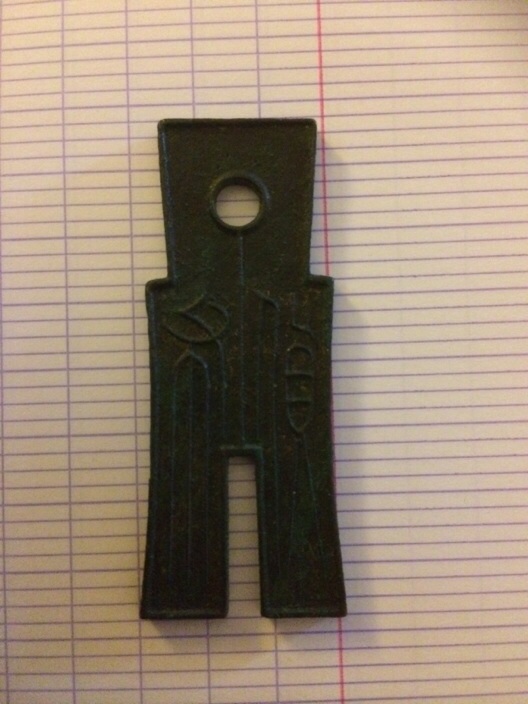
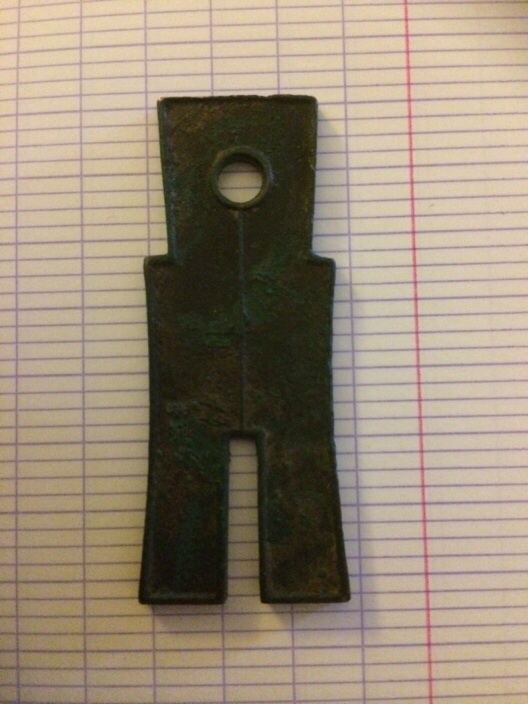
The Chinese speak of genuine ancient artefacts as having "shen", a property that is perhaps best translated as "authenticity". Genuine ancient coins have "shen", fakes do not.
In truth, of course, "shen" is not so much a property of the object as a property of the person looking at it. So the only way to perceive "shen" is through experience.
It has been commonly said that when the Secret Service trains agents to spot fake US paper money, they don't show them a whole bunch of different fake notes and teach them about different kinds of fakeness. Rather, they teach them all about genuine notes. The agents become so familiar with the genuine that anything fake simply screams out at first sight - it may not even be a conscious observation, they may have to study the fake for a while before they really find out what it was that triggered their instinct. And this is what you really need to try to do in order to detect any kind of fakery.
In this case, you can find lots of pictures of genuine Wang Mang spade coins
here. You can be fairly confident that all the coins here are indeed genuine, unless someone has posted a comment that a particular coin is fake.
As for me: I would often question why a 2000 year old copper artefact is not completely covered in thick dark green patina, as it ought to be. However, these spade coins are often found in hoards all fused together face-to-face, with minimal corrosion evident. Nevertheless, any green patination on the coin should be thick and heavy, not thin and powdery-looking.
Don't say "infinitely" when you mean "very"; otherwise, you'll have no word left when you want to talk about something really infinite. - C. S. Lewis










 Posted 06/12/2014 9:36 pm