| Author |
 Replies: 14 / Views: 3,210 Replies: 14 / Views: 3,210 |
|
|
Valued Member
Netherlands
376 Posts |
that during the Second World War Australia did use tokens in internmentcamps for war-prisoners or citizens of German, Italian and Japanese origin.
These tokens were of value 5, 2, 1 shilling and 3 pence bronze and 1 penny copper.
There could be a whole plunched into the coin.
Is this a make-believe fairytale or the truth, because I have never seen anything like it.
|
|
|
|
Pillar of the Community
Australia
655 Posts |
Yes it is true. From Renniks...
"The department of army issued five tokens for use in internment camps during WW2. The five shilling, two shilling and penny designations were struck by Australian contractors, R. Arendeen & sons Pty Ltd, Malvern Victoria, and the other denominations, shilling and threepence by K.G Luke & Co Pty Ltd, Fitzroy, Victoria. These dies were the property of the army. These tokens were especially designed so they could not be used in aiding the escape of any prisoners from the camp.
Use of the tokens was confined to the compound and an audit was taken daily for security reasons in order to check on the use and circulation of the tokens.
Australian coins were prohibited within the compound. At the end of the war these tokens were withdrawn and remelted by the authorities as their circulation would be a contravention of the Commonwealth coinage act. A number of these, no doubt, were souvenired by officials, army personnel and even prisoners, and today they are eagerly sought by collectors of Australiana as they form part of our history. These tokens were also used in New Zealand.
These tokens are extremely difficult to obtain: The five shilling and two shilling denominations being the scarcest. The threepence token on the obverse, occurs with the word "Camp" or "Camps", the latter being re-engraved. The penny is the commonest of this scarce series. The dies for the internment camp tokens are now held by the Royal Australian Mint, Canberra."
|
|
Pillar of the Community
United States
4589 Posts |
That is very interesting, I would love to get my hands on historic pieces like these
|
|
Valued Member
United Kingdom
91 Posts |
Does anybody have any pictures or links to the said coins?
|
|
Pillar of the Community
Australia
655 Posts |
There's tiny B+W pictures in the latest 22nd edition Renniks coin and banknote values. I might be going too far with copywrong to scan them here.
Best of luck getting hold of one. They are rare.
Five Shillings Plain edge 22.85mm, Bronze. Estimated number in existence 50-100.
VF $1,800 EF 2,500 aUnc $3000 Unc $3950.
The others look like they may be more common with prices a little lower.
Apparently there's some WW1 GCC (German Concentration Camp) tokens also? I'm not sure what these are. The book is a bit vague.
Edited by Learjet
08/16/2007 5:57 pm
|
|
Pillar of the Community
Australia
655 Posts |
Edited by Learjet
08/16/2007 6:20 pm
|
|
Pillar of the Community
United States
4589 Posts |
thanks for the links I will be loooking out for them now
|
|
Moderator
 Australia
16982 Posts |
They're listed in the Krause catalogues, too, right at the end of the Australia listing just before the patterns, under "token coinage". I've only got one in the series, a threepence I picked up at a local (Brisbane) auction a decade ago: 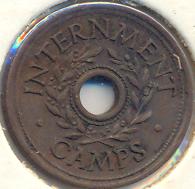  Don't say "infinitely" when you mean "very"; otherwise, you'll have no word left when you want to talk about something really infinite. - C. S. Lewis
|
|
Bedrock of the Community
United States
14454 Posts |
|
|
Pillar of the Community
Australia
2830 Posts |
G'day, the Camps also had paper money. Here is a link to a 6d note: http://nla.gov.au/nla.cs-pa-HTTP%25...ELC02552.001The camps held enemy aliens detained early in the war: migrants; seamen in port at the outbreak of the war. To this were added Prisoners of War. Australia did not take Germans, except those captured by the Royal Australian Navy - and most of them were from the Kormorant. There were significant numbers of Italians captured in the Libyan campaign. Many of these were paroled, and sent to work on farms, without guards. Quite a few of these returned to Oz after the war as voluntary migrants. A fascinating part of Australian history. Peter in Oz |
|
Valued Member
United Kingdom
91 Posts |
Excellent, thanks for the info guys>
|
|
Pillar of the Community
United States
1267 Posts |
|
|
Valued Member
 Netherlands
376 Posts |
Thanks for all the information you GUYS!! I do not mind to ask difficult questions, and look what it brought me . Thanks everyone for sharing this information. And Sap, thanks for reminding me they are pictured in the Krause Mishler.
|
|
Pillar of the Community
Australia
1295 Posts |
Here's my internment 3d 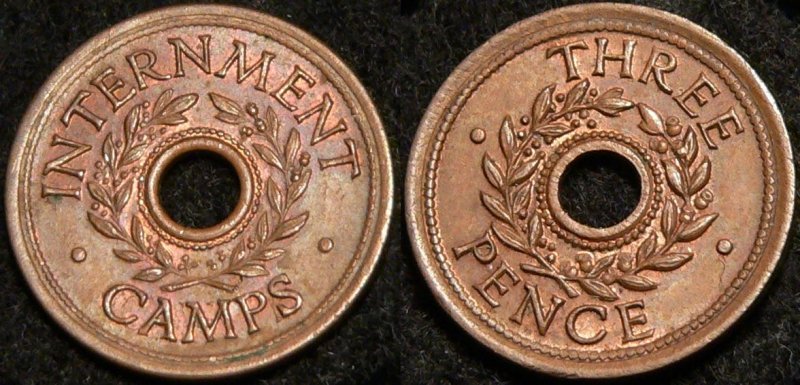 I am told a lot of the internment tokens on the market are actually re-strikes from the 1970's. The dies used to strike the tokens during ww2 are apparently still in private hands (as they were struck by private companies in WW2). |
|
Pillar of the Community
Australia
653 Posts |
...a recent addition to my collection. An interesting piece of Australian history. The coin has the central hole punched noticably "off centre". I like this coin because it looks "handled". Maybe the real thing and not a "restrike" from the 1970's Squire 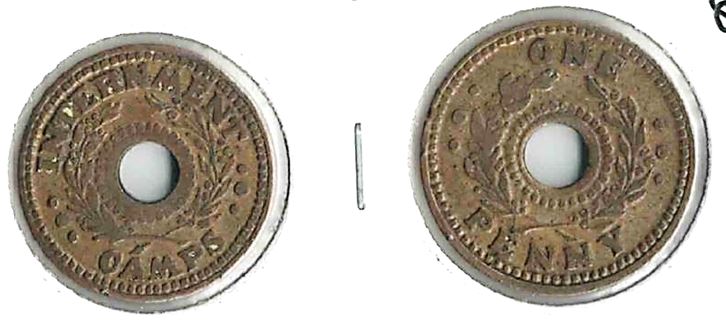 Edited by Squire Wilson
03/30/2017 12:50 am
|
| |
Replies: 14 / Views: 3,210 |
|







 Posted 08/16/2007 3:41 pm





