| Author |
 Replies: 8 / Views: 1,962 Replies: 8 / Views: 1,962 |
|
|
New Member
United States
6 Posts |
I do not know what this is but it could be a yazidi (yezidi) token. It is silver and the diameter of a US silver dollar but a few grams lighter. No one on Zeno coins has been able to ID it which means that it is not common. Please let me know if you can ID it or if you know someone who can. The other side has a peacock on it. Thanks Tom Pesacreta 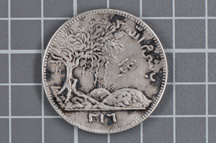 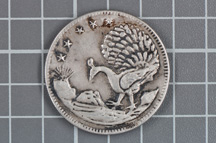 Edited by doctortom
08/26/2014 1:53 pm
|
|
|
|
Pillar of the Community
United Kingdom
2490 Posts |
The peacock and the script make me think Burmese
|
|
New Member
 United States
6 Posts |
I also thought that it could be Burmese. I am no expert in that area but some native Burmese have indicated that it is not typical Burmese script.
|
|
Moderator
 Australia
16982 Posts |
Here is doctortom's medal on zeno.ru, which shows bigger pics. Here's the other side. The script is Arabic, yet the imagery looks non-Islamic. Yezidi is one possibility and the peacock is sacred imagery in the Yezidi faith, but it could also be Mandaean, or Sikh. Sikh would have been my guess, simply because the tradition of "religious medals" is strongest in India. But the number "216" is written in Eastern Arabic numerals, not the Persian or Indian variants. The number "216" is one estimation of "Plato's number", but I'm not aware of any modern religion that places any heavy meaning or significance on that number. Arabic speakers laugh at me when I try to transcribe Arabic by myself, but I'll never get better without practice, so here goes: I believe the script says "bismallah", though it is written curiously differently to "normal", with the letters B, S and M written separately rather than connectedly. That clearly indicates to me an Islamic flavour, since Yezidis would not refer to their god as "Allah".
Don't say "infinitely" when you mean "very"; otherwise, you'll have no word left when you want to talk about something really infinite. - C. S. Lewis
|
|
Pillar of the Community
Canada
1118 Posts |
I concur with Sap (not the Yezidi stuff, never heard of it, the Arabic part)
Bismillah (In the name of God, short for Bismillah ir-Rahman ir-Rahim.) looks strange though, Arabic letters can be written 4 different ways and they aren't particularly right.
I know some Muslims believe certain things not because it comes from the Holy Book but because it comes from orally transmitted ideas of what the Prophet PBUH supposedly said. Some of those ideas include not depicting certain things so Muslims developed a "number code" to get around it. The 216 didn't ring a bell for me but Sap thinks it has something to do with Pluto.
|
|
New Member
United States
6 Posts |
About the number an the token, several people, upon seeing the number, immediately come to the conclusion that this is a hajj token (please forgive my possible mis-spelling). This idea makes some sense given that such tokens are given to pilgrims and commonly have a numerical reference to a portion of the Koran on them. I have not seen any such tokens made of silver but my expertise is not in this area. To me, given that this is an Islamic token, this idea makes sense. If so, the number simply refers to the idea that we must look to God to tell us what is right and what is wrong. But, what are the 5 stars about? And, is there any significance to the sun rising on one side and setting on the other? I have Googled 5 stars Islam, and 5 stars peacock, 5 stars yezidi, 5 stars Burma and get nothing that makes any sense.
|
|
New Member
United States
6 Posts |
One further idea, there are 5 smaller stars surrounding a single larger star on the flag of Burma that was used after the union in the 1940s until the 1970s. The Five stars represent the five ethnic groups that comprise Burma. So, it is possible that the 5 stars on the token refer to the ethnic diversity of Burma. The peacock would be the union of the groups. I don't know if all of these groups were Muslim.
|
|
Pillar of the Community
United Kingdom
2490 Posts |
My suggestion of a Burmese origin was made before you edited the post to include the peacock.
It's unlike any Burmese peacock that I've seen, but does have some parallels in Iranian imagery.
|
|
Pillar of the Community
Canada
1118 Posts |
The peacock made me think Islamic Republic of Pakistan but I doubt it now, along with Iran, Afghanistan or any Persian-y country because the Arabic numbers and letters where altered to accompany local languages and dialects (ex, the "pa" sound does not exist in Arabic). If you look at the numbers on the token it looks more Arab land then Persin, Turkish, Pustuo, ex.)
|
| |
Replies: 8 / Views: 1,962 |
|





 Posted 08/26/2014 5:56 pm





