| Author |
 Replies: 16 / Views: 2,862 Replies: 16 / Views: 2,862 |
|
Pillar of the Community
United States
4778 Posts |
 Ok, not really  But its in such great shape I might as well have  I've showed this one before but recently got around to reshooting new photos of it. This AE3 of Roman emperor Valentinian I is easily one of my best late Romans, condition-wise. Some people may describe this type and emperor "as common as dirt", and they are very easy to find, but it gets more difficult (but not impossible) to find one of these in this great of a shape, especially at the price I got it for (I believe around $15). I wouldn't be surprised if it got lost not long after it left the mint. Its a nice dark brown color all around (except for the light layer of sand at the base of teh bust/mintmark area), but I had to sacrifice some of it in the photo to shoot it at an angle and bring out the details. Interesting tidbit: the goddess Victory (Victoria, shown on my coin's reverse) is said to have been the inspiration for the look of Christian angels. From Wikipedia: Quote:
Valentinian I (Latin: Flavius Valentinianus Augustus; 321 â€" 17 November 375), also known as Valentinian the Great, was Roman emperor from 364 to 375. Upon becoming emperor he made his brother Valens his co-emperor, giving him rule of the eastern provinces while Valentinian retained the west.
During his reign, Valentinian fought successfully against the Alamanni, Quadi, and Sarmatians. Most notable was his victory over the Alamanni in 367 at the Battle of Solicinium. His brilliant general Count Theodosius defeated a revolt in Africa and the Great Conspiracy, a coordinated assault on Roman Britain by Picts, Scots, and Saxons. Valentinian was also the last emperor to conduct campaigns across both the Rhine and Danube rivers. Valentinian rebuilt and improved the fortifications along the frontiers, even building fortresses in enemy territory.
Due to the successful nature of his reign and almost immediate decline of the empire after his death, he is often considered the "last great western emperor". He founded the Valentinian Dynasty, with his sons Gratian and Valentinian II succeeding him in the western half of the empire. Obv: D N VALENTINI-ANVS P F AVG, pear-diademed, draped bust right Rev: SECVRITAS REIPVBLICAE, Victory advancing left, holding wreath and palm branch, field marks to left and right Mint: Siscia (mintmark: Gamma SISC [not sure of the last letter], struck 364-375 AD) Ref: RIC 15a
|
|
|
|
Moderator
 United States
23731 Posts |
Beautiful detail on this coin, looks like it was struck yesterday.
|
|
Pillar of the Community
United States
2480 Posts |
|
|
Moderator
United States
15960 Posts |
|
|
Pillar of the Community
 United States
4778 Posts |
Thanks all! The coin does look like it came right out of the mint (perhaps except for the brown color of it). It probably looks no different than when it was last held in ancient hands.
|
|
Bedrock of the Community
United States
10045 Posts |
Very nice! It probably doesn't look too different than when it was in a Roman's hands.
|
|
Pillar of the Community
United States
4778 Posts |
|
|
Pillar of the Community
Netherlands
1204 Posts |
|
|
Pillar of the Community
United States
5010 Posts |
|
|
Pillar of the Community
United States
5155 Posts |
Its funny I have a few high grade LRBs and one of them is Gamma SIS as well... Good coin. Struck 326 AD Constantine I "Campgate" 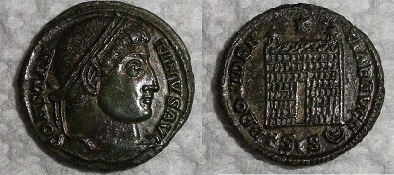 Edited by Ancientnoob
09/15/2014 4:59 pm
|
|
New Member
United States
3 Posts |
I'm a little suspect of coins that are supposed to be two millennium old being that sharp. What makes people think that the ancient uncs all over this site are real?
|
|
New Member
United States
3 Posts |
"Beautiful detail on this coin, looks like it was struck yesterday."
Indeed!
|
|
Pillar of the Community
United States
4778 Posts |
I had a feeling someone was going to ask  Well for starters, late Roman bronzes are rarely the target of modern counterfeiters (as opposed to famous types like the Greek Owl coin), so the probability mine isn't real is pretty low. The style is in line with coins from this period, there are flow lines from being struck, and there is no seam on the edge. Also, where it was stored for one-and-a-half millennia makes a huge difference. Not sure exactly where/how for my coin but apparently it was good enough to not harshly affect my coin (I'm guessing perhaps a jar, in non-acidic soil, also someplace where air and moisture couldn't get to the coin. |
|
Pillar of the Community
United States
4778 Posts |
Also they made millions upon millions of this type, so there's bound to be a few to survive in good shape.
|
|
Pillar of the Community
United States
4778 Posts |
Oh and great coin Anoob!  |
|
Pillar of the Community
United States
3497 Posts |
Quote:
I'm a little suspect of coins that are supposed to be two millennium old being that sharp And so are we all ! Whenever an ancient collector worth his/her salt finds such a beauty we do find caution is required. As stated above LRB's tend not to be the object of industrious 'entreprenuers' with backyard forging operations. But as most of us have noticed high quality fakes have been coming out of eastern Europe in the last few years. Modern technology is making the job of spotting these harder and harder short of high tech analysis of the metal being used. Generally though the fakes will tend to gravitate toward the 'high end' material. Coins that sell for under $100 are for us 'chumps'. A good forger can make a killing with the big boys selling $1000-30,000 coins. A good indicator of fakes of course is when too many of the same die manufacture turn up ! One $20,000 sale solves that problem. Personally I feel much safer with patinated bronze with a bit o' encrustation on it for good measure. The Nero which I posted a few hours ago is a good case. In fact the patination has reached such a thickness that it can be seen from a 'blemish' on the reverse that the oxidation is so thick that it penetrates deep into the surface. Remove the patina and the coin is all but destroyed ! |
| |
Replies: 16 / Views: 2,862 |







 Posted 09/13/2014 2:36 pm





