











 Posted 09/18/2014 5:37 pm


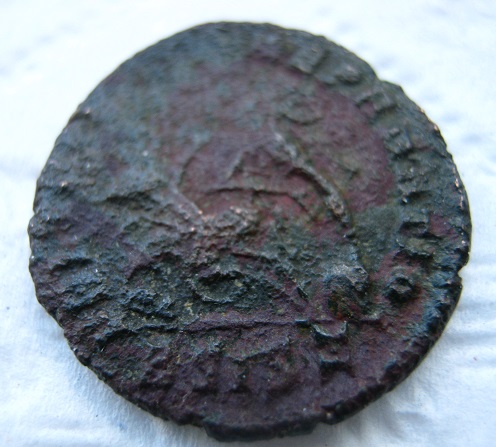
You're welcome. Good to see it made it. I'll admit, this one would be tough with no prior knowledge, so I'll help you out with info. A lot of Roman coins (not all, like Greek Imperial provincials) have Latin words and letters on them, so reading them is generally easy if the legends are still there (actual meanings of the words/phrases are another thing!), so on your coin, the obverse is tough to read, but fortunately the reverse legends are clearer, so the word REPARATIO is readable on the right side (if you look closely you'll see in front of REPARATIO the words FEL TEMP. On later Roman coins (generally after the mid 3rd century or so), the mintmarks are usually on the bottom of the reverse, in an area called the exergue. In your coin's case its BSISZ (either Z or one of those strange Siscian symbols, can't recall, but you have enough of the mintmark for an ID). Any mintmark with SIS in it means its from Siscia (in modern-day Croatia). Whenever you see FEL TEMP REPARATIO together with what looks like a man leaping over a guy and his horse, its the soldier spearing fallen horseman reverse, struck from the 350s-370s.
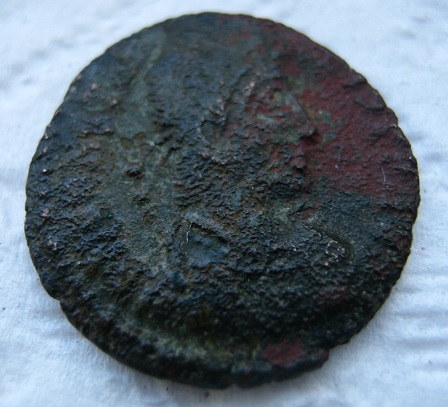
Several rulers used this reverse, so a quick rule of thumb: if you see a diadem of pearls or a rosette diadem (fancier, more detailed) and a couple of pearls trailing, you are looking at an Augustus (as opposed to the lesser bare-headed Caesar). Two rulers that struck this type were Augustii: Constantius II and his brother Constans, CONSTANTIVS and CONSTANS respectively. Of the Augustii who struck this type, the only exception is Magnentius, who is bare-headed on all of his coins. Last time I checked the name is more or less visible, but if you can't really distinguish the individual letters, the number of characters will usually tell you who it is. More characters=longer name, so in this case, yours is Constantius II (if all you have are endings of the names like "TIVS" and "NS", that will tell you also who it is). He struck the most of these coins, and the mint that struck the most of this type was Siscia, so when you find one of these, its a safe bet its going to be a Constantius II from Siscia. Also this type is made out of bronze.
Several rulers used this reverse, so a quick rule of thumb: if you see a diadem of pearls or a rosette diadem (fancier, more detailed) and a couple of pearls trailing, you are looking at an Augustus (as opposed to the lesser bare-headed Caesar). Two rulers that struck this type were Augustii: Constantius II and his brother Constans, CONSTANTIVS and CONSTANS respectively. Of the Augustii who struck this type, the only exception is Magnentius, who is bare-headed on all of his coins. Last time I checked the name is more or less visible, but if you can't really distinguish the individual letters, the number of characters will usually tell you who it is. More characters=longer name, so in this case, yours is Constantius II (if all you have are endings of the names like "TIVS" and "NS", that will tell you also who it is). He struck the most of these coins, and the mint that struck the most of this type was Siscia, so when you find one of these, its a safe bet its going to be a Constantius II from Siscia. Also this type is made out of bronze.
Edited by VisigothKing
09/18/2014 5:48 pm
09/18/2014 5:48 pm


 Its that oval thing with legs under the guy reaching with his arm upwards. The denomination would be Follis. A more modern designation would be AE-3 (there's AE 1-4 for late Roman bronzes. Its based on size, so 1 would be largest and 4 smallest). AE Follis is acceptable as well. If I recall correctly the specific region Siscia is located in was called Pannonia.


