| Author |
 Replies: 16 / Views: 4,393 Replies: 16 / Views: 4,393 |
|
New Member
Greece
16 Posts |
Please your opinion for this Greek Tetradrachm of Îœacedonian King Philip ii - ΦΙΛΙΠΠ-OY silver coin. I have seen a lot of Greek and Celtic tetradrachms replicas,copies and authentics , but nothing exactly like this one. Please take a close look at the letters - HΣΩ - (Greek: hita,sigma,omega),and the icon between the horses front legs. The coin is 24mm diameter. I will appreciate any help and opinion as I nave this coin and want to know if it's a replica,copie,or authentic. I've post in a few other Ancient Coins forums but no luck so far. Thank you in advance. 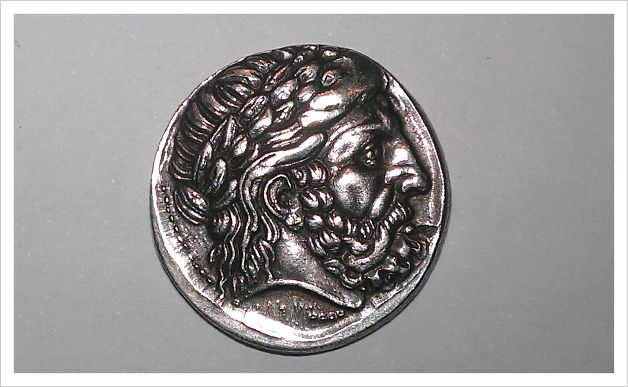 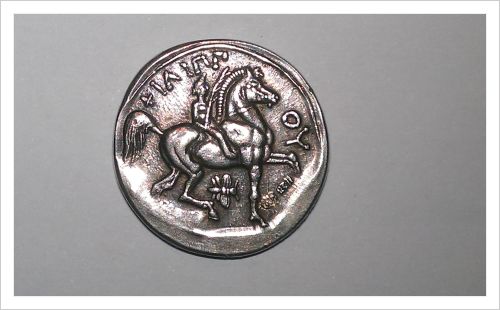 Edited by ilisiamis53
10/11/2014 1:52 pm
|
|
|
|
Moderator
 United States
23731 Posts |
 to the community If it looks too good to be true, it probably isn't. This piece looks like it was just struck, with very sharp edges. In my opinion it is 100% fake. |
|
Pillar of the Community
3772 Posts |
Somehow doesn't look right to me, but wait for comments from those who have more experience with ancient Greek silver.
What is the diameter? And what is the weight?
Can you also make a picture which shows the rim and profile?
|
|
New Member
 Greece
16 Posts |
Thank you "Medieval" ,
The diameter is 24mm and the weght is 11.1g .
I agree with "echizento" it looks like an almost UNCIRCULATED coin .
Is it possible to find one today ?
I bought this together with a John Short Cross Penny (Circa. 1199-1216)from an old person from Albania.
|
|
Bedrock of the Community
Australia
21794 Posts |
Unfortunately, I am forced to agree with Medieval and echizento.
The edges are far too smooth for a genuine coin, the patina looks artificial, and the style especially of the reverse, to my eye, does not equate with the tetradrachms of Philip 11 that were struck to commemmorate his victory in the Pan Hellenic games at Olympia in 356 BC.
There were two mints for this coin: Pella and Amphipolis. I am not familiar with the mintmarks for this series, but the bee (wasp) below the horse could be the mint mark. I guess Amphipolis is the mint, because thunderbolts were used by Pella.
It appears to be silver plated; the genuine coin should weigh around 14.5 grammes.
The marks below the truncation of the bust (obv.) and between the forelegs of the horse (rev.) may indicate who was responsible for the making of this replica.
If this is the case, this piece was probably in compliance with local law for replica coins, and thus not intended to deceive, as the law would recognise it.
These comments I have tendered here are open to correction, but at least, they should provide a good start.
|
|
Pillar of the Community
3772 Posts |
Quote:
it looks like an almost UNCIRCULATED coin It's not only that but also something about the style especially on the obverse, but as said: others know more about ancient Greek coinage than I do. And Quote:
from an old person from Albania has nothing to say. |
|
New Member
Greece
16 Posts |
If a replica, good or bad copy, then where is the Genuine and authentic one ?
It has been one month that I am searching the internet sites to find the exact mach but nothing found.
I am not an expert on Ancient coins only what I can learn from you people mostly in the internet.
Where is the best place to take this coin to find if genuine or not.
Any suggestions ?
|
|
Pillar of the Community
United Kingdom
2121 Posts |
EF and Uncirculated examples can certainly be found today so saying it is too good to be true is not an adequate response.
Saying that the style is too bad to be true is better. The style is simply unlike anything you would find from any of the mints producing these coins.
Absolutely modern fake.
|
|
Pillar of the Community
United Kingdom
3626 Posts |
|
|
Pillar of the Community
3772 Posts |
Quote:
Where is the best place to take this coin to find if genuine or not. A coin dealer or auction house with experience in dealing with Greek coins. Quote:
The marks below the truncation ... That crossed my mind as well, but couldn't actually make out what they 'say', looked unusual for a genuine coin, especially after looking at what 'pishpash' found  |
|
Pillar of the Community
United Kingdom
3626 Posts |
Can you post a photo of the edge of the coin?
|
|
Pillar of the Community
1121 Posts |
If you would like a more accurate opinion you could take some 'close-up photos of the marks (near the rim) below the bust AND the marks (near the rim) between the horses front legs, and also some close-up shots if the rim itself (from the side).
This (as stated) would be of great help, to the members, in determining the answers to your questions.
|
|
New Member
Greece
16 Posts |
Here is another close up foto. Now that I see it more clear the three Greek letters may not be (H=hita , Σ=sigma , Ω=omega) but (H=hita , Z=zihta , O=omicron). If any body knows what are these letters means. Also the symbol (icon) next what maybe. Also can use these links for better quality pictures . Use the image upload program provided here. I'm not sure how safe the one you are using is. 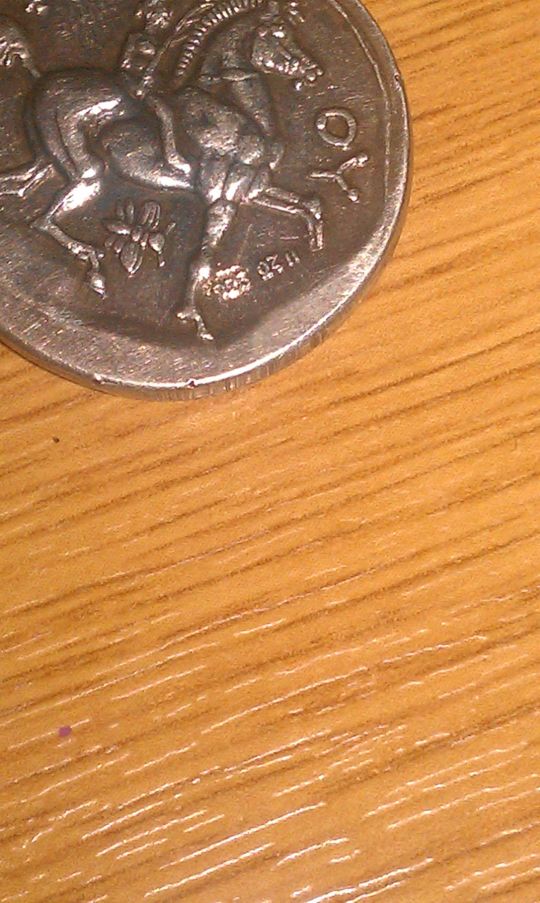 Edited by ilisiamis53
10/12/2014 3:16 pm
|
|
Moderator
United States
23731 Posts |
Can't quite make out the first three letters or numbers, but the last two look like OZ for ounce. I think it's the weight of the coin.
|
|
New Member
Greece
16 Posts |
OZ are 2 letters here we have 3 letters, and one of them is H= Greek hita.
I will also post a photo of the edge of the coin "pishpash" .
|
|
Valued Member
United Kingdom
435 Posts |
Of course, discussing a replica for the sake of interest is perfectly fine. Someone might, by chance, recognise the type and be able to say which city market or gift shop produced the item. However, as people have already said on this thread, this item is definitely a replica or fantasy piece. It could not be called a forgery or fake, because I doubt the manufacturer had any intention to deceive with this product. It is clearly a modern tourist piece. Now, having been so categoric, let somebody make a complete fool of me, by proving I am utterly wrong, lol.   Edited by Valecrucis
10/12/2014 4:26 pm
|
| |
Replies: 16 / Views: 4,393 |







 Posted 10/11/2014 07:39 am


