| Author |
 Replies: 12 / Views: 1,417 Replies: 12 / Views: 1,417 |
|
|
Valued Member
Canada
403 Posts |
I'm going through a batch of coins to grade and I'm struggling with the finish on some coins from the 30s-50s. Referencing the Charlton Catalogue, I'm trying to determine if certain non-business strikes are either PL or SP. Based on the Charlton book, am I correct in assuming that 1953 was the first year of PL strikes issued by the RCM? Secondly, how can I differentiate between a PL vs. SP strike post-1953? Pre-1953, how do I differentiate BU vs. SP?  Any help would be much appreciated. Thx! |
|
|
|
Pillar of the Community
 Canada
5420 Posts |
High square razor sharp dentils and edges and well mirrored surfaces are characteristics of the 1950's era Specimens. Post some pix of ones you might have.
|
|
Valued Member
 Canada
403 Posts |
Thx, will do...or at least try to. My pics never turn out so good.
|
|
Valued Member
Canada
403 Posts |
Ugh! I've taken a bunch of pics and none of them are capturing the detail necessary to be helpful here...so here's the narrative of what I have:
1. 1950 25¢ and 50¢ piece: both of which have heavy mirror/brilliant surfaces, the razor denticles as previously mentioned, and both pieces have UHC. It looks more like a PL strike to me, but the Charlton book doesn't make reference to PL strikes until 1953, which leads me to think these may be SP strikes. Thoughts?
2. 1950 10¢ piece: similar description as above, except with a light cameo finish. Does this sound like a SP strike?
3. 1953 $1 (NSF/FWL): with heavy mirror/brilliant surfaces and equally mirrored/brilliant relief, along with sharp/crisp denticles. Could this be PL or SP? I'm leaning toward SP on this one.
4. 1953 50¢ (NSF/SD): matches the description from #1 exactly. Could this be SP or PL? I'm leaning toward PL on this.
Any help would be appreciated. Aside from my uncertainties regarding the timing of PL strikes being introduced, I also know SP strikes changed several times over the years; which is collectively making this a difficult exercise for me. Also, can someone confirm when PL strikes were introduced -- was it 1953?
Thanks all!
|
|
Pillar of the Community
 Canada
9904 Posts |
1949
"Dipping" is not considered cleaning...
-from PCGS website
|
|
Valued Member
Canada
444 Posts |
I'm not sure if the picture will show quality of strike. The first photo to my knowledge is a specimen strike. 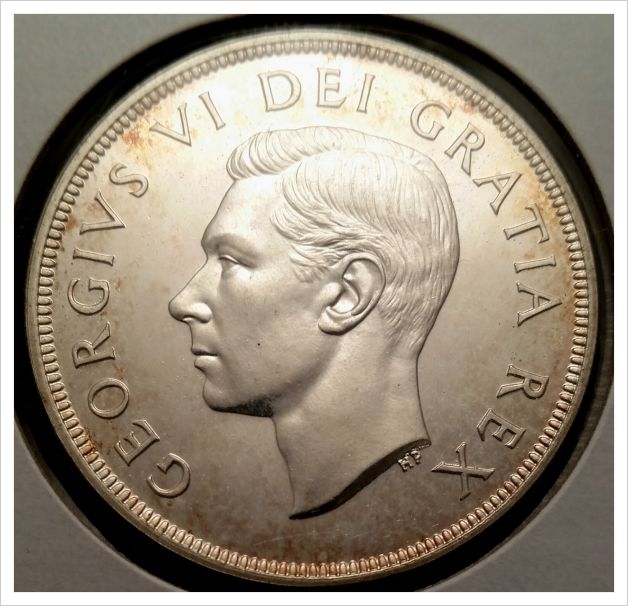 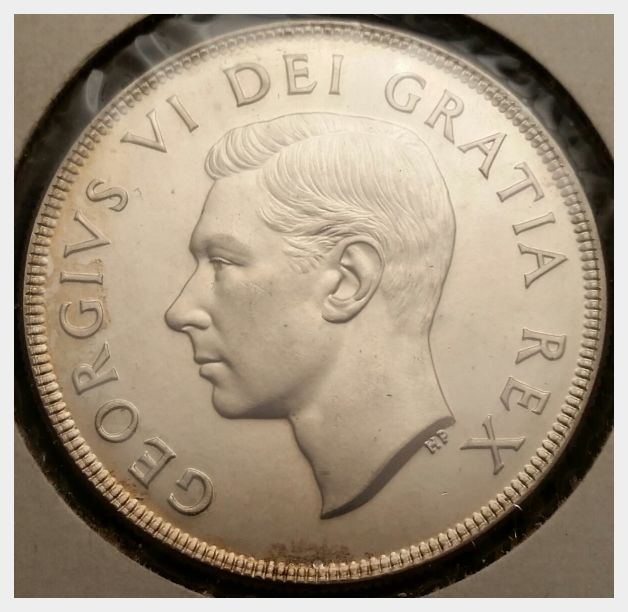 |
|
Pillar of the Community
Canada
9904 Posts |
Reverse pics please CoinScavenger?
"Dipping" is not considered cleaning...
-from PCGS website
|
|
Valued Member
Canada
444 Posts |
Reverse. 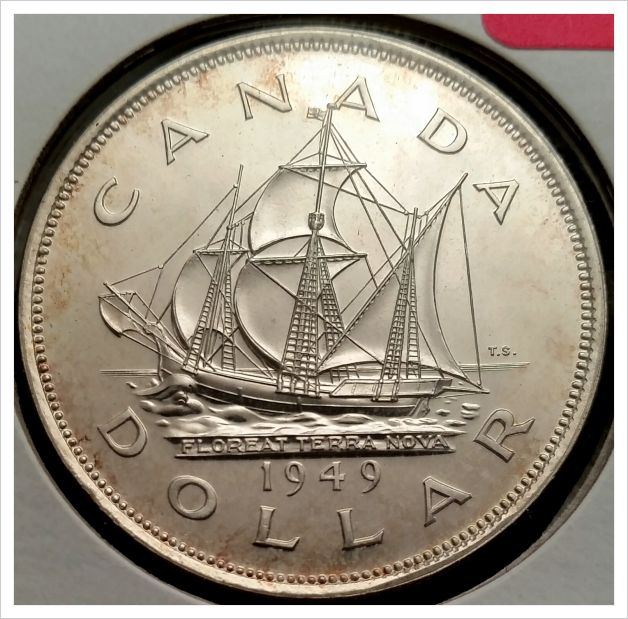 |
|
Valued Member
Canada
444 Posts |
The coin in hand shines. I have to shield the light a lot to show details. Just about went blind trying to take the picture.
|
|
Valued Member
Canada
444 Posts |
Pictures taken with my Samsung Galaxy 5 phone, $12.00 spot light from Ikea, and a piece of tissue paper. I'm pretty impressed with this phone.
|
|
Valued Member
Canada
403 Posts |
Yeah, I think this is one of those coins-in-hand type of questions. Coin Scavenger, much like your 1949 $1, my 1953 $1 has the same highly reflective/mirror shine to it such that I too had to shield my eyes when trying to examine under desk lamp with magnifier, let alone attempt to photograph.
|
|
Valued Member
Canada
403 Posts |
And thx for the clarification DBM, that answers a lot for me. Much appreciated.
|
|
Valued Member
Canada
403 Posts |
Using 1949 as the year of introduction for PL strikes, where can I find trends for the PL strikes dated 1949-1952? None of CCN Trends, Charlton's, or the CoinsandCanada website provide trend values for PL strikes until 1953. Why?
|
| |
Replies: 12 / Views: 1,417 |
|







 Posted 10/21/2014 4:04 pm





