| Author |
 Replies: 17 / Views: 4,056 Replies: 17 / Views: 4,056 |
|
Pillar of the Community
United States
5003 Posts |
picked up a couple of new republicans as part of my autumn coin splurge...  Mn. Cordius Rufus 46 BC AR denarius Rome O: Conjoined heads of the Dioscuri right, each wearing diademed pileus surmounted by star R: Venus standing left, holding scales and scepter, Cupid at her shoulder. Crawford 463/1b. HCRI 63a. Sydenham 976a. Cordia 2b. 18mm 3.7g and....  L. Calpurnius Piso Frugi AR denarius 90 BC o:head of apollo, F behind, R below right (or what is that? a bow?), all in circle of dots. r:galloping horseman with palm branch right, v above, L·PISOFRVGI below SYD 663v 18x19 mm 4.0g if anyone wants to show off a republican coin or two, i'd enjoy seeing them! Edited by chrsmat71
11/15/2014 12:03 am
|
|
|
|
Pillar of the Community
United States
513 Posts |
I love both of them. I'm on the lookout for a coin from the time period of your first, when Caesar was active. That was during his consulship too. Don't think I'd be able to count it as a Caesar but it'd make a nice substitute until I hit the lottery. And I've seen other examples of the second one a few times and really like the reverse. I've probably posted my favorite Republican coin I own a dozen times here but now it'll be a bakers dozen:  A Roman Republic Denarius minted in Rome between 111-110 BC. 3.811 g, 17.6 mm Obverse: helmeted head of Roma right, circular symbol or device behind Reverse: Victory in a triga right, AP•CL•T•MAL•Q•VR (MAL and VR in monogram) in ex Attribution: SRCV I 176, Crawford 299/1a, Sydenham 570, RSC I Claudia 2 And my second favorite, because I love the non-standard obverse:  A Republican Rome denarius minted in Rome in 84 BC. 3.961g, 20.7mm, Obverse: diademed and cloaked bust of Apollo left, from behind, brandishing thunderbolt Reverse: Minerva in quadriga right, holding spear and shield, C•LICINIVS•L•F / MACER in ex Attribution: SRCV 274, RSC I Licinia 16, Crawford 354/1, Sydenham 732, VF, I have seen the figure on the obverse called a different name (Jovis I think) and it seems to be attributed about as much to one as the other. |
|
Pillar of the Community
3772 Posts |
Here on of mine with a few counter- or banker's marks on it. 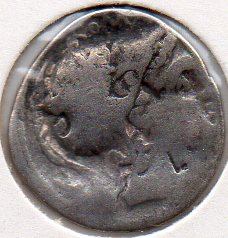 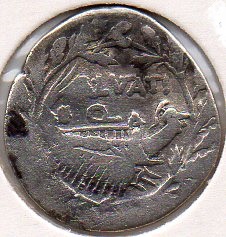 "Q.Lutatis Cerco" (109/8 BC) Obverse: Head of young Mars right, wearing crested Corinthian helmet, star behind ROMA above Reverse: Q'LVATI // Q above galley right, all in oak-wreath What I like about this coin is that it's reverse is similar to the bronze coinage of the time. |
|
Pillar of the Community
1121 Posts |
C.M. Re: Conjoined heads of the Dioscuri right, each wearing diademed pileus surmounted by star
Do you have ANY explanation for the 'marks' on that coin, please?
I am very curious as to how/why they would be there.
|
|
Moderator
 United States
23731 Posts |
Very nice Chris, I particularly like the Mn Cordius Rufus with the jugate busts. I'm slowly expanding my republican collection, very slowly.
|
|
Valued Member
United Kingdom
435 Posts |
Lovely coins Chris....congratulations. And at risk of being repetitive, I also love the first, Dioscuri, one. Beautiful, sensitive portraits.
Edited by Valecrucis
11/15/2014 10:24 am
|
|
Pillar of the Community
United States
5155 Posts |
Aww man I love the jugate busts. You can never go wrong with a good RR. These pretty nice pieces. I see you expanding into silver more, kudos.
|
|
Pillar of the Community
United States
513 Posts |
Topcat, oddly enough I've got one with a similar marking.  It was sold to me (by Forvm) with the description that the marking was ancient graffiti of the name "Alex." A Denarius minted in Rome in 90BC. 18.9 mm, 4.086 g. Graffito on obverse. Obverse: laureate head of Apollo right, PANSA behind, uncertain control symbol below chin Reverse: Minerva in a quadriga right, trophy over shoulder in right, spear and reins in left, C•VIBIVS•C•F• in exergue Attribution: RSC I Vibia 1, Sydenham 684, Crawford 342/5b, SRCV I 242 |
|
Valued Member
United Kingdom
435 Posts |
Anyone observing Roman Republican denarii sees counter marks, banker's marks and test cuts. I have read that they do not commonly occur during all periods. Most commonly they are on denarii produced during periods when there was widespread production of fourées. There are two main types. The first is a much more dramatic and deforming test cut, like one also sees on Athenian owls. The second appear as scratches or crescents and such like on one side of the coin.I would love to ask a metallurgist about what could be the method of producing these marks, because to me it looks as though the tool that was used to make the mark may have been red hot. They often produce imprints with raised lips at the edges as though the metal melted slightly during the cut. I wonder whether the latter method was deemed a less damaging way of performing the test, creating a less bold mark on one side of the coin only. The heat might have enabled a decent cut without the greater pressure that occurs when placing the coin in a pincer. However they were created, they were probably done both by official authorities attempting to cleanse the coinage as a whole of fakes and market traders and bankers wishing to verify that their coins are genuine. I am completely speculating here and make no claim at all to any authority, it would be great if some greater authority could educate us, but amongst publications it is surprisingly difficult to find any decent consideration of the whys and hows of the test cutting that went on, other than to catalogue and observe them. So the field is open for all of us to wonder...
|
|
Pillar of the Community
1121 Posts |
Thanks Chuy and V.C. In many instances the marks are so straight I thought of 'pincers' but often there is no corresponding mark on the other side. Also, if the mark was made with a single tool, by hand, where is the 'shakiness' that would be apparent if I was to do this (in a marketplace) to satisfy myself of the 'genuine' nature of the coin? I think that we may only be half-way there.  Edited by Topcat7
11/15/2014 3:11 pm
|
|
Pillar of the Community
 United States
5003 Posts |
thanks everyone...and thanks for the test cut info as well!
|
|
Pillar of the Community
United States
5155 Posts |
Heres a RR with a bankers marks...I think.. 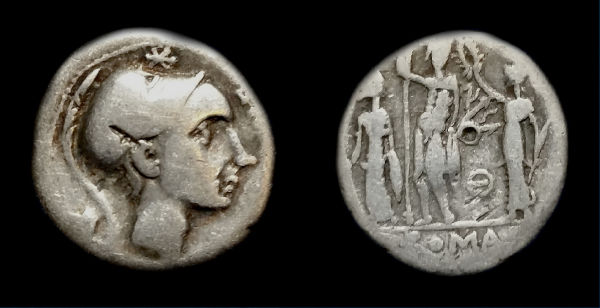 |
|
Valued Member
United Kingdom
435 Posts |
That is very interesting AN. I was trying to work out whether the mark on the obverse aligns with the mark on the reverse by estimating the DA. It's a bit difficult to judge from the pics alone, but I am guessing it is about 40°. Is this right? So maybe the two marks arent quite opposite each other, so maybe weren't created simultaneously. On the reverse mark, the pit, do you see what I mean about the unexpected lip around its edge? that is to what makes me think that it might have been created by a heated tool that was hot enough to melt silver. My theory may be completely misguided, but I would be interested to hear what you think. It is hard to say whether the mark on the obverse, the cut, is a test cut or a bankers mark akin to a counter stamp. Perhaps it served both purposes...
Edited by Valecrucis
11/15/2014 7:18 pm
|
|
Pillar of the Community
3772 Posts |
Here a Republican Denarius which is as Roman as one can get: 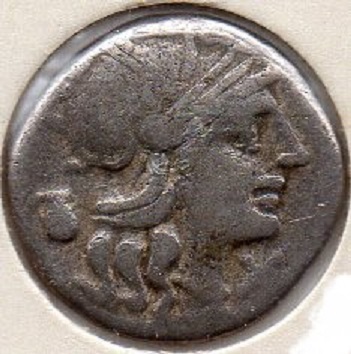 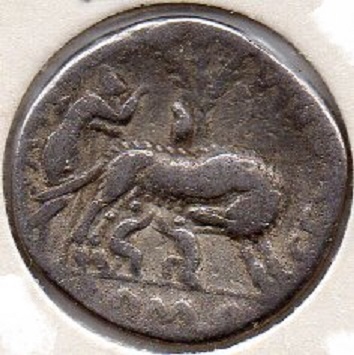 Denarius "Sex.Pompeius" (137BC) - Sear[ME]#112 Obverse: Helmeted head of Roma right, X below chin, jug behind. Reverse: She-wolf standing right, suckling the twins Romulus and Remus, woodpecker on fig-tree in the background, the shepherd Faustulus standing right on the left 'foSTLVS' on left, 'SEX.POM' on right, 'ROMA' in exergue |
|
Pillar of the Community
United States
2596 Posts |
You guys are making me feel cheap. Here I am with a ancient coin collection of mostly common late Roman and Byzantine copper and bronze coins. Nice coins by the way! 😃
|
|
Pillar of the Community
Germany
1856 Posts |
Here is one of the very few republican coins in my collection, a denarius struck by the moneyers Gargonius, Ogulnius and Vergilius. No signature is present, There should be a thunderbolt below the bust but this coin bears no signs of such (probably off the flan). RSC I 226, Sydenham 723, VF, Rome mint, 86 B.C. Obverse laureate head of Apollo right, thunderbolt below, r Reverse Jupiter in quadriga right, brandishing thunderbolt in right. 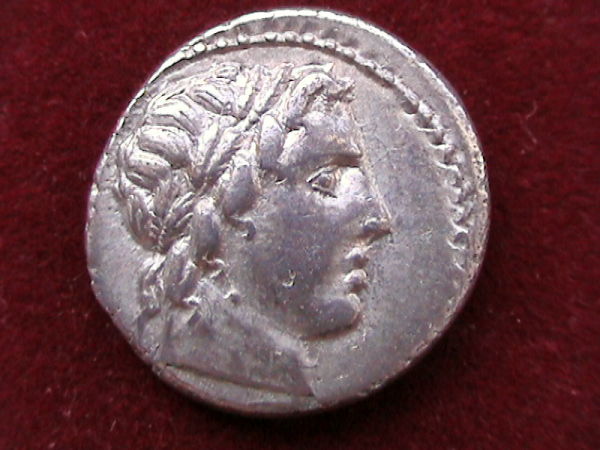 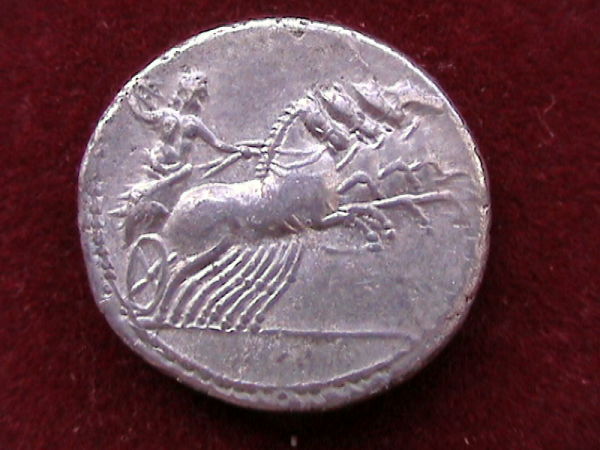 |
| |
Replies: 17 / Views: 4,056 |










 Posted 11/15/2014 12:04 am


