| Author |
 Replies: 16 / Views: 6,755 Replies: 16 / Views: 6,755 |
|
Valued Member
United States
131 Posts |
Can't seem to find any info about this 2" medal...hoping someone can help. Thanks! 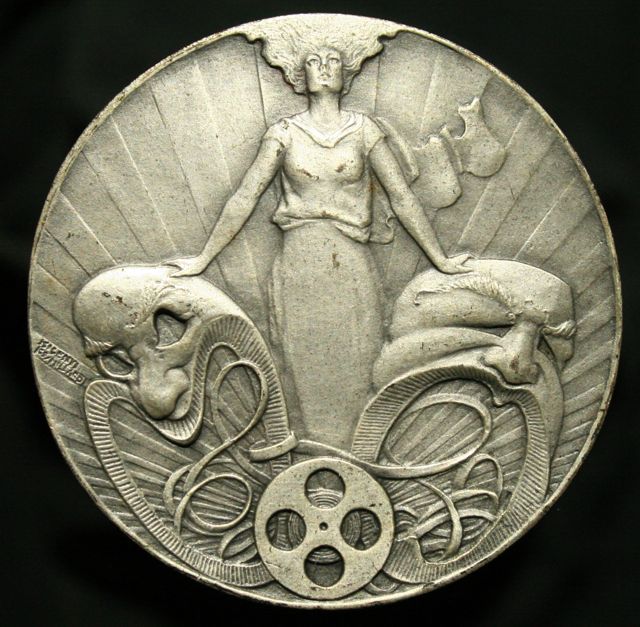 |
|
|
|
Pillar of the Community
United States
937 Posts |
well the subject mater is acting and/or films. What does the other side look like?
|
|
Rest in Peace
United States
4078 Posts |
 A very interesting looking medal. |
|
Valued Member
 United States
131 Posts |
|
|
Valued Member
United States
386 Posts |
Can you get a close-up or post the medal makers name which is engraved on (our) left?
Anything written on the edge of the medal?
|
|
Valued Member
United States
131 Posts |
Nothing on the edge other then medallic art co. ny. It says "kilenyi c/s millard" from what I can tell. I will post a better pic of engravers name shortly.
|
|
New Member
United States
5 Posts |
I was excited to see this medal. It would seem to be the source for the reverse of the 1955 Festival of Film Artists Medal of Honor awarded by George Eastman House. At the end of the post string econrad said he was going to post better artist signatures.I suspect Kilenyi sculpted this medal from a design by the second name. Millard? I could find no information on a Millard. I would love to see better signatures. I have extensive Festival of Film Artists research if you are interested. All the best.
|
|
Valued Member
United States
264 Posts |
Julio Kilenyi (1885-1959) was a medallic sculptor born in Romania who ultimately settled in New York. His list of works is considerable, as a quick internet search will reveal.
There are a few folks with the name Millard during that time frame, but nothing I could confirm.
A closeup of the signatures would certainly be useful. I'd imagine h2osol may then resolve the issue for us.
|
|
Pillar of the Community
United States
4409 Posts |
Take a look at this link http://medalartists.com/j-l.htmlPage 228 shows the 1955 Festival of Film Artists Medal of Honor However, the image in the original post more closely resembles the one found on page 215. If a closeup of the name area picture was provided it might be possible to search the above site for a match or more information. -MV |
|
New Member
United States
5 Posts |
Dear Members, The medal was first struck in 1925 by the Medallic Art Co.#1925-033. It is called the Hugo Riesenfeld medal.The second name on the medal is C.E. Millard. Claude E. Millard (1887-1960) was an illustrator, graphic designer and movie poster creator. He signed his work CE/Millard. It was the slash that confused me. econrad nearly got it right. I just didn't see it. I also thought it was mid-fifties. It was actually 30 years earlier. Riesenfeld was a major film composer who got his start in the silent era from 1915 to 1925 managing three NYC motion picture houses, most notably the Criterion. He was one of the few composers who perfected the art of accompanying silent motion pictures with a live orchestra playing an original score to enhance the action on the screen. Often the orchestras were upwards of 70 musicians. When sound came along he moved to California as MD for United Artists. Millard was a freelancer but Riesenfeld used him in many capacities for his movie houses. Lobby cards, programs, posters, even painted theatrical backdrops. I do not yet know the reason for the medal but I would posit that Riesenfeld commissioned Millard to design it and Julio Kilenyi to sculpt it. Kilenyi had a brother Edward who was also a writer and conductor of musical scores for silent pictures in NYC. They all knew each other. Just as Riesenfeld started the music dept at UA, Edward Kilenyi was the MD for Fox Pictures, later 20th Century Fox. To continue the thread, in 1955 the George Eastman House Festival of Film Artists used the design elements of the Riesenfeld medal for the reverse of their Medal of Honor. So to get the credit right this reverse was sculpted by Paul Fjelde after Julio Kilenyi from a design by Claude E. Millard. It has only taken me 10 years to write that sentence. I have attached the reverse of the 1982 Festival of Film Artists MoH to show how the medal design was adapted. Thanks for your help. 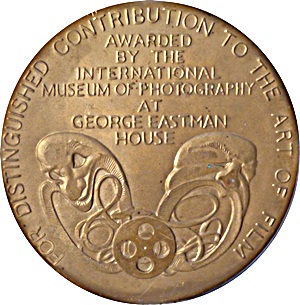 |
|
Pillar of the Community
United States
4409 Posts |
h2osol  and thanks for sharing the background on this piece. I assume the Riesenfeld medal is rare/seldom seen since my attempts to locate a picture of one via Google didn't turn up one or perhaps I was using the wrong keywords. -MV |
|
New Member
United States
5 Posts |
Dear MV
The only two examples known of the Riesenfeld medal are the econrad example and the Medallic Art Co. reference bronze example. There is some evidence that three gold examples were struck but this is an ongoing research quest.
On another issue I have built a bibliography for my Kilenyi catalog of about 80 titles. Probably half the titles would be generic for medal collectors. I would be happy to email you a copy so you could cherry pick the titles of interest for your list
Thanks
BTW Kilenyi was a Hungarian not a Romanian.
|
|
Pillar of the Community
United States
4409 Posts |
I acquired my first medal an 1876 Centennial medal earlier this year. I am just starting out and haven't really chosen a topic or artist to collect.
I cannot send you an email as you don't have the feature turned on. However, if you click on the second icon, the one with the open envelope, you can send me brief message that will go to my personal email. Once I reply, we'll be able to exchange emails back and forth.
-MV
|
|
New Member
United States
5 Posts |
Dear MV,
I got a note from management that since I am a new member the email feature is not available to me.
Sorry about that!
|
|
Valued Member
United States
131 Posts |
Firstly let me apologize for not uploading a closeup of the signatures on the medal. I've not been on this site in awhile. I would also like to thank h2osol for your extensive knowledge about this medal.  Its always nice to know the history behind any medal. Thanks again!  |
|
New Member
United States
5 Posts |
Dear econrad,
Thanks for the post. Further research has revealed that a gold Hugo Riesenfeld medal was issued at least twice.
First here is a sentence from the Riesenfeld NY Times obit that sets up the award. "It was also the belief of Riesenfeld that every picture program should include a short film, of one or two reels, and that this minor attraction should be as carefully produced as the main feature. To stimulate interest in "shorts" he gave a gold medal for the best film of the year in this class."
Second I found two award events:
December 23, 1925; at a luncheon in NYC, The Hugo Riesenfeld gold medal for best short subject (exclusive of comedies) exhibited during the year ending September 1, 1925 was awarded to The Voice of the Nightingale produced in Paris by Louis Starewitch. A jury of five prominent motion picture executives made the selection and Will H. Hays, President of the Motion Picture Producers and Distributors of America presented the medal to E. W. Hammons, President of the US distributor, Educational Film Exchanges, Inc who accepted the medal on behalf of the producer.
March 29, 1927; The Hugo Riesenfeld gold medal was awarded to Eugene Roth for his short subject film The Vision for the year ending September 1, 1926. The presentation was again made by Will H. Hays. This short was also distributed by Educational Film Exchanges.
No further awards are known. There is a photo of the first award presentation in the Democrat & Chronicle, Rochester. NY 12/27/25 p11. I tried to upload the picture but failed
I am compiling a catalog of the works of the Julio Kilenyi and I would appreciate any information you have about your example that would add to my knowledge.
Thanks a lot,
h2osol
|
| |
Replies: 16 / Views: 6,755 |







 Posted 11/21/2014 3:21 pm





