| Author |
 Replies: 11 / Views: 2,075 Replies: 11 / Views: 2,075 |
|
|
Valued Member
Poland
63 Posts |
|
|
|
|
Valued Member
 Poland
63 Posts |
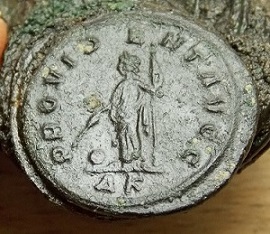
I see PROVIDENTA VGC
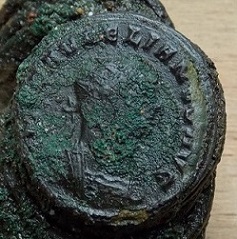
and VAELIANVS AVG ?
|
|
Pillar of the Community
United Kingdom
3626 Posts |
Hard to tell without knowing what the other coins are. Very nice find. Should be worth a bit if you decide to sell them like that.
|
|
Pillar of the Community
3772 Posts |
The second one is by my reading ...AVRELIANVSAVG.
Putting them into distilled water (or olive oil shouldn't destroy them) - but if you want to keep them together either for keeps or sale, that's okay as well.
Without knowing the coins in the stash there is no chance to tell an approximate time of deposit, except that (based on the Aurelian) it would have been after 270.
|
|
Pillar of the Community
United Kingdom
4208 Posts |
Id keep them together and try to sell them as found (or display them as found - very ard to get cois in this condition). You might get more for them.
|
|
Bedrock of the Community
Australia
21792 Posts |
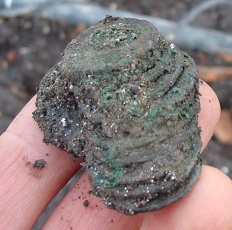
I would try to put the whole lump of coins in an ultrasonic cleaning bath, with distilled water. The lump may fall apart, into individual coins.
The risk remains that the individual coins themselves may fall apart as well. Sometimes, the whole body of a coin that has been buried for 1600 or more years, has deteriorated into corrosion products. The analogy is petrified wood, where the carbon has been replaced by silica.
If your judgemet is that the risk is not worth taking, then don't clean them. The lump of the coins together is probably worth more.
The age of a coin hoard is related to the coin of least age in the hoard. Refer Medieval's comments. (270 AD)
|
|
Valued Member
Poland
63 Posts |
thanks for suggestions, if they were denarii I would decompose them, follis are not so worthy so in this state they have a real value and are a great piece of history. Especially that they are crumbly and little piece felt apart when I tried to clean the mud... No worth of risk...
|
|
Pillar of the Community
United States
5010 Posts |
that's just awesome that you guys/girls can find that stuff.
|
|
Pillar of the Community
United States
1047 Posts |
DISCLAIMER: Please don't do this I could just picture my impatient, curious, and foolish self, drooling with eyes bulging grabbing these and having at it. 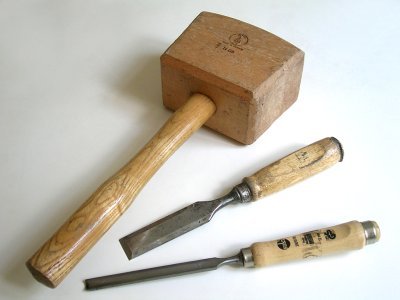
|
|
Moderator
 United States
23731 Posts |
The is an interesting find. Did you find them in Poland? I haven't heard of many finds there. I would consider separating them, I would be too curious just to leave them like that. Sel's method is something to try. You can also try soaking them in olive oil, but that will take a long time for the oil to penetrate and loosen the coins. It's something I've use to separate a few coins not a lump like that though.
|
|
Valued Member
Poland
63 Posts |
no I found it in Italy, near Venice. In Poland I found about 15 silver denarii, but not in one lot, just lost in a hill fort. Also roman bronze fibulas.
I use to pick up roman coins in the past so maybe thats why I'm not so keen to see those coins. The risk of destroying it is too high. Second - follis are quite cheap and common
|
|
New Member
United States
5 Posts |
That is an incredible find. I might keep them as is if they seem to be fused together. But overall, you definitely found something historic and worth something.
|
| |
Replies: 11 / Views: 2,075 |
|









 Posted 11/22/2014 06:03 am





