 The following is a press release from NGC Posted by David Vagi, Director of NGC Ancients
The centering, evenness and strength of the strike can dramatically affect the appearance of an ancient coin.
To the best of our knowledge ancient coins were struck the old-fashioned way - " hand-hammered between two dies. Thus, the quality of strikes is inconsistent. The degree of variability is often difficult to communicate with words alone, so when a group of silver tetrobols of Histiaea were submitted to NGC for grading, it was a perfect chance for us to gather some coins to illustrate different strike qualities.
Histiaea was a Greek city on Euboea, a long island off the eastern shore mainland Greece, not far from Athens. During the 3rd and 2nd Centuries B.C. a large number of silver coins called tetrobols were struck at this city; they show on their obverse the head of a nymph or a maenad, and on their reverse a nymph seated on the stern of a ship. They were popular in Greece at the time, and today they are among the most affordable of all ancient Greek silver coins.
The primary considerations for strike are centering, strength and evenness. However, other factors, including die state, striking cracks and planchet imperfections are also important. Since the quality of strike greatly affects the desirability and market value of ancient coins, all ancients graded by NGC since 2008 (except those submitted on the economy-bulk tier), have a separate evaluation for strike quality on a scale of 1 to 5.
The vast majority of ancient coins were struck without the use of a collar that would have kept the planchet in place. This allowed for the possibility- "truly, the likelihood- " that strikes were not be perfectly centered. The photograph of three Histiaea tetrobols shown below illustrates how much the centering varied, from near-perfect to significant misses.
Strike Centering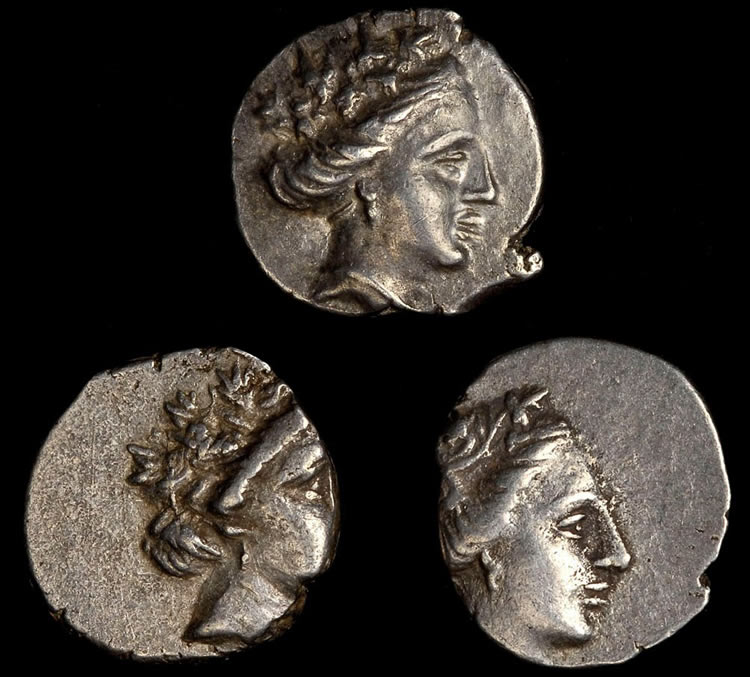
The two coins on the bottom row are about equally off center, though in different directions. This is also an important factor. The one to the left is considerably less desirable than the one on the right, even though they are both about equally off center. The fact is, people value certain parts of a design more than others, in this case being the facial features.
Typically, one die used to strike an ancient coin was set into an "anvil" and the other had a variable position; sometimes it was hand-held and other times it was placed into a hinged mechanism. Though the latter arrangement increased the likelihood that dies were correctly aligned in relation to each other, without a collar it still could not assure that the planchet would be centered at the time of striking.
Equally important are the evenness and the strength of the strike, both of which are independent of centering. Oftentimes the faces of the dies were not perfectly parallel to each other when a strike occurred; this meant the angle of impact was uneven, causing the strike to be stronger on one part of the planchet and weaker on another.
The strength of the strike was dependent on how hard the hammer impacted the "hammer" die; the softer the strike, the softer the detail that was raised from the planchet. The photo below, again showing three Histiaea tetrobols, illustrates this perfectly. The top coin was sharply struck, whereas the two coins in the bottom row were struck weakly or were struck with dies in a worn state. It also may have been due to a combination of these factors, but this is impossible to prove.
Strike Strength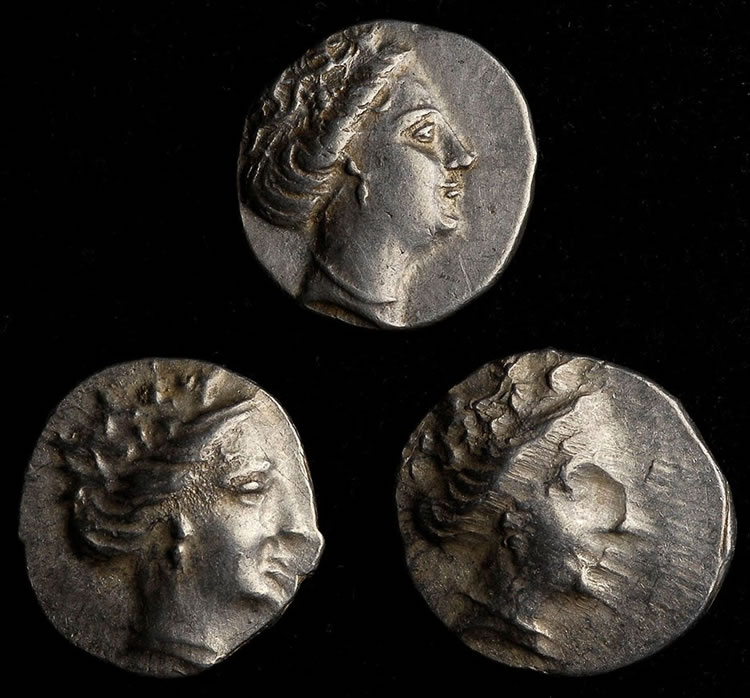
The coin at the lower left has a moderately soft strike, and the one on the lower right is soft enough as to appear blurry. None of this is due to wear, as all three had been subjected to a similar amount of wear before their burial. With these two photographs in mind, it's easy to see how the quality of the strike affects the desirability of ancient coins, independent of other factors such as wear and surface quality. It also makes it clear why NGC Ancients has found it advisable to assign a separate rating for strike, as it is of paramount importance in establishing the market value of an ancient coin.







 Posted 12/17/2014 1:57 pm





