









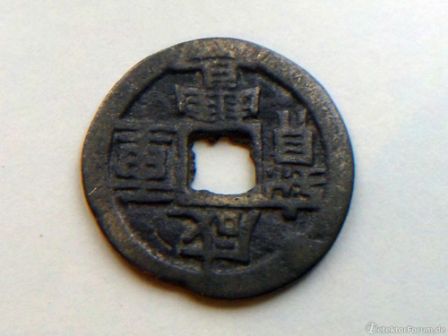
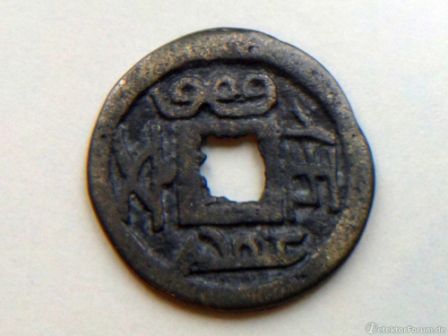


 Posted 01/14/2015 9:42 pm


Yes, it is a coin and not a charm.
The inscription is xian feng zhong bao (Hsien-feng Chung-pao) and it was cast at the Board of Revenue.
However, the denomination is "five cash" (ä¼�æ-‡), not "ten cash".
Mr. Ma Dingxiang (e©¬å®šç¥¥), one of the most famous Chinese numismatists of the 20th century, has rubbings of four varieties of this coin in his book on xian feng coins. (Incidentally, the book has rubbings of 3,698 varieties of xian feng coins.)
All varieties of this "five cash" coin are rare because only "ancestor", "mother" and "pattern" coins are known to exist.
It is believed that no coins were ever produced for circulation.
But as you might expect, "circulated" coins can be found.
You can see a few examples of these "circulated" coins here, here, here, here, here, here,...
All of these are fakes as is the case, unfortunately, with the OP's coin.
Gary
The inscription is xian feng zhong bao (Hsien-feng Chung-pao) and it was cast at the Board of Revenue.
However, the denomination is "five cash" (ä¼�æ-‡), not "ten cash".
Mr. Ma Dingxiang (e©¬å®šç¥¥), one of the most famous Chinese numismatists of the 20th century, has rubbings of four varieties of this coin in his book on xian feng coins. (Incidentally, the book has rubbings of 3,698 varieties of xian feng coins.)
All varieties of this "five cash" coin are rare because only "ancestor", "mother" and "pattern" coins are known to exist.
It is believed that no coins were ever produced for circulation.
But as you might expect, "circulated" coins can be found.
You can see a few examples of these "circulated" coins here, here, here, here, here, here,...
All of these are fakes as is the case, unfortunately, with the OP's coin.
Gary


