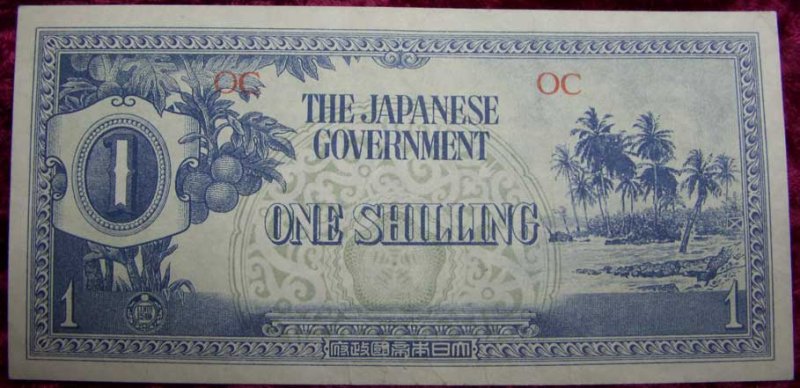
Rather than post bits and pieces of this in each of Arthrene's recent posts of JIM, I thought I'd compile it all in one place.
JIM is the abbreviation for Japanese Invasion Money, the term used for paper money issued by the Japanese government during WWII for use in territory captured from the Allies. Not all territories occupied by the Japanese issued JIM; Japanese-occupied China, French Indochina and Thailand are not considered part of the JIM series.
JIM was issued for six different regions, distinguished by the former occupying power and the currency system in use there. Wherever it was issued, it was intended for use by the conquered civilian population, rather than for paying the occupying troops. Once the conquest was complete, the old currency was withdrawn and declared illegal to use on pain of death. After liberation and the Japanese surrender, the notes of course became worthless.
When in doubt about which region a JIM note was issued for, you can usually distinguish them by the "block letters" - two letters printed on each note. the first letter indicates the intended country of use, the second letter indicates the position on the plate from which that particular note was printed.
Burma - formerly a province of British-ruled India.
Block letter initial: B.
Monetary system: 100 cents to the rupee.
Examples in
this thread. This is the only location where the Japanese actually altered the currency they replaced; the old British Indian currency was predecimal, with 4 pice to the anna, 16 annas to the rupee.
Oceania - these were the islands and territories in the South Pacific formerly owned by Britain. At it's greatest extent, it included much of what is now Papua New Guinea and the Solomon Islands.
Block letter initial: O.
Monetary system: 20 shillings to the pound. There were also presumably 12 pence to the shilling, but no JIM notes denominated in "pence" were issued.
Arthrene doesn't have any Oceania notes posted. Bryan1313 has one in
this old thread. Down here in Oz, these notes are often hyped as "money the Japanese had made for their invasion of Australia", which is at least partly true. I'm not surprised you don't have an example; Oceania is the scarcest series of JIM, and is rarely seen outside Australia.
Malaya - formerly British colonies and protectorates, now known as Malaysia and Singapore.
Block letter initial: M.
Monetary system: 100 cents to the dollar.
Examples in
this thread. You'll sometimes see these notes advertised, quite erroneously, as "money the Japanese had made for the invasion of Hawaii or America".
Philippines - formerly an American commonwealth.
Block letter initial: P.
Monetary system: 100 centavos to the peso.
Examples in
this thread,
this thread, and
this thread. Two features make the Philippine JIM series unique: the inflationary notes, denominated in thousands of pesos, issued in the final days of the occupation, and the JAPWANCAP overprinted notes collected by an organization which attempted to obtain full face value for Philippine JIM from either the Philippine, Japanese or American governments. A related series of notes is the "guerrilla money" issued by Allied holdouts and sympathisers on several of the islands.
Shonan - the Japanese name for the islands we now call Indonesia. Before the war, they were owned by the Dutch, and Shonan is the only JIM series with text in another language.
Block letter initial: S.
Monetary system: originally 100 cents to the gulden. Later, in an attempt to appeal to anti-Dutch sentiment, notes were denominated in roepiah and written in the Indonesian language.
There's an example of the Dutch series in
this thread.
Don't say "infinitely" when you mean "very"; otherwise, you'll have no word left when you want to talk about something really infinite. - C. S. Lewis







 Posted 09/25/2007 7:13 pm