| Author |
 Replies: 7 / Views: 2,413 Replies: 7 / Views: 2,413 |
|
|
New Member
Australia
17 Posts |
Hi, long time no post  Someone showed me a coin the other week, I took some photos to get you educated lot to scrutinise. A 1961 double reverse Shilling (?).The owner told me he received the coin in change in about 1976 and has had it since then (received in leiu of 10 cents I presume). I took some photos of it next to a similar aged coin. I think that this coin is PMD but I'm no expert. The "blob" on one side doesn't look right to me and a couple of "smearings" on the other. The weight seemed right (I photographed the coin at his house and gave it back to him hence I can't weigh it) but the milled edge is not entirely consistant. If it has been produced in the backyard they have done a very good job. 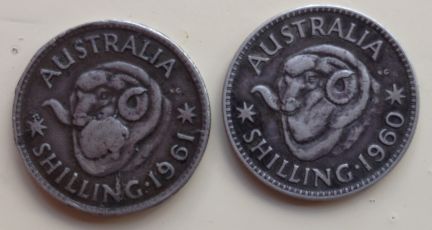 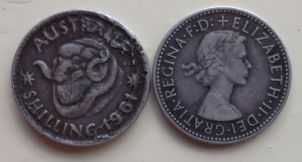 The coin in question is on the left in both photos. Having a struggle with the image uploader, the 2 photos I have uploaded should give you a good idea though  Cheers Curley Edited by Curleys
02/09/2015 9:44 pm
|
|
|
|
Valued Member
Australia
102 Posts |
I have always been told, if it is rotated exactly 180 degrees from the other side, you have a chance at it being real, if it isn't, fake/man made
|
|
Bedrock of the Community
Australia
21789 Posts |
First of all, it's a shilling (deaner), not a florin (two bob). You have already, and quite rightly, expressed some doubts about the blob, the smearing and the edge. Almost certainly a Magician's coin. If it is, then it is relatively common. Edited by sel_69l
02/09/2015 8:35 pm
|
|
New Member
 Australia
17 Posts |
Oops, Florin, Shilling  Thanks for pointing out my mistake sel, I have corrected this as such. Magicians coin? Makes sense a little now. It still has me beat how they could make such a coin? So what would a Magicians coin such as this be worth? Thanks for the replies. Cheers Curley |
|
Bedrock of the Community
Australia
21789 Posts |
The usual method of making a Magician's coin is to almost hollow out one coin with an upwards chamfer in the pan so that all of the edge graining remains. The face of the other coin is machined off with an opposite but matching chamfer. The two pieces are then pressed together, with an almost an interference fit. Easy job for a skilled metal machinist. A highly skilled metal machinist is also good for making hubbed dies for striking forged coins. The techniques essentially are those already used by a mint for making genuine coins. |
|
Pillar of the Community
Australia
1041 Posts |
mate easy test get another shilling on a hard bench top drop them on the rims and listen if its been tamperd with it will sound dull if sound the same .... step 2 if sound not the same tose it in the river and listen to the sound
|
|
Moderator
 Australia
16982 Posts |
I think you would find, if you looked closely just inside the rim of the mangled side, that there would be a fine seam where the two half-coins would have been joined together.
Don't say "infinitely" when you mean "very"; otherwise, you'll have no word left when you want to talk about something really infinite. - C. S. Lewis
|
|
Valued Member
Australia
216 Posts |
Hi Guys, Some of the really bad ones of these I've seen have just been two coins sanded on one side then stuck together. The result is a line around the middle of the rim. The method described by Sel is essentially the same, it is just more sophisticated in the placement of the seam between the two halves. P.S. Sorry guys, could not resist..... I CALL TAILS   |
| |
Replies: 7 / Views: 2,413 |
|










 Posted 02/09/2015 8:29 pm


